Faculty of Education, Bar-Ilan University, Ramat Gan 5290002, Israel.
Psychology Department, University of Nevada, Las Vegas, NV 89154, USA.
Int J Environ Res Public Health. 2021 Dec 28;19(1):296. doi: 10.3390/ijerph19010296.
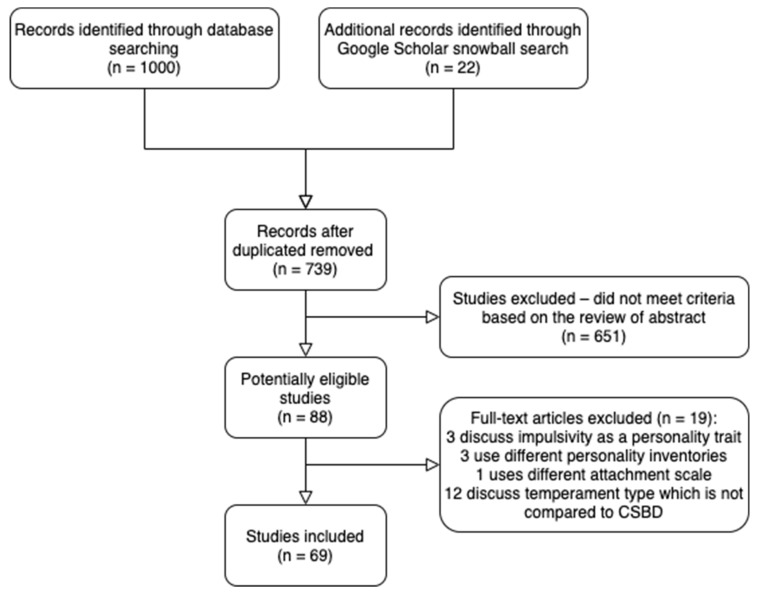
Do addictions share common traits of an "addictive personality" or do different addictions have distinct personality profiles? This narrative review examines the differences in the associations between substance use disorder (SUD) and compulsive sexual behavior disorder (CSBD), on the one hand, and personality traits, attachment dispositions, and temperament, on the other hand. We found that both people with a SUD and people with CSBD tended to be more spontaneous, careless, and less reliable, to place self-interest above getting along with others, to show emotional instability and experience negative emotions such as anger, anxiety, and/or depression, to be less able to control their attention and/or behavior, and to be engulfed with a constant sensation of "wanting". Only people with CSBD, but not SUD, noted concerns with their social ties, fear of losing close others, and/or trusting others around them. Results also suggested that people with a SUD and people with CSBD share high commonalities in personality traits and temperament, yet there are noted differences in their social tendencies, especially with close others. People with CSBD reported more concerns with possible relationship losses compared to people with SUD issues, who may be more worried about losing their source of escapism.
成瘾是否具有“成瘾人格”的共同特征,还是不同的成瘾具有不同的人格特征?本叙述性综述研究了物质使用障碍(SUD)和强迫性性行为障碍(CSBD)与人格特质、依恋倾向和气质之间关联的差异。我们发现,有 SUD 和 CSBD 的人往往更冲动、粗心、不可靠,将自身利益置于与他人相处之上,表现出情绪不稳定和经历愤怒、焦虑和/或抑郁等负面情绪,更难以控制自己的注意力和/或行为,并且总是有一种“渴望”的感觉。只有 CSBD 患者,而不是 SUD 患者,才会关注他们的社会关系、担心失去亲近的人,以及/或者信任身边的人。结果还表明,有 SUD 和 CSBD 的人在人格特质和气质方面有很高的共同点,但他们的社交倾向存在明显差异,尤其是与亲近的人。与有 SUD 问题的人相比,CSBD 患者更担心可能的关系丧失,而 SUD 患者可能更担心失去逃避现实的来源。