College of Chinese Medicine, Changchun University of Chinese Medicine, Changchun 130117, China.
State Key Laboratory of Pathogen and Biosecurity, Institute of Microbiology and Epidemiology, Academy of Military Medical Sciences, Beijing 100071, China.
Molecules. 2022 Jan 2;27(1):272. doi: 10.3390/molecules27010272.
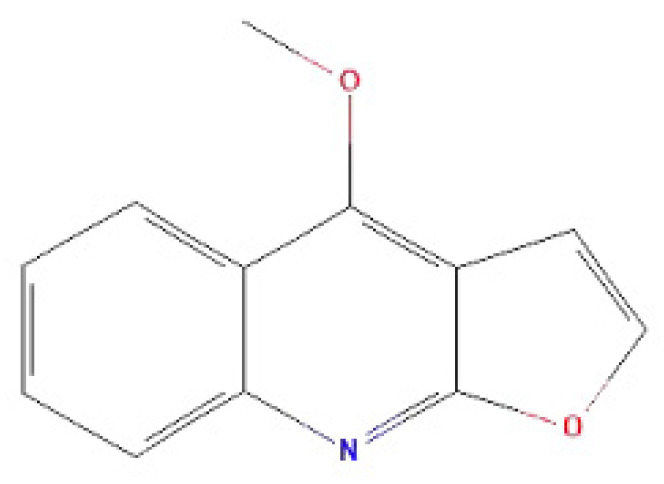
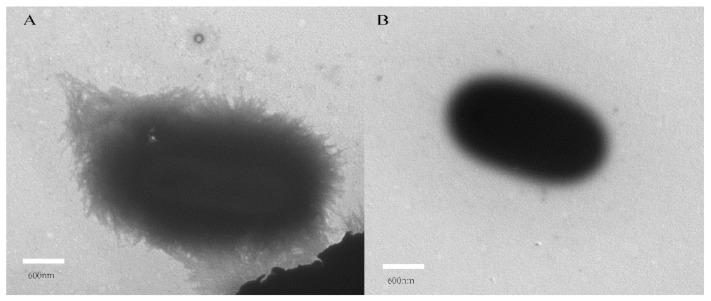
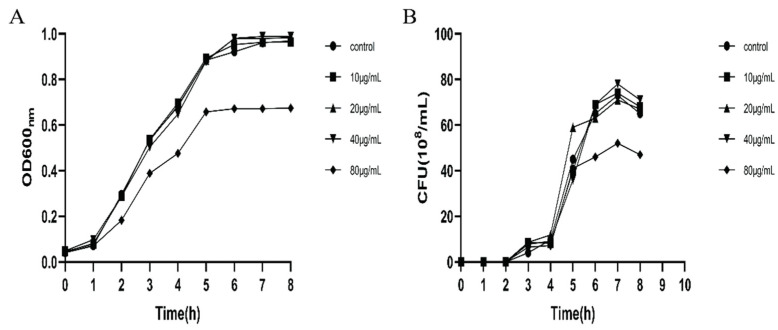
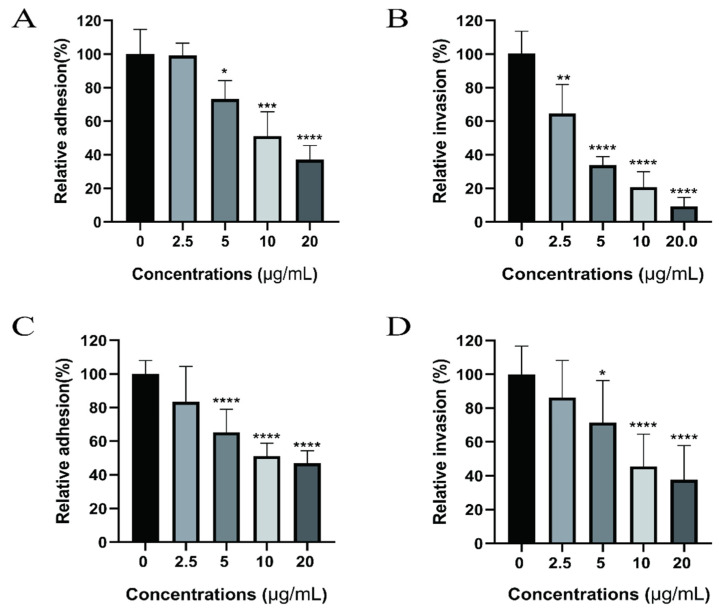
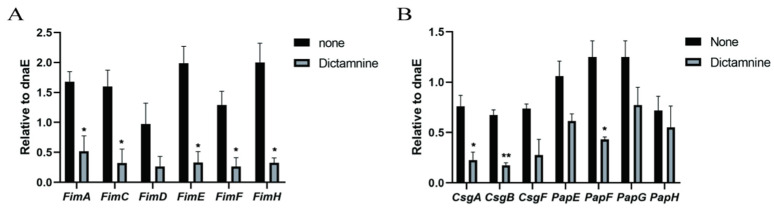
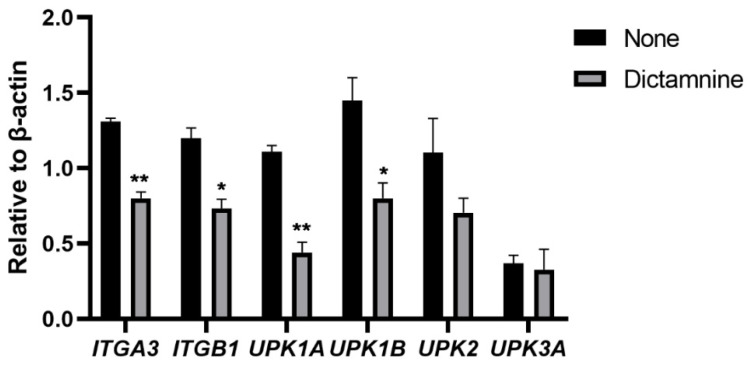
Uropathogenic (UPEC) is the most common pathogenic bacteria associated with urinary tract infection (UTI). UPEC can cause UTI by adhering to and invading uroepithelial cells. Fimbriae is the most important virulence factor of UPEC, and a potentially promising target in developing novel antibacterial treatments. In this study, the antibacterial properties and effects of the compound dictamnine, extracted from the traditional Chinese medicine Cortex Dictamni, on the bacterial morphology, cell adhesion, and invasion of UPEC were studied. Dictamnine exhibited no obvious antibacterial activity against UPEC, but significantly impeded the ability of UPEC to adhere to and invade uroepithelial cells. RT-qPCR analysis showed that treatment downregulated the expression of type 1 fimbriae, P fimbriae, and curli fimbriae adhesion genes, and also downregulated adhesion-related receptor genes of uroepithelial cells. Transmission electron microscopy showed that dictamnine destroyed the structure of the fimbriae and the surface of the bacteria became smooth. These results suggest that dictamnine may help to prevent UTI by simultaneously targeting UPEC fimbriae and urothelial adhesin receptors, and may have a potential use as a new anti-UPEC drug.
尿路致病性(UPEC)是与尿路感染(UTI)相关的最常见的致病性细菌。UPEC 可以通过粘附和侵入尿路上皮细胞来引起 UTI。菌毛是 UPEC 最重要的毒力因子,是开发新型抗菌治疗方法的一个潜在有希望的靶点。在这项研究中,从中药白鲜皮中提取的化合物白鲜碱对 UPEC 的形态、细胞粘附和侵袭的抗菌特性和作用进行了研究。白鲜碱对 UPEC 没有明显的抗菌活性,但显著阻碍了 UPEC 粘附和侵入尿路上皮细胞的能力。RT-qPCR 分析表明,治疗下调了 1 型菌毛、P 菌毛和卷曲菌毛粘附基因的表达,还下调了尿路上皮细胞的粘附相关受体基因的表达。透射电子显微镜显示,白鲜碱破坏了菌毛的结构,使细菌表面变得光滑。这些结果表明,白鲜碱可能通过同时靶向 UPEC 菌毛和尿路上皮黏附受体来帮助预防 UTI,并有作为新型抗 UPEC 药物的潜力。