Takata Masashi, Ishikawa Hiroto, Ikeda Tomohiro, Gomi Fumi
Department of Ophthalmology, Hyogo College of Medicine, Nishinomiya 6638501, Japan.
J Clin Med. 2021 Dec 23;11(1):46. doi: 10.3390/jcm11010046.
Conventional trabeculotomy (CT) is performed in an ab-externo manner with at most 120 degrees of incision area of Schlemm's canal (SC). Recently, gonioscopy-assisted transluminal trabeculotomy (GATT), which makes possible a 360-degree incision area of SC in an ab-interno manner, is introduced. The purpose of this study was to compare surgical outcomes for CT and GATT with and without simultaneous phacoemulsification over 24 months and to identify factors associated with surgical success.
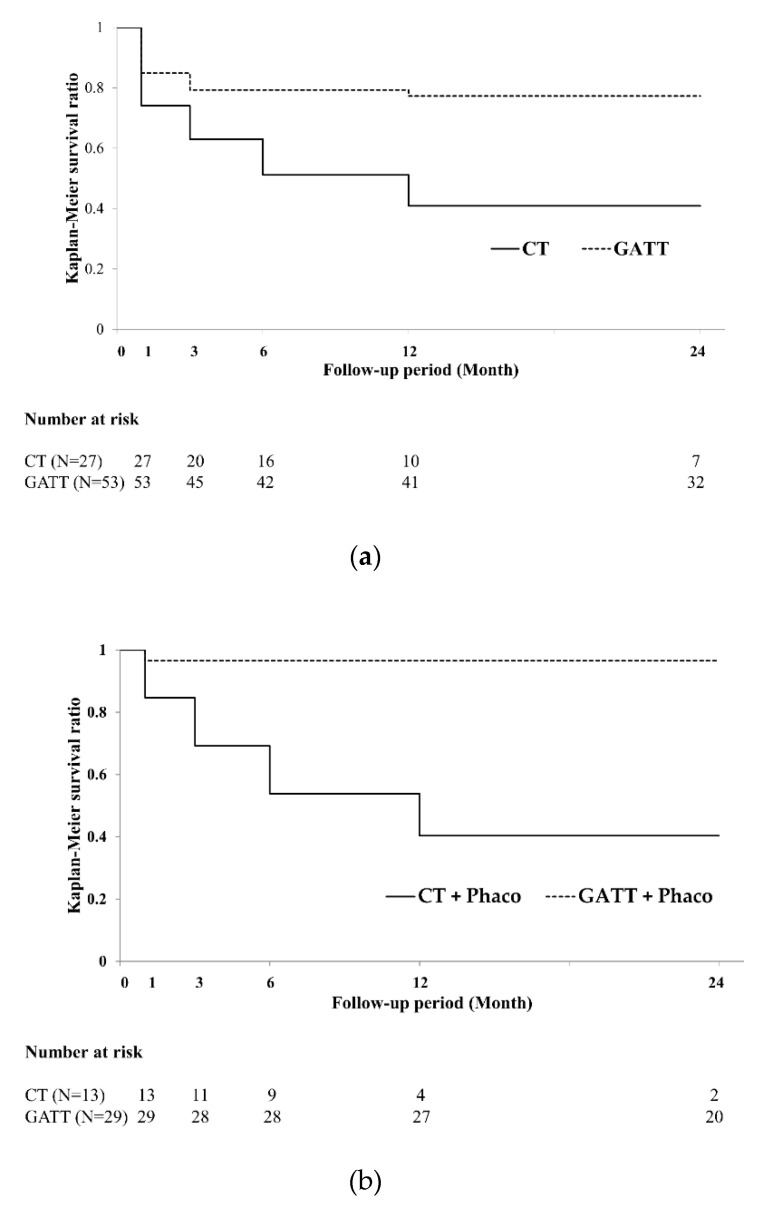
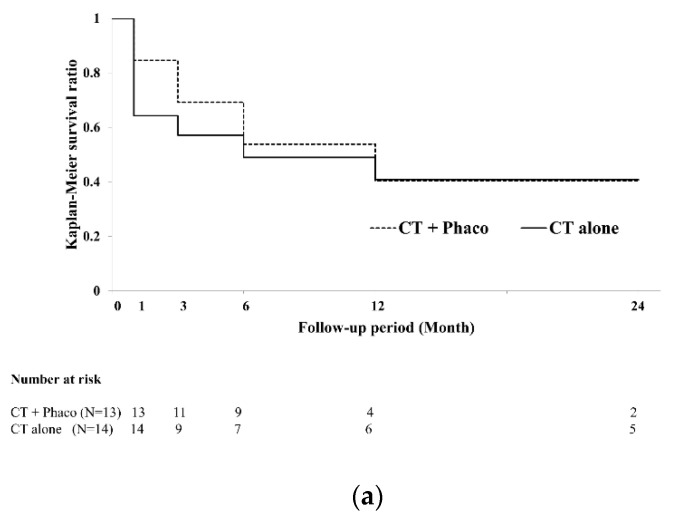
Patients' baseline characteristics were not significantly different between two groups. The surgical success rate in CT and GATT with phacoemulsification groups were 40.4% and 96.6% and were significantly higher in the GATT group than in the CT group ( < 0.001). However, the surgical success rate in CT and GATT without phacoemulsification groups were 40.8% and 54.2%, and there were no significant differences between two groups without phacoemulsification ( = 0.55). Similarly, the postoperative IOP was significantly lower in the GATT group than in the CT group only in eyes with simultaneous phacoemulsification. There were no significant differences in the numbers of glaucoma medications between the two groups. Additional glaucoma surgery was needed in 13.2% and 25.9% of patients in the GATT and CT groups, respectively ( = 0.157). The multivariate logistic regression analysis revealed that the surgical success of trabeculotomy was significantly associated with combined phacoemulsification and the type of glaucoma surgery (GATT).
Although both groups without phacoemulsification had a similar surgical success and IOP-lowering effect, GATT combined with phacoemulsification had a higher surgical success rate and a greater IOP-lowering effect compared with combined CT and phacoemulsification. Multivariate logistic regression analysis showed that the factors associated with higher surgical success at one year and two years postoperatively were the combined phacoemulsification procedure and the GATT.
传统小梁切开术(CT)以外路方式进行,施莱姆管(SC)的切口面积最大为120度。最近,引入了前房角镜辅助的经腔小梁切开术(GATT),该术式以内路方式实现了SC 360度的切口面积。本研究的目的是比较24个月内CT和GATT在联合与不联合超声乳化白内障吸除术情况下的手术效果,并确定与手术成功相关的因素。
两组患者的基线特征无显著差异。CT联合超声乳化白内障吸除术组和GATT联合超声乳化白内障吸除术组的手术成功率分别为40.4%和96.6%,GATT组显著高于CT组(<0.001)。然而,CT不联合超声乳化白内障吸除术组和GATT不联合超声乳化白内障吸除术组的手术成功率分别为40.8%和54.2%,两组在不联合超声乳化白内障吸除术时无显著差异(=0.55)。同样,仅在联合超声乳化白内障吸除术的眼中,GATT组术后眼压显著低于CT组。两组青光眼药物使用数量无显著差异。GATT组和CT组分别有13.2%和25.9%的患者需要额外的青光眼手术(=0.157)。多因素逻辑回归分析显示,小梁切开术的手术成功与联合超声乳化白内障吸除术及青光眼手术类型(GATT)显著相关。
尽管两组不联合超声乳化白内障吸除术时手术成功率和降低眼压效果相似,但与CT联合超声乳化白内障吸除术相比,GATT联合超声乳化白内障吸除术具有更高的手术成功率和更大的降低眼压效果。多因素逻辑回归分析表明,术后一年和两年手术成功率较高的相关因素是联合超声乳化白内障吸除术和GATT。