Department of Atmospheric Chemistry and Climate, Institute of Physical Chemistry Rocasolano, CSIC, Serrano 119, 28006, Madrid, Spain.
CIEMAT, Environmental Department, Av. Complutense 40, 28040, Madrid, Spain.
Nat Commun. 2022 Jan 10;13(1):88. doi: 10.1038/s41467-021-27642-5.
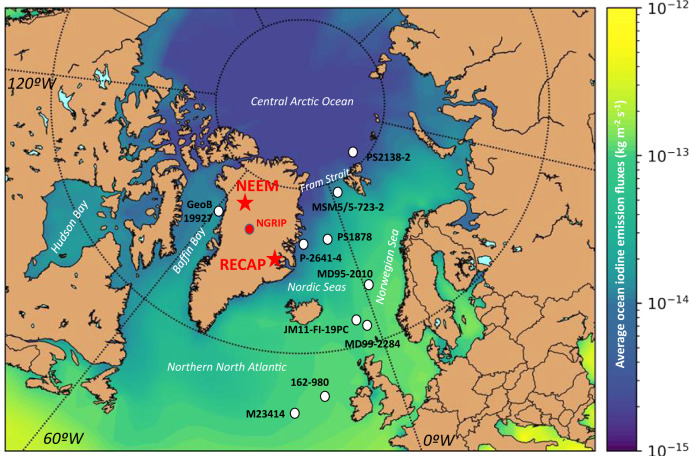
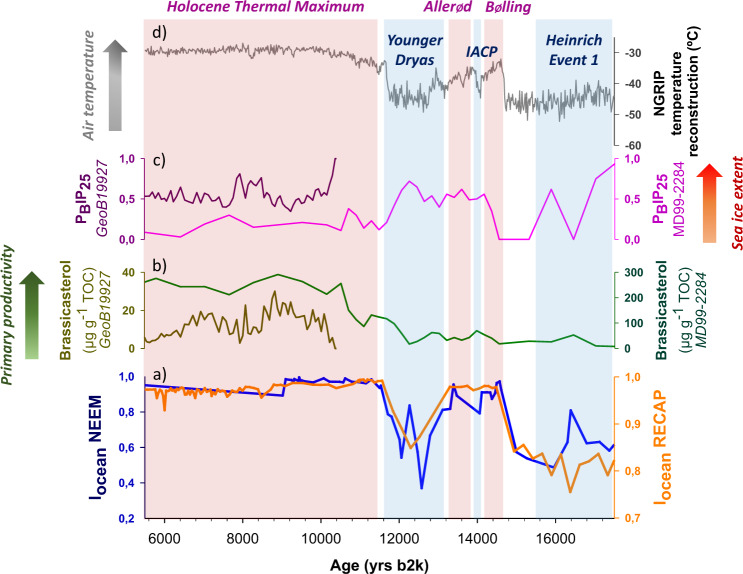
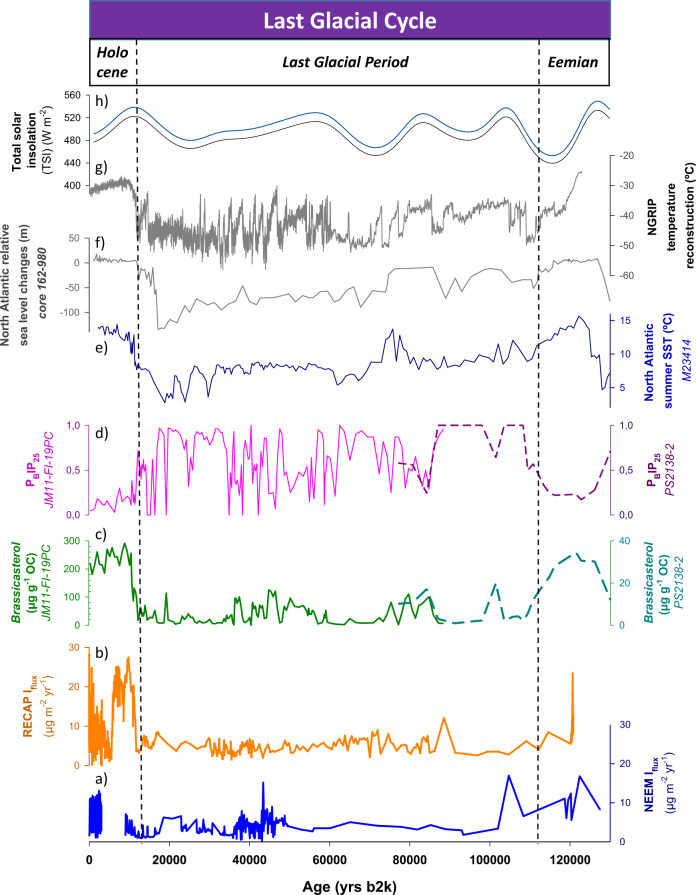
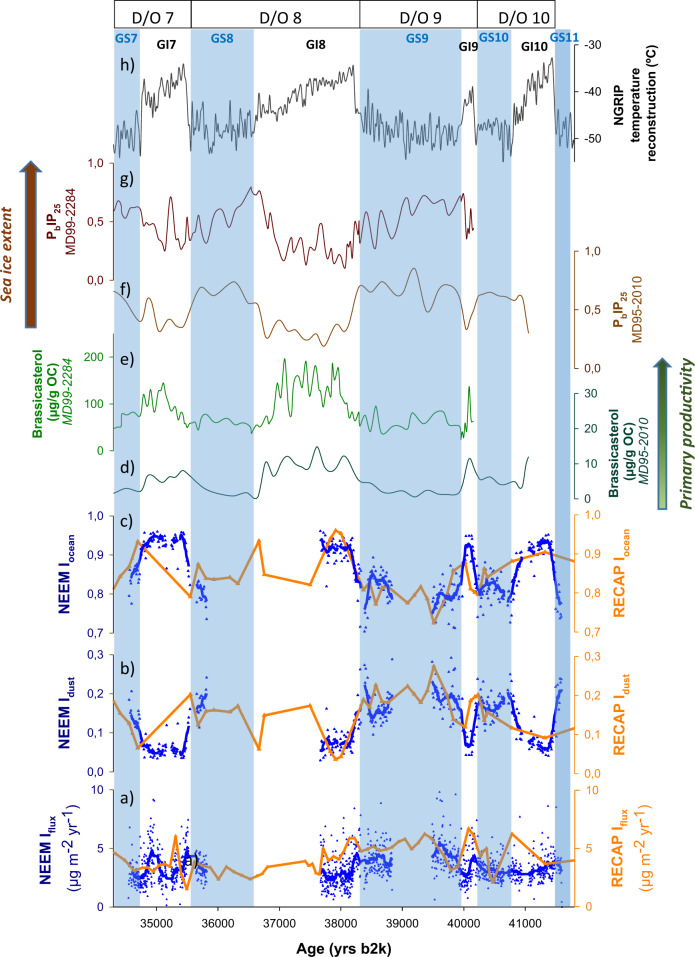
Iodine has a significant impact on promoting the formation of new ultrafine aerosol particles and accelerating tropospheric ozone loss, thereby affecting radiative forcing and climate. Therefore, understanding the long-term natural evolution of iodine, and its coupling with climate variability, is key to adequately assess its effect on climate on centennial to millennial timescales. Here, using two Greenland ice cores (NEEM and RECAP), we report the Arctic iodine variability during the last 127,000 years. We find the highest and lowest iodine levels recorded during interglacial and glacial periods, respectively, modulated by ocean bioproductivity and sea ice dynamics. Our sub-decadal resolution measurements reveal that high frequency iodine emission variability occurred in pace with Dansgaard/Oeschger events, highlighting the rapid Arctic ocean-ice-atmosphere iodine exchange response to abrupt climate changes. Finally, we discuss if iodine levels during past warmer-than-present climate phases can serve as analogues of future scenarios under an expected ice-free Arctic Ocean. We argue that the combination of natural biogenic ocean iodine release (boosted by ongoing Arctic warming and sea ice retreat) and anthropogenic ozone-induced iodine emissions may lead to a near future scenario with the highest iodine levels of the last 127,000 years.
碘对促进新的超细气溶胶颗粒的形成和加速对流层臭氧损耗有显著影响,从而影响辐射强迫和气候。因此,了解碘的长期自然演化及其与气候变率的耦合关系,是充分评估其对百年至千年时间尺度气候影响的关键。在这里,我们使用格陵兰冰芯(NEEM 和 RECAP),报告了过去 127,000 年来北极碘的变化情况。我们发现,在间冰期和冰期分别记录到了最高和最低的碘水平,这是由海洋生物生产力和海冰动力学调节的。我们的亚十年分辨率测量结果表明,与 Dansgaard/Oeschger 事件同步发生的高频碘排放变化,突出了北极海洋-冰-大气碘交换对突然气候变化的快速响应。最后,我们讨论了过去温暖期的碘水平是否可以作为未来无冰北极海情景的类似物。我们认为,自然生物海洋碘释放(受当前北极变暖及海冰消退的推动)与人为臭氧引起的碘排放的结合,可能导致未来近未来出现过去 127,000 年来最高的碘水平。