Shemyakin-Ovchinnikov Institute of Bioorganic Chemistry, 117997, Moscow, Russia.
Center for Precision Genome Editing and Genetic Technologies for Biomedicine, Pirogov Russian National Research Medical University, 117997, Moscow, Russia.
Nat Commun. 2022 Jan 10;13(1):171. doi: 10.1038/s41467-021-27796-2.
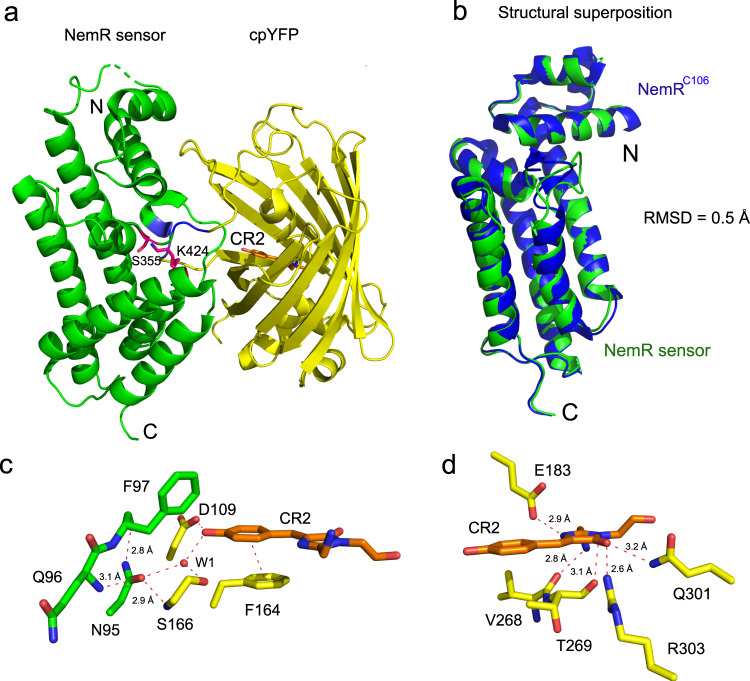
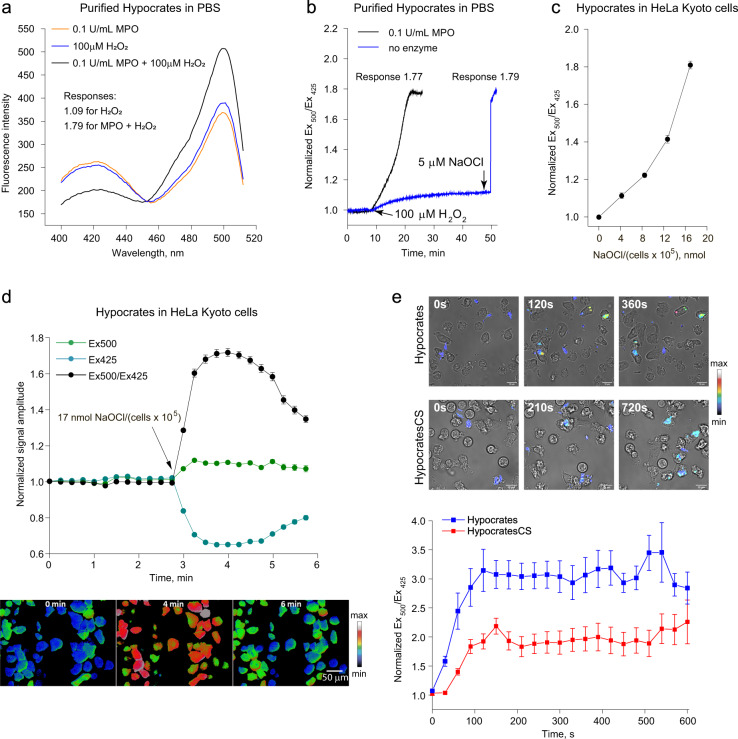
The lack of tools to monitor the dynamics of (pseudo)hypohalous acids in live cells and tissues hinders a better understanding of inflammatory processes. Here we present a fluorescent genetically encoded biosensor, Hypocrates, for the visualization of (pseudo)hypohalous acids and their derivatives. Hypocrates consists of a circularly permuted yellow fluorescent protein integrated into the structure of the transcription repressor NemR from Escherichia coli. We show that Hypocrates is ratiometric, reversible, and responds to its analytes in the 10 Ms range. Solving the Hypocrates X-ray structure provided insights into its sensing mechanism, allowing determination of the spatial organization in this circularly permuted fluorescent protein-based redox probe. We exemplify its applicability by imaging hypohalous stress in bacteria phagocytosed by primary neutrophils. Finally, we demonstrate that Hypocrates can be utilized in combination with HyPerRed for the simultaneous visualization of (pseudo)hypohalous acids and hydrogen peroxide dynamics in a zebrafish tail fin injury model.
缺乏监测活细胞和组织中(拟)次卤酸动态的工具,阻碍了对炎症过程的更好理解。在这里,我们提出了一种荧光基因编码生物传感器 Hypocrates,用于可视化(拟)次卤酸及其衍生物。Hypocrates 由一个环状排列的黄色荧光蛋白整合到大肠杆菌的转录抑制剂 NemR 结构中。我们表明 Hypocrates 是比率型的、可逆的,并在 10 Ms 范围内对其分析物做出响应。解决 Hypocrates 的 X 射线结构提供了对其传感机制的深入了解,允许确定这种环状排列的荧光蛋白基氧化还原探针中的空间组织。我们通过成像被原代中性粒细胞吞噬的细菌中的次卤应激来举例说明其适用性。最后,我们证明 Hypocrates 可以与 HyPerRed 结合使用,用于在斑马鱼尾鳍损伤模型中同时可视化(拟)次卤酸和过氧化氢的动态。