Institut Jean Nicod, Département d'études Cognitives, Ecole Normale Supérieure, EHESS, Université PSL, 75005, Paris, France.
Santa Clara University, Santa Clara, CA, 95053, USA.
Sci Rep. 2022 Jan 10;12(1):442. doi: 10.1038/s41598-021-04046-5.
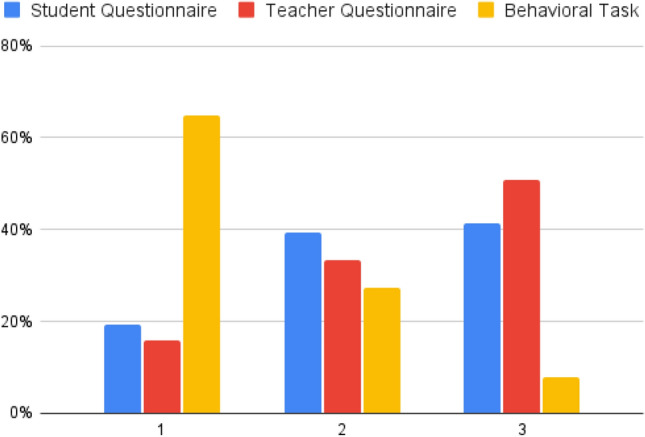
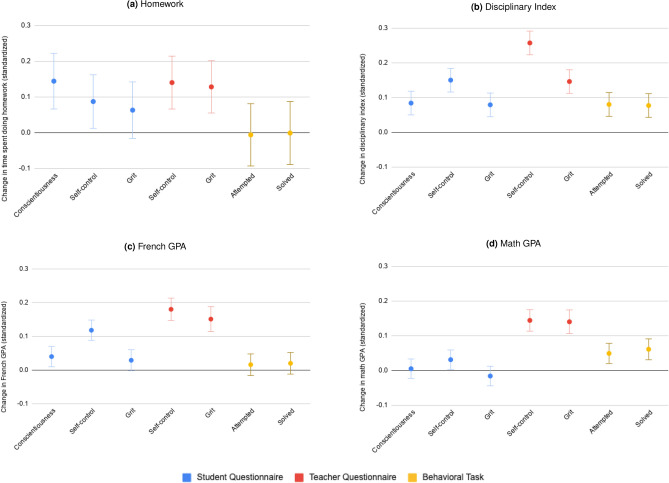
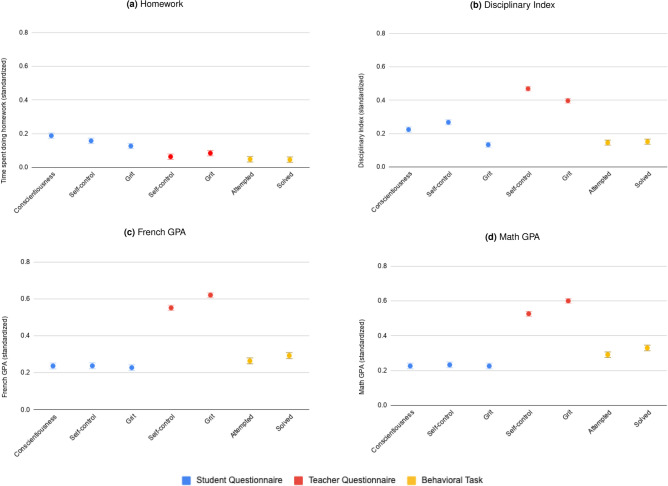
Recent empirical research has shown that improving socio-emotional skills such as grit, conscientiousness and self-control leads to higher academic achievement and better life outcomes. However, both theoretical and empirical works have raised concerns about the reliability of the different methods used to measure socio-emotional skills. We compared the reliability and validity of the three leading measurements methods-a student-reported questionnaire, a teacher-reported questionnaire, and a behavioral task-in a sample of 3997 French students. Before analyzing the data, we polled 114 international researchers in cognitive development and education economics; most researchers in both fields predicted that the behavioral task would be the best method. We found instead that the teacher questionnaire was more predictive of students' behavioral outcomes and of their grade progression, while the behavioral task was the least predictive. This work suggests that researchers may not be using optimal tools to measure socio-emotional skills in children.
最近的实证研究表明,提高坚毅、尽责和自我控制等社会情感技能会导致更高的学业成绩和更好的生活结果。然而,理论和实证工作都对用于衡量社会情感技能的不同方法的可靠性提出了担忧。我们在 3997 名法国学生的样本中比较了三种主要测量方法(学生自评问卷、教师报告问卷和行为任务)的可靠性和有效性。在分析数据之前,我们对 114 名认知发展和教育经济学方面的国际研究人员进行了民意调查;这两个领域的大多数研究人员都预测行为任务将是最好的方法。然而,我们发现,教师问卷反而更能预测学生的行为表现和成绩进步,而行为任务的预测能力最差。这项工作表明,研究人员可能没有使用最佳工具来衡量儿童的社会情感技能。