Division of Infectious Diseases, Department of Internal Medicine, Chung-Ang University Hospital, Chung-Ang University College of Medicine, Seoul, Korea.
Department of Internal Medicine, Chung-Ang Medical Health Care System Hyundae Hospital, Namyangju, Korea.
J Korean Med Sci. 2022 Jan 10;37(2):e15. doi: 10.3346/jkms.2022.37.e15.
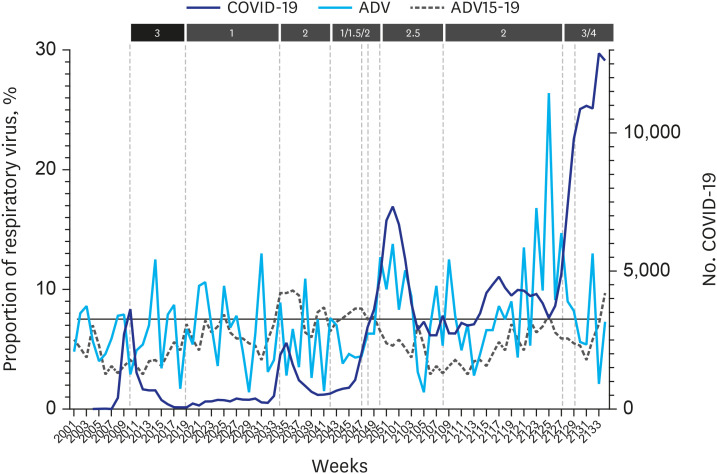
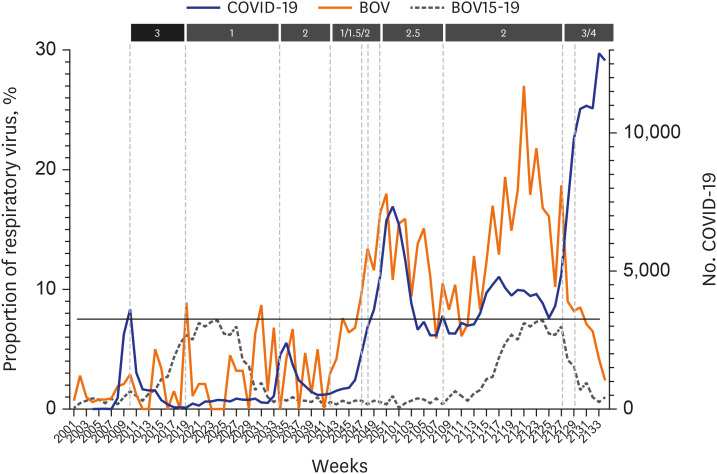
During the coronavirus disease 2019 (COVID-19) pandemic, the incidence of rhinovirus (RV) is inversely related to the intensity of non-pharmacological interventions (NPIs), such as universal mask wearing and physical distancing.
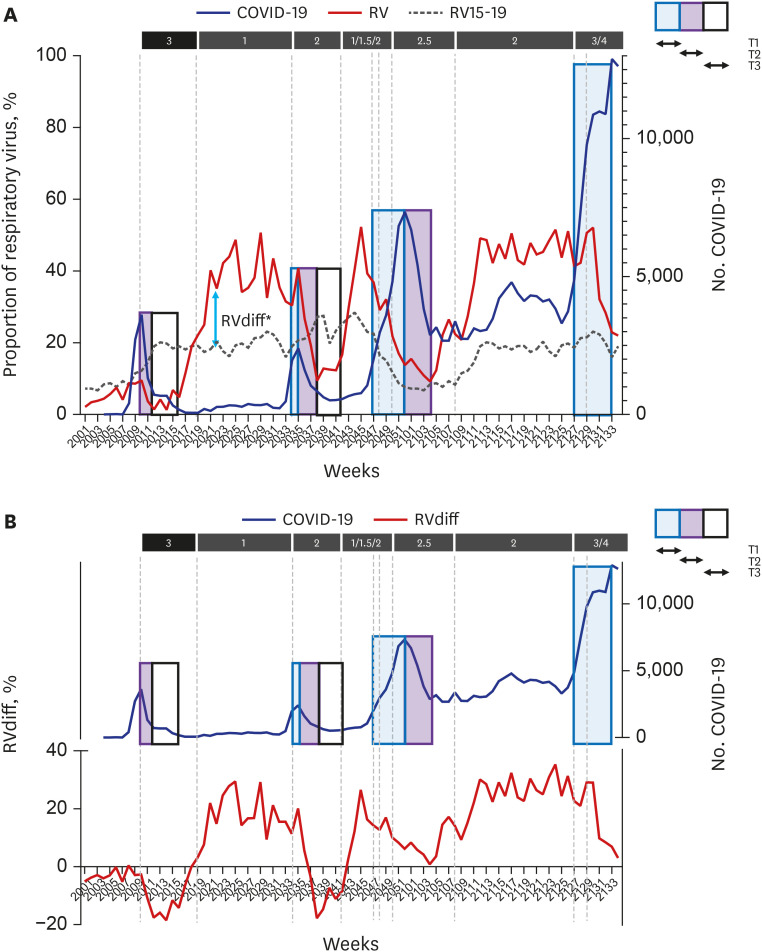
Using RV surveillance data, changes in the effect of NPIs were investigated in South Korea during the pandemic. The time to the first visible effect of NPIs after the onset of NPIs (T1), time to the maximum effect (T2), and duration of the maximum effect (T3) were measured for each surge. For each week, the RVdiff [(RV incidence during the pandemic) - (RV incidence within 5 years before the pandemic)] was calculated, and number of weeks for RVdiff to be below zero after NPIs (time to RVdiff ≤ 0) and number of weeks RVdiff remains below zero after NPIs (duration of RVdiff ≤ 0) were measured for each surge.
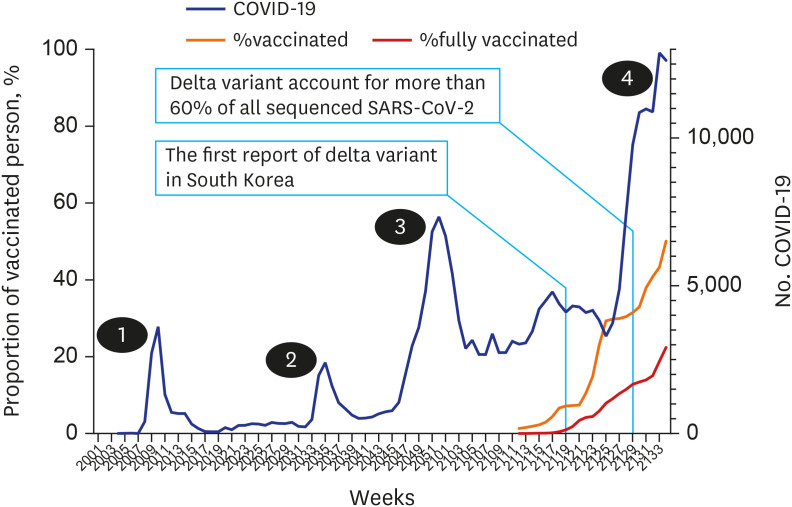
During the study period, four surges of COVID-19 were reported. As the pandemic progressed, T1 and T2 increased, but T3 decreased. Additionally, the "time to RVdiff of ≤ 0" increased and "duration of RVdiff of ≤ 0" decreased. These changes became more pronounced during the third surge (mid-November 2020), before the introduction of the COVID-19 vaccine, and from the emergence of the delta variant.
The effect of NPIs appears slower, the duration of the effect becomes shorter, and the intensity also decreases less than a year after the onset of the pandemic owing to people's exhaustion in implementing NPIs. These findings suggest that the COVID-19 response strategy must be completely overhauled.
在 2019 年冠状病毒病(COVID-19)大流行期间,鼻病毒(RV)的发病率与非药物干预(NPI)的强度呈反比,例如普遍戴口罩和保持身体距离。
利用 RV 监测数据,研究了大流行期间韩国 NPI 变化的影响。测量了每次流行高峰时 NPI 开始后首次可见效果的时间(T1)、最大效果的时间(T2)和最大效果的持续时间(T3)。对于每一周,计算 RVdiff [(大流行期间的 RV 发病率)-(大流行前 5 年的 RV 发病率)],并测量 NPI 后 RVdiff 低于零的周数(RVdiff≤0 的时间)和 NPI 后 RVdiff 持续低于零的周数(RVdiff≤0 的持续时间)。
在研究期间,报告了四次 COVID-19 流行高峰。随着大流行的发展,T1 和 T2 增加,但 T3 减少。此外,“RVdiff≤0 的时间”增加,“RVdiff≤0 的持续时间”减少。这些变化在第三次流行高峰(2020 年 11 月中旬)期间变得更加明显,当时 COVID-19 疫苗尚未推出,并且 delta 变异出现。
由于人们实施 NPI 的疲劳,大流行开始一年后,NPI 的效果似乎更慢,效果的持续时间更短,强度也降低。这些发现表明,必须彻底改革 COVID-19 应对策略。