Division of Orthodontics and Dentofacial Orthopedics, Tohoku University Graduate School of Dentistry, Aoba‑ku, Sendai, Miyagi 980‑8575, Japan.
Mol Med Rep. 2022 Mar;25(3). doi: 10.3892/mmr.2022.12594. Epub 2022 Jan 11.
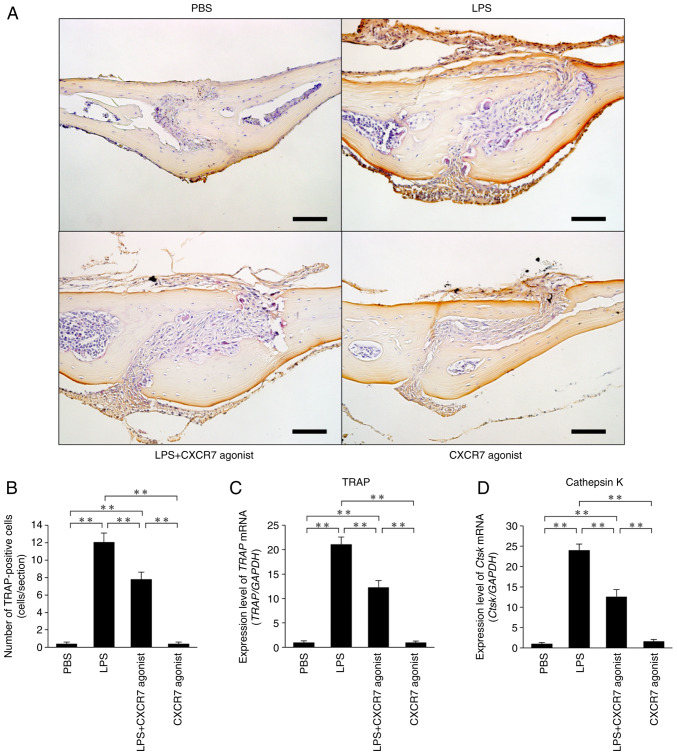
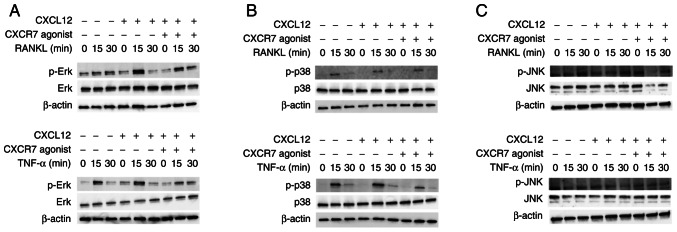
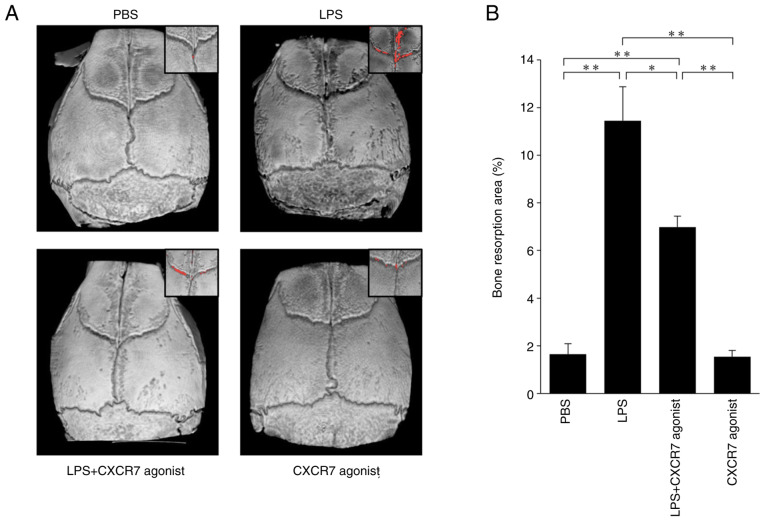
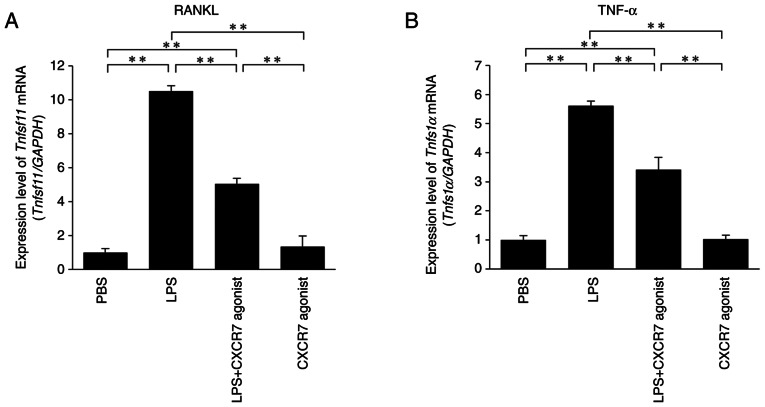
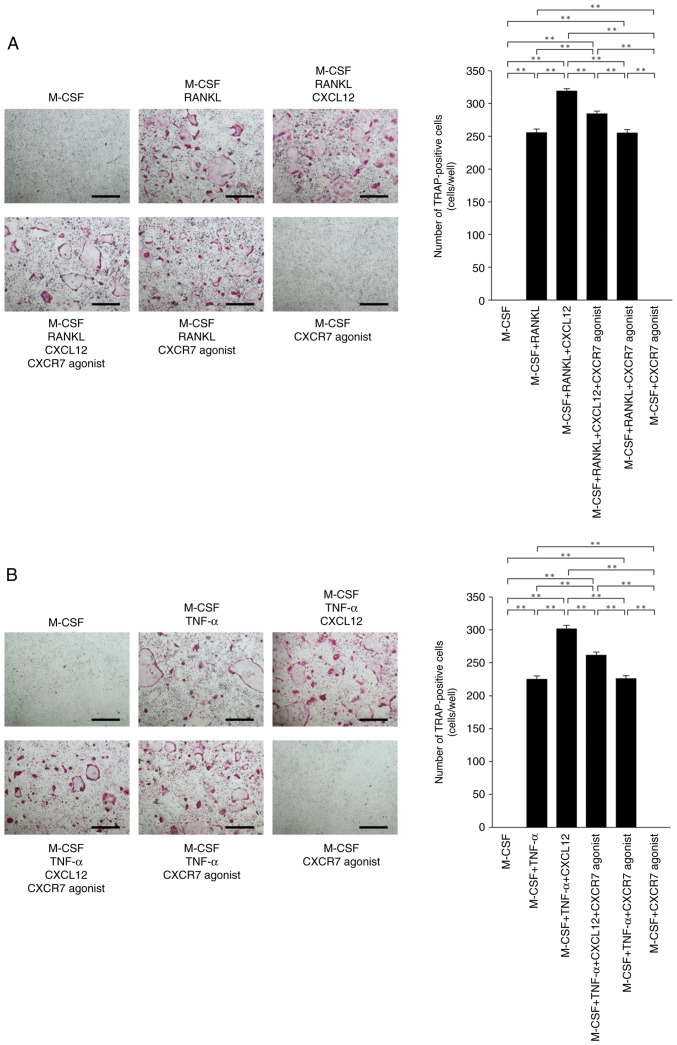
The C‑X‑C receptor (CXCR) 7 agonist, VUF11207, is a chemical compound that binds specifically to CXCR7, and negatively regulates C‑X‑C motif chemokine ligand 12 (CXCL12) and CXCR4‑induced cellular events. Lipopolysaccharide (LPS) can induce inflammatory cytokines and pathological bone loss. LPS also induces expression of CXCL12, enhancing sensitivity to receptor activator of NF‑κB ligand (RANKL) and tumor necrosis factor‑α (TNF‑α) . RANKL and TNF‑α induce the differentiation of osteoclasts into osteoclast precursors and bone resorption. The current study was performed to examine the effects of a CXCR7 agonist on osteoclastogenesis and bone resorption induced by LPS . In addition, the mechanisms underlying these effects were investigated by experiments. Eight‑week‑old male C57BL/6J mice were subcutaneously injected over the calvariae with LPS alone or LPS and CXCR7 agonist. After sacrifice, the number of osteoclasts and the bone resorption area were measured. experiments were performed to investigate the effects of CXCL12 and CXCR7 agonist on osteoclastogenesis induced by RANKL and TNF‑α. Mice injected with LPS and CXCR7 agonist showed significantly reduced osteoclastogenesis and bone resorption compared with mice injected with LPS alone. Moreover, the CXCR7 agonist inhibited CXCL12 enhancement of RANKL‑ and TNF‑α‑induced osteoclastogenesis . Thus, CXCR7 agonist inhibited LPS‑induced osteoclast‑associated cytokines, such as RANKL and TNF‑α, as well as RANKL‑ and TNF‑α‑induced osteoclastogenesis in vitro by modulating CXCL12‑mediated enhancement of osteoclastogenesis. In conclusion, CXCR7 agonist reduced CXCL12‑mediated osteoclastogenesis and bone resorption.
C-X-C 趋化因子受体(CXCR)7 激动剂 VUF11207 是一种特异性结合 CXCR7 的化学化合物,可负向调节 C-X-C 基序趋化因子配体 12(CXCL12)和 CXCR4 诱导的细胞事件。脂多糖(LPS)可诱导炎症细胞因子和病理性骨丢失。LPS 还可诱导 CXCL12 的表达,增强对核因子-κB 配体受体激活剂(RANKL)和肿瘤坏死因子-α(TNF-α)的敏感性。RANKL 和 TNF-α诱导破骨细胞前体向破骨细胞分化和骨吸收。本研究旨在探讨 CXCR7 激动剂对 LPS 诱导的破骨细胞生成和骨吸收的影响。此外,通过实验研究了这些作用的机制。将 8 周龄雄性 C57BL/6J 小鼠皮下注射 LPS 或 LPS 和 CXCR7 激动剂于颅骨。处死动物后,测量破骨细胞数量和骨吸收面积。实验研究了 CXCL12 和 CXCR7 激动剂对 RANKL 和 TNF-α诱导的破骨细胞生成的影响。与单独注射 LPS 的小鼠相比,注射 LPS 和 CXCR7 激动剂的小鼠破骨细胞生成和骨吸收明显减少。此外,CXCR7 激动剂抑制了 CXCL12 增强 RANKL 和 TNF-α诱导的破骨细胞生成。因此,CXCR7 激动剂通过调节 CXCL12 介导的破骨细胞生成增强,抑制 LPS 诱导的破骨细胞相关细胞因子(如 RANKL 和 TNF-α)以及 RANKL 和 TNF-α 诱导的破骨细胞生成。总之,CXCR7 激动剂减少了 CXCL12 介导的破骨细胞生成和骨吸收。