Renal Division, Shanxi Medical University Second Affiliated Hospital, Taiyuan, Shanxi, China.
Renal Divison, Shanxi Cardiovascular Hospital, Taiyuan, Shanxi, China.
BMJ Open. 2022 Jan 11;12(1):e050843. doi: 10.1136/bmjopen-2021-050843.
The benefits of a low-salt diet for patients with chronic kidney disease (CKD) are controversial. We conducted a systematic review and meta-analysis of the effect of a low-salt diet on major clinical outcomes.
Systematic review and meta-analysis.
MEDLINE by Ovid, EMBASE and the Cochrane Library databases.
We included randomised controlled trials (RCTs) and cohort studies that assessed the effect of a low-salt diet on the renal composite outcomes (more than 50% decline in estimated glomerular filtration rate (eGFR) during follow-up, doubling of serum creatinine or end-stage renal disease), rate of eGFR decline, change in proteinuria, all-cause mortality events, cardiovascular (CV) events, and changes in systolic blood pressure and diastolic blood pressure.
Two independent researchers extracted data and evaluated their quality. Relative risks (RRs) with 95% CIs were used for dichotomous data. Differences in means (MDs) or standardised mean differences (SMDs) with 95% CIs were used to pool continuous data. We used the Cochrane Collaboration risk-of-bias tool to evaluate the quality of RCTs, and Newcastle-Ottawa Scale to evaluate the quality of cohort studies.
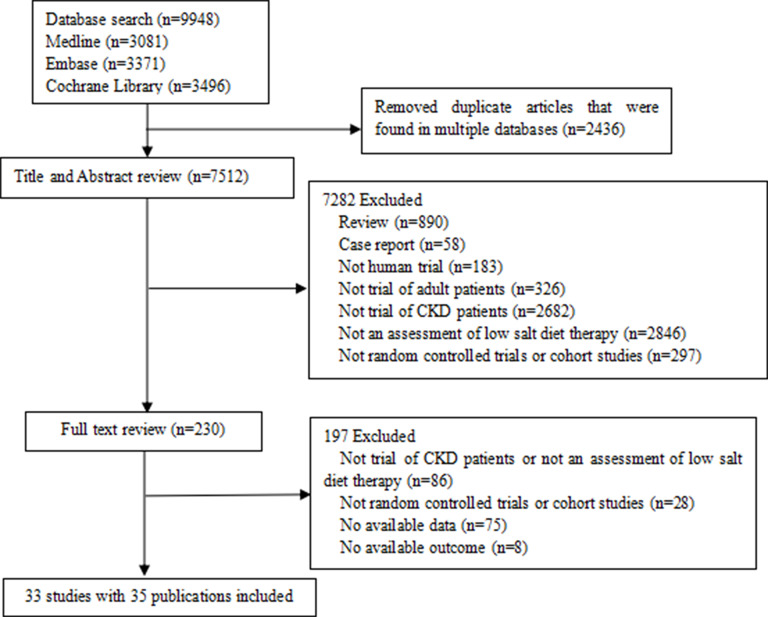
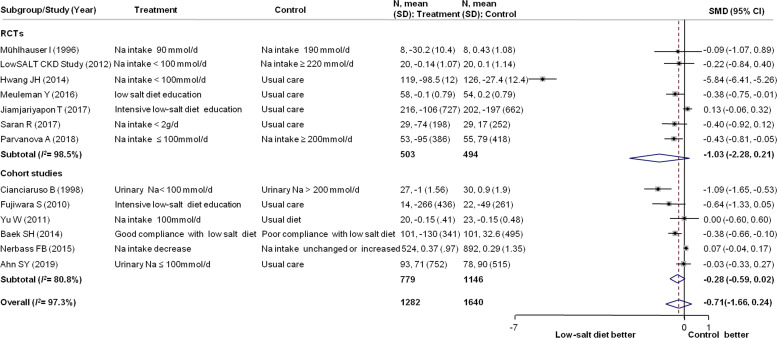
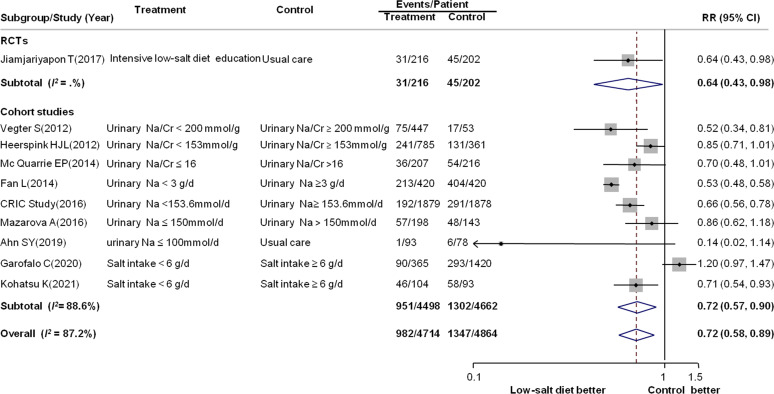
We found 9948 potential research records. After removing duplicates, we reviewed the titles and abstracts, and screened the full text of 230 publications. Thirty-three studies with 101 077 participants were included. A low-salt diet produced a 28% reduction in renal composite outcome events (RR: 0.72; 95% CI: 0.58 to 0.89). No significant effects were found in terms of changes in proteinuria (SMD: -0.71; 95% CI: -1.66 to 0.24), rate of eGFR (decline MD: 1.16; 95% CI: -2.02 to 4.33), risk of all-cause mortality (RR: 0.92; 95% CI: 0.58 to 1.46) and CV events (RR: 1.01; 95% CI: 0.46 to 2.22).
A low-salt diet seems to reduce the risk for renal composite outcome events in patients with CKD. However, no compelling evidence indicated that such a diet would reduce the eGFR decline rate, proteinuria, incidence of all-cause mortality and CV events. Further, more definitive studies are needed.
CRD42017072395.
低钠饮食对慢性肾脏病(CKD)患者的益处存在争议。我们对低钠饮食对主要临床结局的影响进行了系统评价和荟萃分析。
系统评价和荟萃分析。
Ovid 中的 MEDLINE、EMBASE 和 Cochrane 图书馆数据库。
我们纳入了评估低钠饮食对肾脏复合结局(随访期间估计肾小球滤过率(eGFR)下降超过 50%、血清肌酐倍增或终末期肾病)、eGFR 下降率、蛋白尿变化、全因死亡率事件、心血管(CV)事件以及收缩压和舒张压变化的随机对照试验(RCT)和队列研究。
两名独立的研究人员提取数据并评估其质量。使用二项数据的相对风险(RR)和 95%置信区间(CI)。使用均值差(MD)或标准化均数差(SMD)和 95%CI 来汇总连续数据。我们使用 Cochrane 协作风险偏倚工具评估 RCT 的质量,使用纽卡斯尔-渥太华量表评估队列研究的质量。
我们发现了 9948 条潜在的研究记录。在去除重复项后,我们查看了标题和摘要,并筛选了 230 篇出版物的全文。有 33 项研究,涉及 101077 名参与者,被纳入分析。低钠饮食使肾脏复合结局事件的风险降低了 28%(RR:0.72;95%CI:0.58 至 0.89)。在蛋白尿变化(SMD:-0.71;95%CI:-1.66 至 0.24)、eGFR 下降率(MD:1.16;95%CI:-2.02 至 4.33)、全因死亡率风险(RR:0.92;95%CI:0.58 至 1.46)和 CV 事件风险(RR:1.01;95%CI:0.46 至 2.22)方面,未发现显著影响。
低钠饮食似乎降低了 CKD 患者的肾脏复合结局事件风险。然而,没有确凿的证据表明这种饮食会降低 eGFR 下降率、蛋白尿、全因死亡率和 CV 事件的发生率。此外,还需要进一步的、更明确的研究。
PROSPERO 注册号:CRD42017072395。