Karunaratna Sumudu, Ranaweera Dewanee, Vitharana Harshini, Ranaweera Prasad, Mendis Kamini, Fernando Deepika
Anti Malaria Campaign, Ministry of Health, Sri Lanka.
Department of Parasitology, Faculty of Medicine, University of Colombo, Colombo, Sri Lanka.
J Glob Infect Dis. 2021 Nov 9;13(4):172-176. doi: 10.4103/jgid.jgid_9_21. eCollection 2021 Oct-Dec.
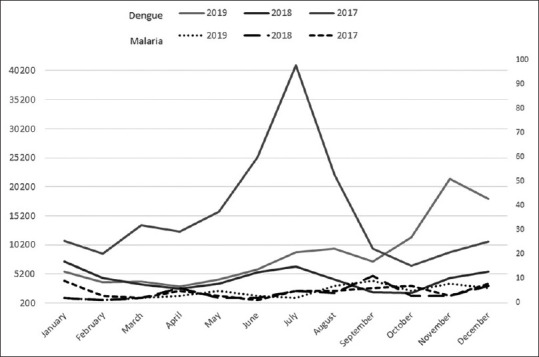
Fever and thrombocytopenia, often presenting features of malaria, are also the hallmarks of dengue infections. This study examines the degree and duration of thrombocytopenia in imported malaria infections in Sri Lanka and the extent to which this could provide a false trail in favor of a dengue diagnosis.
The data of all confirmed malaria cases reported in Sri Lanka from 2017 to 2019 were extracted from the national malaria database. These included detailed histories, the time to malaria diagnosis, platelet counts, and in 2019, the trail of diagnostic procedures.
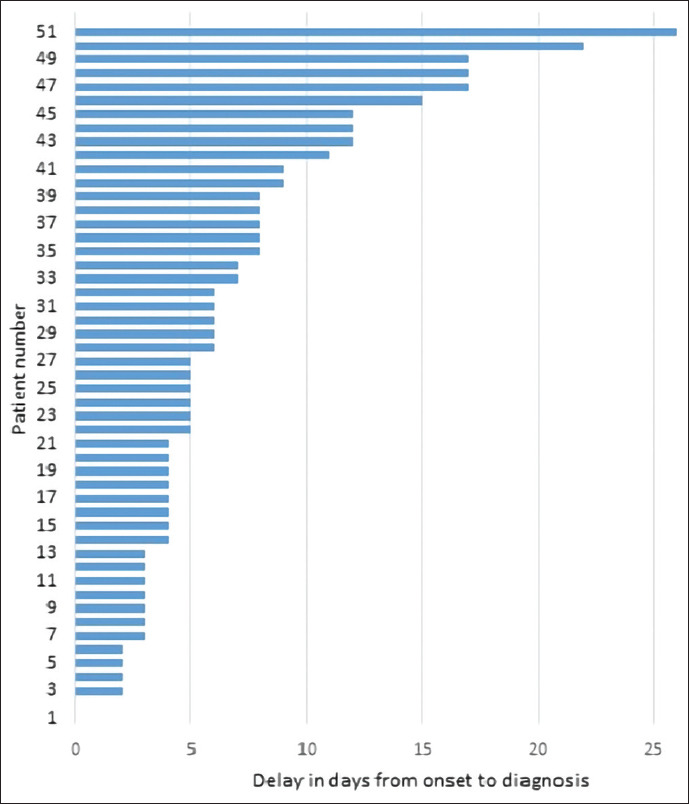
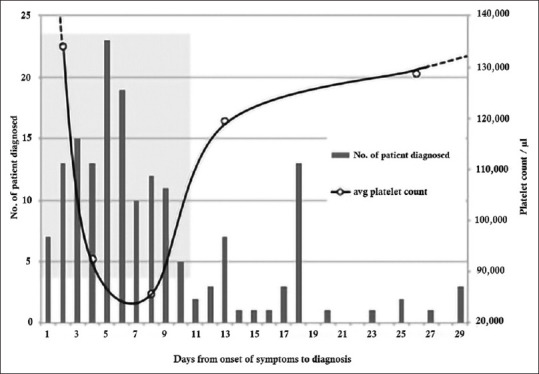
Over the 3 years, 158 malaria cases (157 imported and one introduced) were reported. Platelet counts were available in 90.5% ( = 143) of patients among whom 86% ( = 123) showed a thrombocytopenia (<150,000 cells/μl) and in nearly a third ( = 52) a severe thrombocytopenia (<50,000 cells/μl). Only 30% of patients ( = 48) were diagnosed with malaria within 3 days of the onset of symptoms, while in 37% ( = 58) it took 7 or more days. Platelet counts where significantly higher in patients who had symptoms for 7 days or more compared to those who had symptoms for <7 days (χ = 6.888, = 0.009). Dengue fever was suspected first in 30% ( = 16) of the total malaria patients reported in 2019.
Low platelet counts could delay suspecting and testing for malaria. Eliciting a history of travel to a malaria-endemic country could provide an important and discerning clue to suspect and test for malaria in such patients.
发热和血小板减少通常是疟疾的表现特征,也是登革热感染的标志。本研究调查了斯里兰卡输入性疟疾感染中血小板减少的程度和持续时间,以及这在多大程度上可能导致误诊为登革热。
从国家疟疾数据库中提取了2017年至2019年斯里兰卡报告的所有确诊疟疾病例的数据。这些数据包括详细病史、疟疾诊断时间、血小板计数,以及2019年的诊断程序记录。
在这3年中,共报告了158例疟疾病例(157例输入性病例和1例本地感染病例)。90.5%(n = 143)的患者有血小板计数数据,其中86%(n = 123)出现血小板减少(<150,000个细胞/μl),近三分之一(n = 52)出现严重血小板减少(<50,000个细胞/μl)。只有30%(n = 48)的患者在症状出现后3天内被诊断为疟疾,而37%(n = 58)的患者则需要7天或更长时间。与症状出现<7天的患者相比,症状出现7天或更长时间的患者血小板计数显著更高(χ² = 6.888,P = 0.009)。在2019年报告的所有疟疾病例中,30%(n = 16)的患者最初被怀疑为登革热。
血小板计数低可能会延迟对疟疾的怀疑和检测。询问前往疟疾流行国家的旅行史可为怀疑和检测此类患者的疟疾提供重要且有鉴别力的线索。