Unit of Obstetrics and Gynaecology, Faculty of Medicine and Health Sciences, University of Zimbabwe, Harare, Zimbabwe.
Zimbabwe College of Public Health Physicians, Harare, Zimbabwe.
Pan Afr Med J. 2021 Nov 24;40:180. doi: 10.11604/pamj.2021.40.180.30824. eCollection 2021.
Zimbabwe was one of the first countries to run a national COVID-19 vaccination programme in Africa. Lessons learnt could inform the roll-out of similar programmes in sub-Saharan Africa. To describe the trends of uptake of the COVID-19 vaccines in the first three months (February - May 2021) of the Zimbabwe vaccination programme and the lessons learnt.
a secondary descriptive analysis of routinely available COVID-19 vaccination data extracted from the daily situation reports published by the Ministry of Health and Child Care.
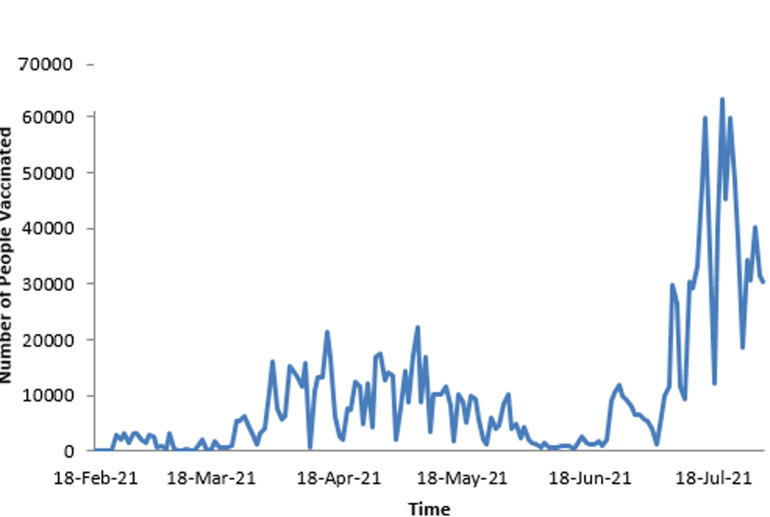
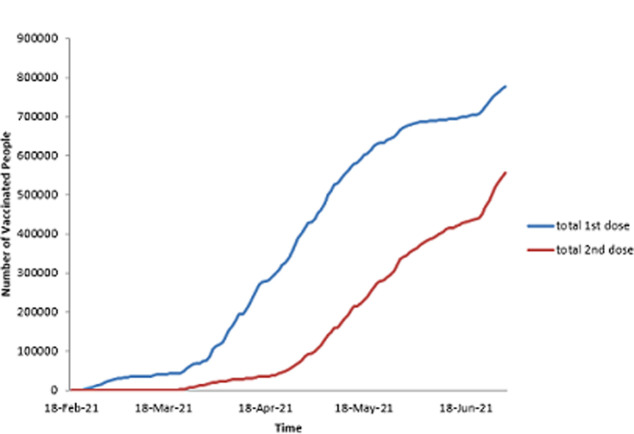
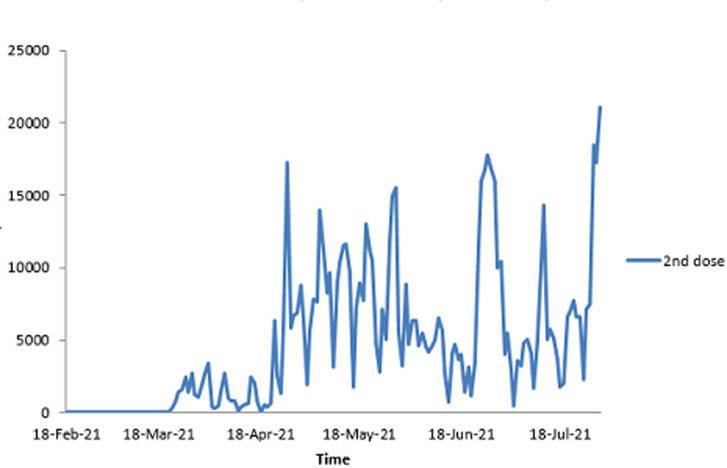
in the first three months of the programme, 1 020 078 doses were administered, with 675 678 being first doses and 344 400 were second doses. Using population estimates, at three months, 5.2% of the population had received at least one dose and 2.6% had received the full two doses. Uptake was initially slow, followed by a gradual, and subsequently an exponential increase.
by the end of May 2021, Zimbabwe had rolled out one of the largest COVID-19 vaccination programme in sub-Saharan Africa. The uptake followed a pattern and trend that is consistent with vaccine hesitancy reported in the literature, driven by a combination of confidence, complacency and convenience factors. The gradual increase in uptake followed a series of national and local community engagement programmes. The roll-out of similar programmes must recognise likely patterns of uptake across the population and ensure plans are in place to address vaccine hesitancy. The available data did not allow granular analysis to understand the demographics of people who participated in the programme, which is important for surveillance, targeted action, preventing inequalities and ensuring adequate and proportionate protection of residents prioritising the most vulnerable. Further analysis of the process, outcomes and impact of the programme will be helpful in informing the roll-out of similar programmes across Africa.
津巴布韦是非洲第一个开展全国 COVID-19 疫苗接种计划的国家之一。从中吸取的经验教训可能会为撒哈拉以南非洲类似计划的推出提供信息。描述津巴布韦疫苗接种计划头三个月(2021 年 2 月至 5 月)COVID-19 疫苗接种的趋势以及从中吸取的经验教训。
对卫生部和儿童保健部发布的日常情况报告中提取的 COVID-19 疫苗接种常规数据进行二次描述性分析。
在该计划的头三个月内,共接种了 1 020 078 剂疫苗,其中 675 678 剂为第一剂,344 400 剂为第二剂。根据人口估计,在三个月内,5.2%的人口至少接种了一剂,2.6%的人口接种了两剂。接种开始时速度较慢,随后逐渐增加,随后呈指数增长。
到 2021 年 5 月底,津巴布韦已经在撒哈拉以南非洲推出了规模最大的 COVID-19 疫苗接种计划之一。接种情况遵循了与文献中报道的疫苗犹豫一致的模式和趋势,这是由信心、自满和便利因素共同驱动的。接种率的逐渐增加是在一系列国家和地方社区参与计划之后发生的。推出类似计划必须认识到人口中可能存在的接种模式,并确保制定计划来解决疫苗犹豫问题。现有的数据不允许进行细粒度分析来了解参与该计划的人群的人口统计学特征,这对于监测、有针对性的行动、预防不平等以及确保优先保护最脆弱人群的居民获得充分和适当的保护至关重要。进一步分析该计划的过程、结果和影响将有助于为非洲类似计划的推出提供信息。