Division of Hematology/Oncology, Department of Medicine, Rhode Island Hospital, Warren Alpert Medical School of Brown University, Providence, RI 02903, USA.
Division of Pulmonary, Critical Care and Sleep Medicine, Department of Medicine, Rhode Island Hospital, Warren Alpert Medical School of Brown University, Providence, RI 02903, USA.
Cardiovasc Res. 2022 Dec 29;118(16):3211-3224. doi: 10.1093/cvr/cvac001.
Pulmonary arterial hypertension (PAH) is a fatal disease without a cure. Previously, we found that transcription factor RUNX1-dependent haematopoietic transformation of endothelial progenitor cells may contribute to the pathogenesis of PAH. However, the therapeutic potential of RUNX1 inhibition to reverse established PAH remains unknown. In the current study, we aimed to determine whether RUNX1 inhibition was sufficient to reverse Sugen/hypoxia (SuHx)-induced pulmonary hypertension (PH) in rats. We also aimed to demonstrate possible mechanisms involved.
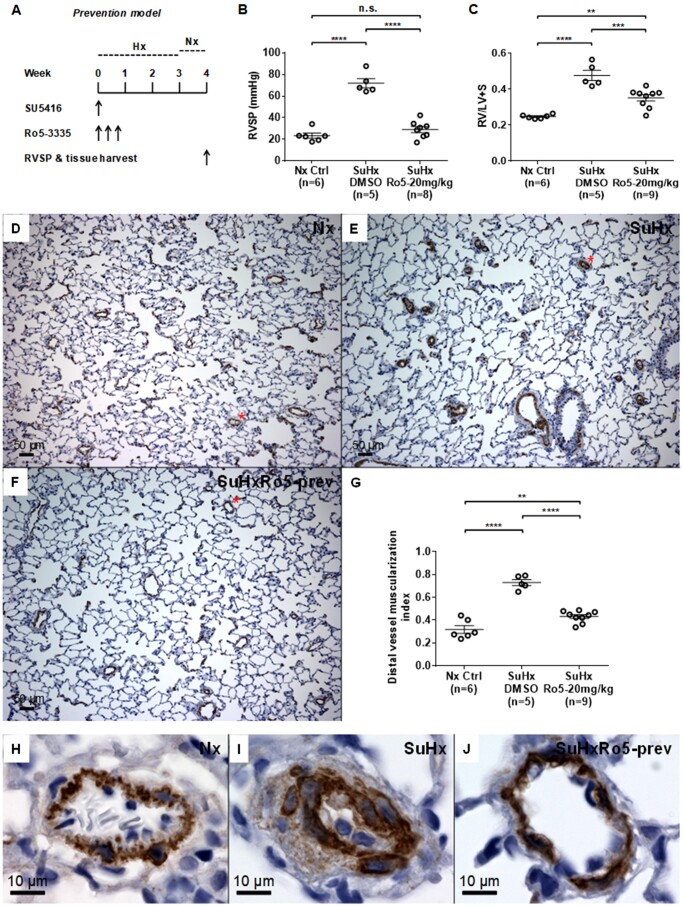
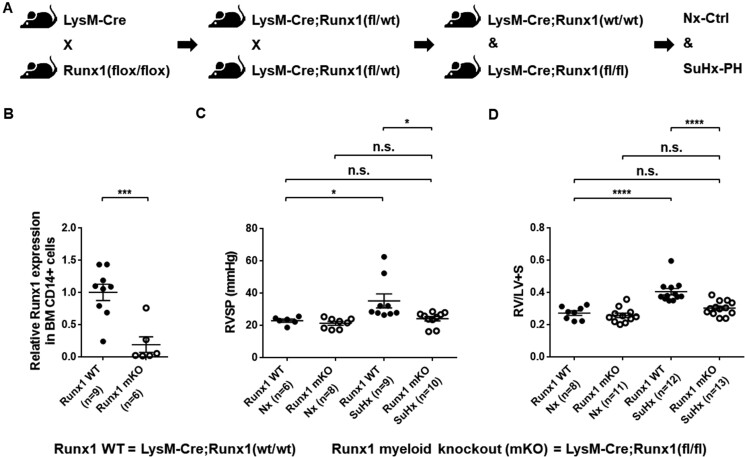
We administered a small molecule specific RUNX1 inhibitor Ro5-3335 before, during, and after the development of SuHx-PH in rats to investigate its therapeutic potential. We quantified lung macrophage recruitment and activation in vivo and in vitro in the presence or absence of the RUNX1 inhibitor. We generated conditional VE-cadherin-CreERT2; ZsGreen mice for labelling adult endothelium and lineage tracing in the SuHx-PH model. We also generated conditional Cdh5-CreERT2; Runx1(flox/flox) mice to delete Runx1 gene in adult endothelium and LysM-Cre; Runx1(flox/flox) mice to delete Runx1 gene in cells of myeloid lineage, and then subjected these mice to SuHx-PH induction. RUNX1 inhibition in vivo effectively prevented the development, blocked the progression, and reversed established SuHx-induced PH in rats. RUNX1 inhibition significantly dampened lung macrophage recruitment and activation. Furthermore, lineage tracing with the inducible VE-cadherin-CreERT2; ZsGreen mice demonstrated that a RUNX1-dependent endothelial to haematopoietic transformation occurred during the development of SuHx-PH. Finally, tissue-specific deletion of Runx1 gene either in adult endothelium or in cells of myeloid lineage prevented the mice from developing SuHx-PH, suggesting that RUNX1 is required for the development of PH.
By blocking RUNX1-dependent endothelial to haematopoietic transformation and pulmonary macrophage recruitment and activation, targeting RUNX1 may be as a novel treatment modality for pulmonary arterial hypertension.
肺动脉高压(PAH)是一种无法治愈的致命疾病。此前,我们发现转录因子 RUNX1 依赖性内皮祖细胞的造血转化可能导致 PAH 的发病机制。然而,RUNX1 抑制逆转已建立的 PAH 的治疗潜力尚不清楚。在本研究中,我们旨在确定 RUNX1 抑制是否足以逆转 Sugen/缺氧(SuHx)诱导的大鼠肺动脉高压(PH)。我们还旨在证明涉及的可能机制。
我们在 SuHx-PH 大鼠发展过程中之前、期间和之后给予小分子特异性 RUNX1 抑制剂 Ro5-3335,以研究其治疗潜力。我们在存在或不存在 RUNX1 抑制剂的情况下体内和体外量化肺巨噬细胞募集和激活。我们生成了条件性 VE-cadherin-CreERT2;ZsGreen 小鼠,用于在 SuHx-PH 模型中标记成年内皮细胞和谱系追踪。我们还生成了条件性 Cdh5-CreERT2;Runx1(flox/flox) 小鼠以在成年内皮细胞中删除 Runx1 基因,LysM-Cre;Runx1(flox/flox) 小鼠以在髓系细胞中删除 Runx1 基因,然后将这些小鼠暴露于 SuHx-PH 诱导。体内 RUNX1 抑制有效阻止了发展,阻止了进展,并逆转了大鼠 SuHx 诱导的 PH。RUNX1 抑制显著抑制了肺巨噬细胞的募集和激活。此外,用诱导型 VE-cadherin-CreERT2;ZsGreen 小鼠进行的谱系追踪表明,SuHx-PH 发展过程中发生了依赖 RUNX1 的内皮到造血的转化。最后,在成年内皮细胞或髓系细胞中特异性删除 Runx1 基因可防止小鼠发生 SuHx-PH,表明 RUNX1 是 PH 发生所必需的。
通过阻断 RUNX1 依赖性内皮到造血的转化以及肺巨噬细胞的募集和激活,靶向 RUNX1 可能成为肺动脉高压的一种新的治疗方法。