State Key Laboratory of Microbial Resources, Institute of Microbiology, Chinese Academy of Sciences, Beijing, China.
College of Life Sciences, University of Chinese Academy of Sciences, Beijing, China.
Microbiol Spectr. 2022 Feb 23;10(1):e0238021. doi: 10.1128/spectrum.02380-21. Epub 2022 Jan 12.
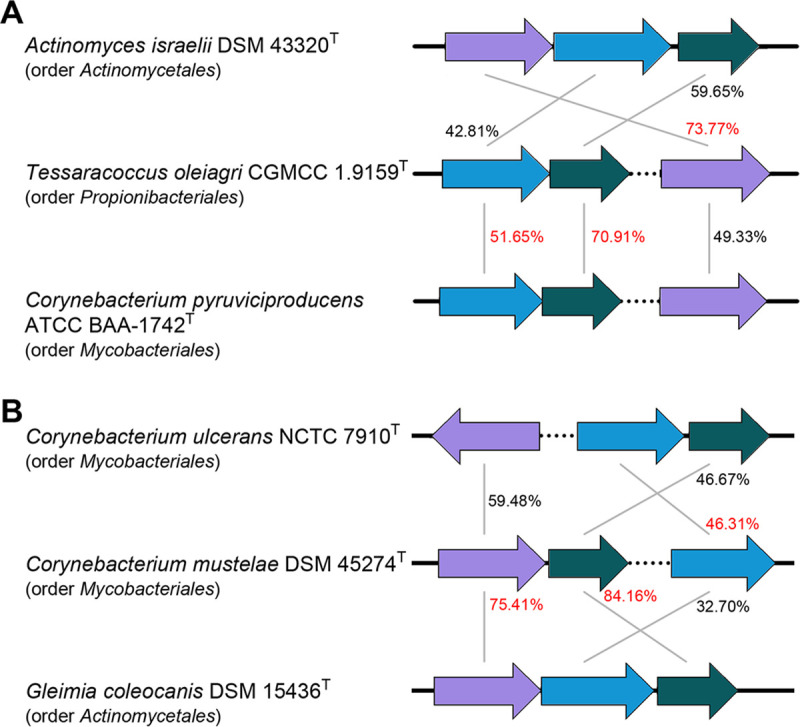
Sialic acids are present in humans and other metazoans, playing essential roles in physiological and pathological processes. Commensal and pathogenic bacteria have evolved the capacity to utilize sialic acids as nutrient and energy sources. However, in some actinobacteria, sialic acid catabolism (SAC) is associated with free-living populations. To unravel the distribution and evolutionary history of SAC in the phylum , we analyzed the presence and diversity of the putative SAC gene cluster () in 7,180 high-quality, nonredundant actinobacterial genomes that covered 1,969 species. The results showed that ∼13% of actinobacterial species had the potential to utilize sialic acids, with 45 species capable of anhydro-SAC, all except two of them through the canonical pathway. These species belonged to 20 orders and 81 genera, with ∼36% of them from four genera, , , , and . Moreover, ∼40% of the -positive species are free living. Phylogenetic analysis of the key genes, , , and , revealed a strong signal of horizontal gene transfer (HGT), accompanied with vertical inheritance and gene loss. This evolutionary pattern led to high diversity and differential distribution of among actinobacterial taxa and might cause the cluster to spread to some free-living species while losing in some host-associated species. The evolution of SAC in actinobacteria probably represents the evolution of certain kinds of noncore bacterial functions for environmental adaptation and lifestyle switch, in which HGT plays a dominant role. Sialic acids play essential roles in the physiology of humans and other metazoan animals, and microbial sialic acid catabolism (SAC) is one of the processes critical for pathogenesis. To date, microbial SAC is studied mainly in commensals and pathogens, while its distribution in free-living microbes and evolutionary pathway remain largely unexplored. Here, by examining all actinobacterial genomes available, we demonstrate that putative SAC is present in a small proportion of actinobacterial species, of which, however, ∼40% are free-living species. We also reveal remarkable difference in the distribution of SAC among actinobacterial taxa and high diversity of the putative SAC gene clusters. HGT plays a significant role in the evolution of SAC, accompanied with vertical inheritance and gene loss. Our results provide a comprehensive and systematic picture of the distribution and evolutionary history of SAC in actinobacteria, expanding the current knowledge on bacterial adaptation and diversification.
唾液酸存在于人类和其他后生动物中,在生理和病理过程中发挥着重要作用。共生菌和致病菌已经进化出利用唾液酸作为营养和能量来源的能力。然而,在一些放线菌中,唾液酸分解代谢(SAC)与自由生活种群有关。为了揭示 SAC 在门中的分布和进化历史,我们分析了 7180 个高质量、非冗余放线菌基因组中假定的 SAC 基因簇()的存在和多样性,这些基因组涵盖了 1969 个物种。结果表明,约 13%的放线菌物种具有利用唾液酸的潜力,其中 45 种能够进行无水 SAC,除了两种外,它们都是通过典型途径进行的。这些物种属于 20 个目和 81 个属,其中约 36%来自四个属,、、和。此外,约 40%的阳性物种是自由生活的。关键基因、、和的系统发育分析表明,存在强烈的水平基因转移(HGT)信号,同时伴随着垂直遗传和基因丢失。这种进化模式导致了 SAC 在放线菌分类群中的高度多样性和差异分布,可能导致该簇传播到一些自由生活的物种,而在一些宿主相关的物种中丢失。放线菌 SAC 的进化可能代表了某些非核心细菌功能的进化,以适应环境和生活方式的转变,其中 HGT 起着主导作用。 唾液酸在人类和其他后生动物的生理中起着至关重要的作用,微生物唾液酸分解代谢(SAC)是发病机制的关键过程之一。迄今为止,微生物 SAC 主要在共生菌和病原体中进行研究,而其在自由生活微生物中的分布和进化途径在很大程度上仍未得到探索。在这里,通过检查所有可用的放线菌基因组,我们证明了假定的 SAC 存在于一小部分放线菌物种中,然而,其中约 40%是自由生活的物种。我们还揭示了 SAC 在放线菌分类群中的分布存在显著差异,并且假定的 SAC 基因簇具有高度多样性。HGT 在 SAC 的进化中起着重要作用,伴随着垂直遗传和基因丢失。我们的研究结果提供了 SAC 在放线菌中的分布和进化历史的全面和系统的图片,扩展了细菌适应和多样化的现有知识。