Department of Social and Behavioral Sciences, Harvard T.H. Chan School of Public Health, Boston, MA, United States of America.
Apollo Telemedicine Networking Foundation, Chennai, Tamil Nadu, India.
PLoS One. 2022 Jan 13;17(1):e0261907. doi: 10.1371/journal.pone.0261907. eCollection 2022.
Telehealth can improve access to high-quality healthcare for rural populations in India. However, rural communities often have other needs, such as sanitation or employment, to benefit fully from telehealth offerings, highlighting a need for systems-level solutions. A Business of Humanity approach argues that innovative solutions to wicked problems like these require strategic decision-making that attends to a) humaneness, e.g., equity and safety and b) humankind, or the needs and potential of large and growing markets comprised of marginalized and low-income individuals. The approach is expected to improve economic performance and long-term value creation for partners, thus supporting sustainability.
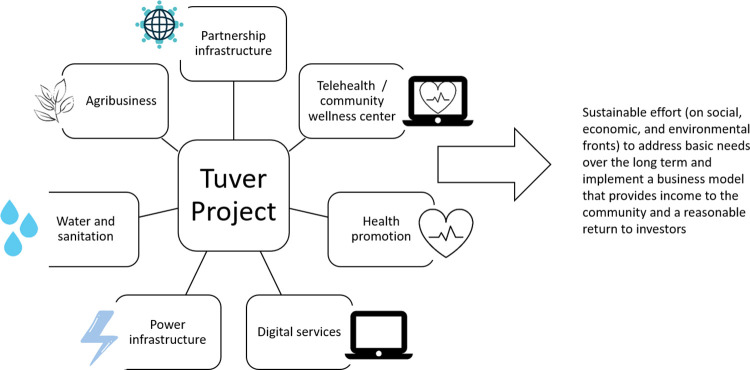
A demonstration project was conducted in Tuver, a rural and tribal village in Gujarat, India. The project included seven components: a partnership that emphasized power-sharing and complementary contributions; telehealth services; health promotion; digital services; power infrastructure; water and sanitation; and agribusiness. Core partners included the academic partner, local village leadership, a local development foundation, a telehealth provider, and a design-build contractor. This early process evaluation relies on administrative data, field notes, and project documentation and was analyzed using a case study approach.
Findings highlight the importance of taking a systems perspective and engaging inter-sectoral partners through alignment of values and goals. Additionally, the creation of a synergistic, health-promoting ecosystem offers potential to support telehealth services in the long-term. At the same time, engaging rural, tribal communities in the use of technological advances posed a challenge, though local staff and intermediaries were effective in bridging disconnects.
Overall, this early process evaluation highlights the promise and challenges of using a Business of Humanity approach for coordinated, sustainable community-level action to improve the health and well-being of marginalized communities.
远程医疗可以改善印度农村地区获得高质量医疗保健的机会。然而,农村社区通常还有其他需求,例如卫生或就业,才能充分受益于远程医疗服务,这凸显了需要系统层面的解决方案。人类商业方法认为,解决这些棘手问题的创新解决方案需要战略决策,既要考虑到 a)人道性,例如公平和安全,又要考虑到 b)人类,即由边缘化和低收入个人组成的庞大且不断增长的市场的需求和潜力。该方法有望提高合作伙伴的经济绩效和长期价值创造,从而支持可持续性。
在印度古吉拉特邦的图维尔(Tuver)进行了一个示范项目。该项目包括七个组成部分:强调权力共享和互补贡献的伙伴关系;远程医疗服务;健康促进;数字服务;电力基础设施;水和卫生设施;以及农业综合企业。核心合作伙伴包括学术合作伙伴、当地村庄领导、当地发展基金会、远程医疗提供商和设计-建造承包商。本早期过程评估依赖于行政数据、实地记录和项目文件,并使用案例研究方法进行分析。
研究结果强调了采取系统视角的重要性,并通过价值和目标的一致性来吸引跨部门合作伙伴。此外,创建一个协同的、促进健康的生态系统有潜力为远程医疗服务提供长期支持。与此同时,让农村、部落社区参与使用技术进步带来了挑战,尽管当地工作人员和中介机构在弥合差距方面非常有效。
总的来说,本早期过程评估强调了使用人类商业方法进行协调、可持续的社区层面行动以改善边缘化社区健康和福祉的前景和挑战。