
稀土氧化物的表观表面自由能受碳氢化合物吸附作用的支配。
The apparent surface free energy of rare earth oxides is governed by hydrocarbon adsorption.
作者信息
Oh Junho, Orejon Daniel, Park Wooyoung, Cha Hyeongyun, Sett Soumyadip, Yokoyama Yukihiro, Thoreton Vincent, Takata Yasuyuki, Miljkovic Nenad
机构信息
Department of Mechanical Science and Engineering, University of Illinois at Urbana-Champaign, Urbana, IL 61801, USA.
Department of Mechanical Engineering, BK21 FOUR ERICA-ACE Center, Hanyang University, Ansan, Gyeonggi 15588, Republic of Korea.
出版信息
iScience. 2021 Dec 25;25(1):103691. doi: 10.1016/j.isci.2021.103691. eCollection 2022 Jan 21.
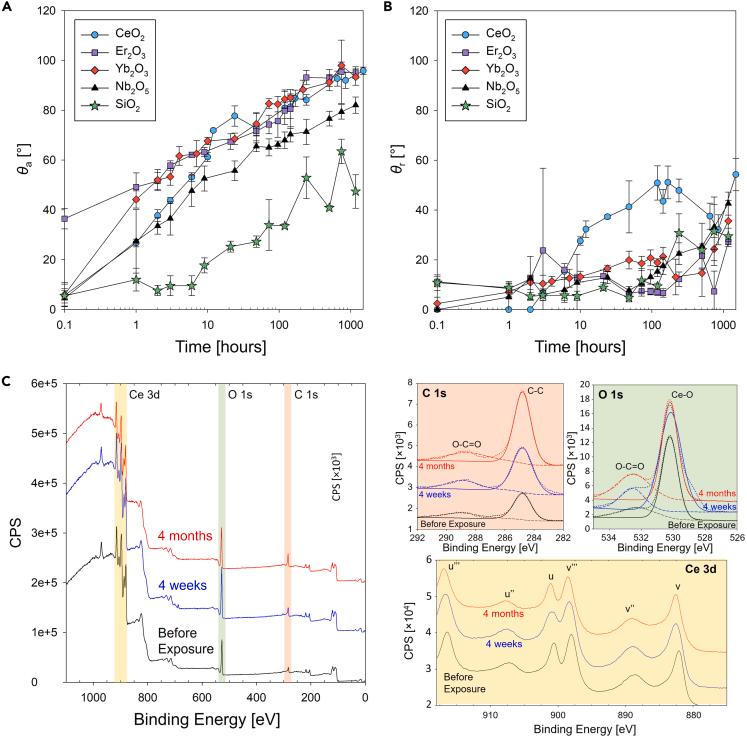
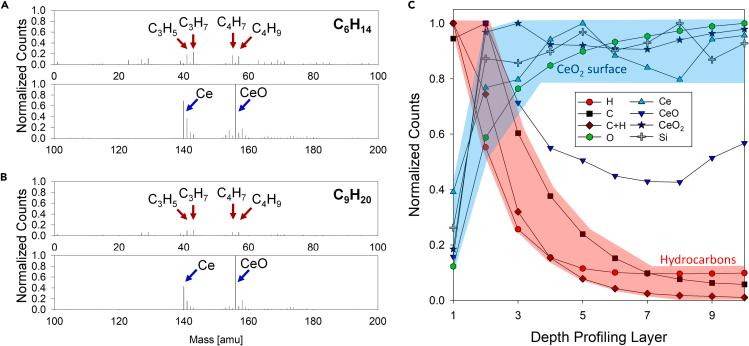
The surface free energy of rare earth oxides (REOs) has been debated during the last decade, with some reporting REOs to be intrinsically hydrophilic and others reporting hydrophobic. Here, we investigate the wettability and surface chemistry of pristine and smooth REO surfaces, conclusively showing that hydrophobicity stems from wettability transition due to volatile organic compound adsorption. We show that, for indoor ambient atmospheres and well-controlled saturated hydrocarbon atmospheres, the apparent advancing and receding contact angles of water increase with exposure time. We examined the surfaces comprehensively with multiple surface analysis techniques to confirm hydrocarbon adsorption and correlate it to wettability transition mechanisms. We demonstrate that both physisorption and chemisorption occur on the surface, with chemisorbed hydrocarbons promoting further physisorption due to their high affinity with similar hydrocarbon molecules. This study offers a better understanding of the intrinsic wettability of REOs and provides design guidelines for REO-based durable hydrophobic coatings.
在过去十年里,稀土氧化物(REOs)的表面自由能一直存在争议,一些研究报告称REOs本质上是亲水的,而另一些则报告其为疏水的。在此,我们研究了原始光滑REO表面的润湿性和表面化学性质,最终表明疏水性源于挥发性有机化合物吸附导致的润湿性转变。我们发现,对于室内环境大气和严格控制的饱和烃大气,水的表观前进和后退接触角会随着暴露时间增加。我们使用多种表面分析技术对表面进行了全面检查,以确认烃类吸附并将其与润湿性转变机制相关联。我们证明,物理吸附和化学吸附都发生在表面,化学吸附的烃类因其与相似烃分子的高亲和力而促进进一步的物理吸附。这项研究有助于更好地理解REOs的固有润湿性,并为基于REO的耐用疏水涂层提供设计指导。





 Zotero 插件