Rodriguez-Flores Juan L, Messai-Badji Radja, Robay Amal, Temanni Ramzi, Syed Najeeb, Markovic Monika, Al-Khayat Eiman, Qafoud Fatima, Nawaz Zafar, Badii Ramin, Al-Sarraj Yasser, Mbarek Hamdi, Al-Muftah Wadha, Alvi Muhammad, Rostami Mahboubeh R, Cruzado Juan Carlos Martinez, Mezey Jason G, Shakaki Alya Al, Malek Joel A, Greenblatt Matthew B, Fakhro Khalid A, Machaca Khaled, Al-Nabet Ajayeb, Afifi Nahla, Brooks Andrew, Ismail Said I, Althani Asmaa, Crystal Ronald G
Department of Genetic Medicine, Weill Cornell Medicine, New York, NY, USA.
Regeneron Genetics Center, Tarrytown, NY, USA.
NPJ Genom Med. 2022 Jan 19;7(1):3. doi: 10.1038/s41525-021-00270-0.
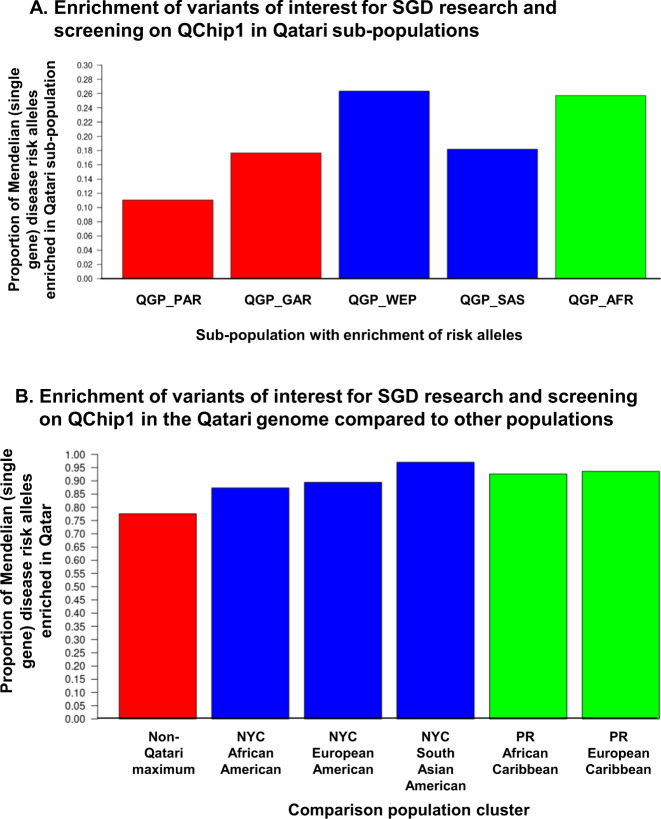
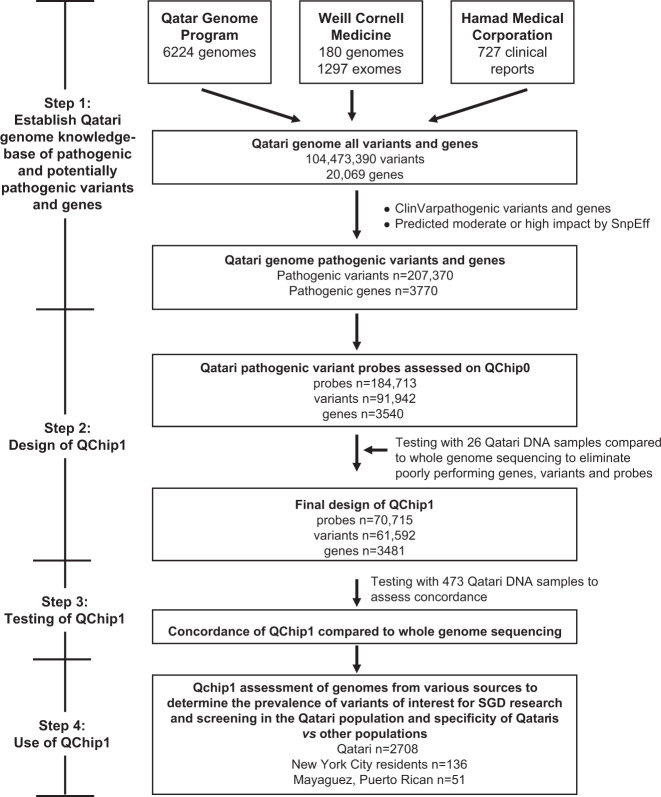
Risk genes for Mendelian (single-gene) disorders (SGDs) are consistent across populations, but pathogenic risk variants that cause SGDs are typically population-private. The goal was to develop "QChip1," an inexpensive genotyping microarray to comprehensively screen newborns, couples, and patients for SGD risk variants in Qatar, a small nation on the Arabian Peninsula with a high degree of consanguinity. Over 10 variants in 8445 Qatari were identified for inclusion in a genotyping array containing 165,695 probes for 83,542 known and potentially pathogenic variants in 3438 SGDs. QChip1 had a concordance with whole-genome sequencing of 99.1%. Testing of QChip1 with 2707 Qatari genomes identified 32,674 risk variants, an average of 134 pathogenic alleles per Qatari genome. The most common pathogenic variants were those causing homocystinuria (1.12% risk allele frequency), and Stargardt disease (2.07%). The majority (85%) of Qatari SGD pathogenic variants were not present in Western populations such as European American, South Asian American, and African American in New York City and European and Afro-Caribbean in Puerto Rico; and only 50% were observed in a broad collection of data across the Greater Middle East including Kuwait, Iran, and United Arab Emirates. This study demonstrates the feasibility of developing accurate screening tools to identify SGD risk variants in understudied populations, and the need for ancestry-specific SGD screening tools.
孟德尔(单基因)疾病(SGDs)的风险基因在不同人群中是一致的,但导致SGDs的致病风险变异通常是特定于某一人群的。目标是开发一种名为“QChip1”的低成本基因分型微阵列,用于全面筛查卡塔尔新生儿、夫妇和患者是否存在SGDs风险变异。卡塔尔是阿拉伯半岛上的一个小国,近亲结婚程度很高。在8445名卡塔尔人中鉴定出了10多个变异,将其纳入一个基因分型阵列,该阵列包含针对3438种SGDs中83542个已知和潜在致病变异的165695个探针。QChip1与全基因组测序的一致性为99.1%。用2707个卡塔尔基因组对QChip1进行测试,共鉴定出32674个风险变异,每个卡塔尔基因组平均有134个致病等位基因。最常见的致病变异是导致同型胱氨酸尿症(风险等位基因频率为1.12%)和斯特格特氏病(2.07%)的变异。卡塔尔SGDs致病变异中的大多数(85%)在西方人群中不存在,如纽约市的欧美裔、南亚裔和非裔美国人,以及波多黎各的欧洲裔和非裔加勒比人;在包括科威特、伊朗和阿联酋在内的大中东地区的广泛数据集中,只有50%的变异被观察到。这项研究证明了开发准确的筛查工具以识别未充分研究人群中SGDs风险变异的可行性,以及对特定血统的SGDs筛查工具的需求。