Jia Yuheng, Luosang Gaden, Li Yiming, Wang Jianyong, Li Pengyu, Xiong Tianyuan, Li Yijian, Liao Yanbiao, Zhao Zhengang, Peng Yong, Feng Yuan, Jiang Weili, Li Wenjian, Zhang Xinpei, Yi Zhang, Chen Mao
Department of Cardiology, West China Hospital, Sichuan University, Chengdu, Sichuan, People's Republic of China.
Machine Intelligence Laboratory, College of Computer Science, Sichuan University, Chengdu, Sichuan, People's Republic of China.
Clin Epidemiol. 2022 Jan 12;14:9-20. doi: 10.2147/CLEP.S333147. eCollection 2022.
Late major bleeding is one of the main complications after transcatheter aortic valve replacement (TAVR). We aimed to develop a risk prediction model based on deep learning to predict major or life-threatening bleeding complications (MLBCs) after TAVR.
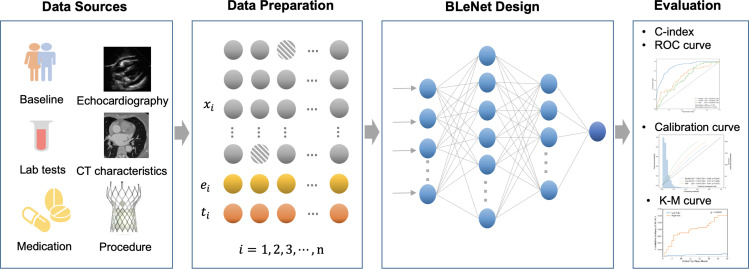
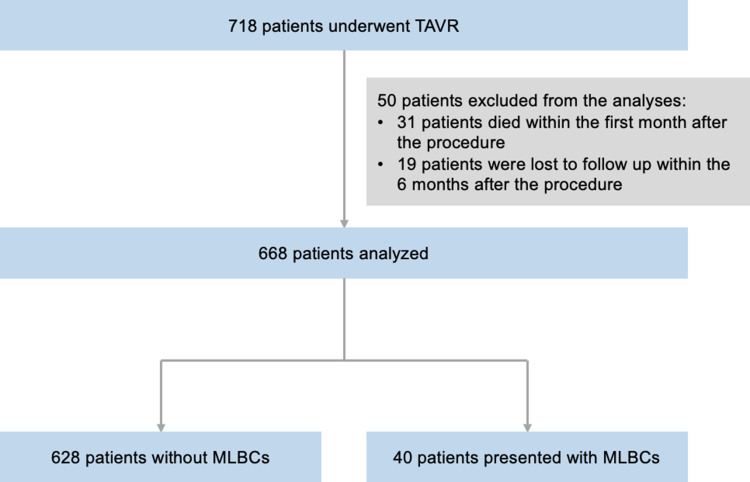
This was a retrospective study including TAVR patients from West China Hospital of Sichuan University Transcatheter Aortic Valve Replacement Registry (ChiCTR2000033419) between April 17, 2012 and May 27, 2020. A deep learning-based model named BLeNet was developed with 56 features covering baseline, procedural, and post-procedural characteristics. The model was validated with the bootstrap method and evaluated using Harrell's concordance index (c-index), receiver operating characteristics (ROC) curve, calibration curve, and Kaplan-Meier estimate. Captum interpretation library was applied to identify feature importance. The BLeNet model was compared with the traditional Cox proportional hazard (Cox-PH) model and the random survival forest model in the metrics mentioned above.
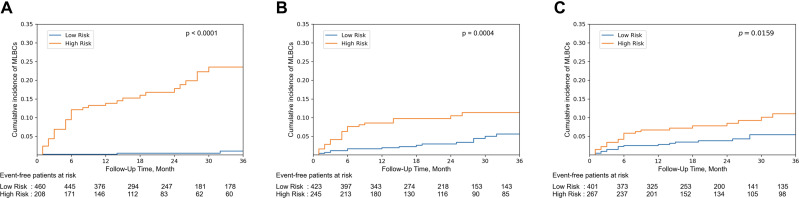
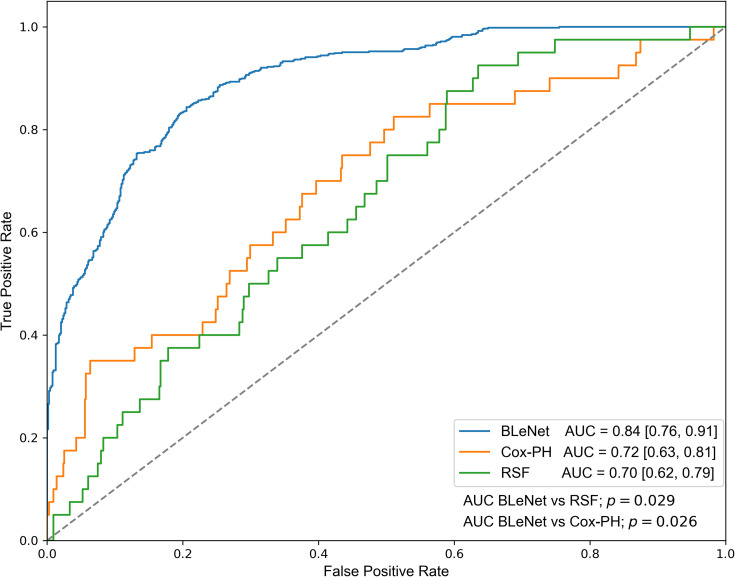
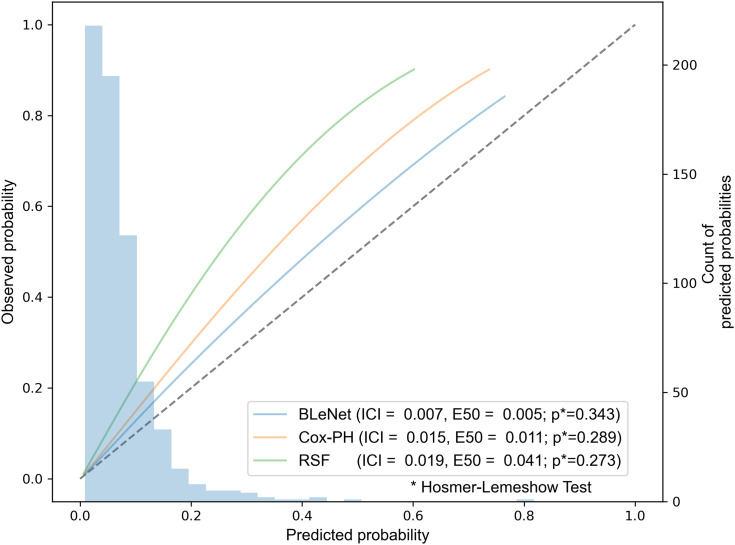
The BLeNet model outperformed the Cox-PH and random survival forest models significantly in discrimination [optimism-corrected c-index of BLeNet vs Cox-PH vs random survival forest: 0.81 (95% CI: 0.79-0.92) vs 0.72 (95% CI: 0.63-0.77) vs 0.70 (95% CI: 0.61-0.74)] and calibration (integrated calibration index of BLeNet vs Cox-PH vs random survival forest: 0.007 vs 0.015 vs 0.019). In Kaplan-Meier analysis, BLeNet model had great performance in stratifying high- and low-bleeding risk patients (p < 0.0001).
Deep learning is a feasible way to build prediction models concerning TAVR prognosis. A dedicated bleeding risk prediction model was developed for TAVR patients to facilitate well-informed clinical decisions.
晚期严重出血是经导管主动脉瓣置换术(TAVR)后的主要并发症之一。我们旨在开发一种基于深度学习的风险预测模型,以预测TAVR术后的严重或危及生命的出血并发症(MLBCs)。
这是一项回顾性研究,纳入了2012年4月17日至2020年5月27日期间来自四川大学华西医院经导管主动脉瓣置换注册研究(ChiCTR2000033419)的TAVR患者。开发了一种名为BLeNet的基于深度学习的模型,该模型具有56个涵盖基线、手术过程和术后特征的特征。该模型采用自助法进行验证,并使用Harrell一致性指数(c指数)、受试者工作特征(ROC)曲线、校准曲线和Kaplan-Meier估计进行评估。应用Captum解释库来确定特征重要性。在上述指标方面,将BLeNet模型与传统的Cox比例风险(Cox-PH)模型和随机生存森林模型进行比较。
在区分能力方面,BLeNet模型显著优于Cox-PH模型和随机生存森林模型[BLeNet与Cox-PH与随机生存森林的乐观校正c指数:0.81(95%CI:0.79-0.92)对0.72(95%CI:0.63-0.77)对0.70(95%CI:0.61-0.74)],在校准方面也是如此[BLeNet与Cox-PH与随机生存森林的综合校准指数:0.007对0.015对0.019]。在Kaplan-Meier分析中,BLeNet模型在对高出血风险和低出血风险患者进行分层方面表现出色(p<0.0001)。
深度学习是构建有关TAVR预后预测模型的可行方法。为TAVR患者开发了一个专门的出血风险预测模型,以促进明智地做出临床决策。