• 文献检索
  • 文档翻译
  • 深度研究
  • 学术资讯
  • Suppr Zotero 插件Zotero 插件
  • 邀请有礼
  • 套餐&价格
  • 历史记录
应用&插件
Suppr Zotero 插件Zotero 插件浏览器插件Mac 客户端Windows 客户端微信小程序
定价
高级版会员购买积分包购买API积分包
服务
文献检索文档翻译深度研究API 文档MCP 服务
关于我们
关于 Suppr公司介绍联系我们用户协议隐私条款
关注我们

Suppr 超能文献

核心技术专利:CN118964589B侵权必究
粤ICP备2023148730 号-1Suppr @ 2026

文献检索

告别复杂PubMed语法,用中文像聊天一样搜索,搜遍4000万医学文献。AI智能推荐,让科研检索更轻松。

立即免费搜索

文件翻译

保留排版,准确专业,支持PDF/Word/PPT等文件格式,支持 12+语言互译。

免费翻译文档

深度研究

AI帮你快速写综述,25分钟生成高质量综述,智能提取关键信息,辅助科研写作。

立即免费体验

肺炎或败血症住院后,入住康复护理院 30 天内再次住院的原因和时间。

Causes and timing of 30-day rehospitalization from skilled nursing facilities after a hospital admission for pneumonia or sepsis.

机构信息

Department of Health Services, Policy, and Practice, Brown University School of Public Health, Providence, RI, United States of America.

Center for Gerontology and Healthcare Research, Brown University School of Public Health, Providence, RI, United States of America.

出版信息

PLoS One. 2022 Jan 20;17(1):e0260664. doi: 10.1371/journal.pone.0260664. eCollection 2022.

DOI:10.1371/journal.pone.0260664
PMID:35051181
原文链接:https://pmc.ncbi.nlm.nih.gov/articles/PMC8775208/
Abstract

BACKGROUND

Pneumonia and sepsis are among the most common causes of hospitalization in the United States and often result in discharges to a skilled nursing facility (SNF) for rehabilitation. We described the timing and most common causes of 30-day unplanned hospital readmission following an index hospitalization for pneumonia or sepsis.

METHODS AND FINDINGS

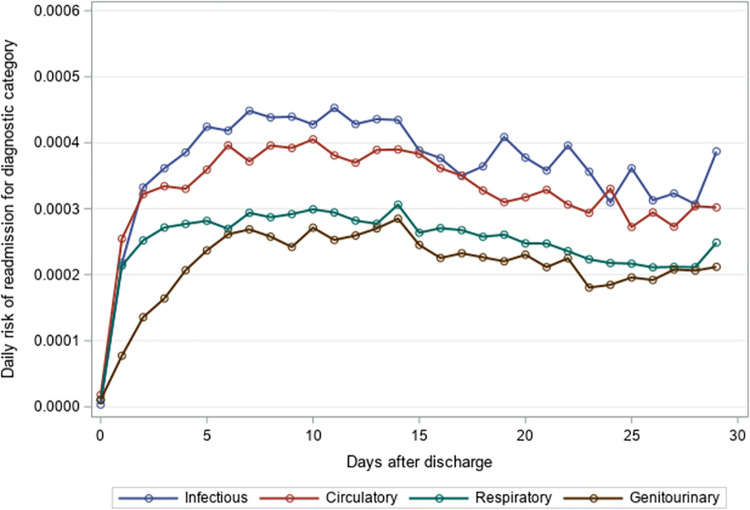
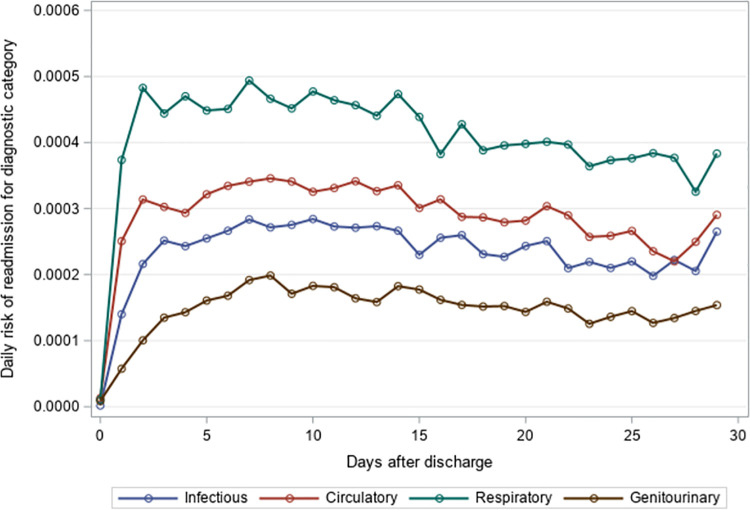
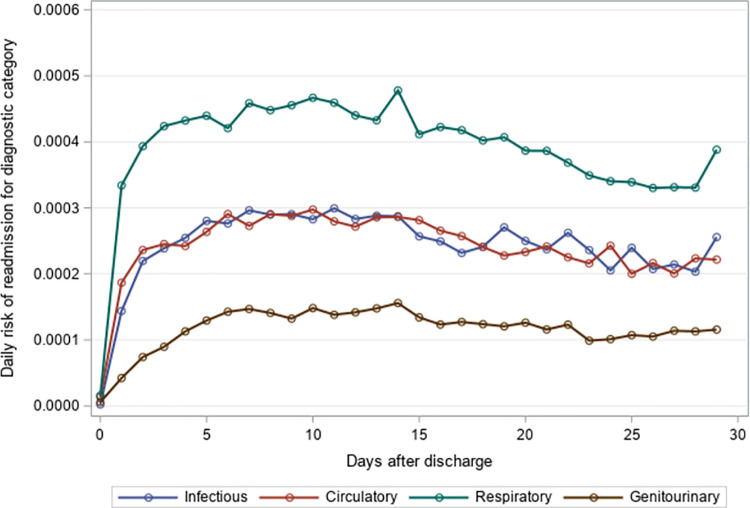
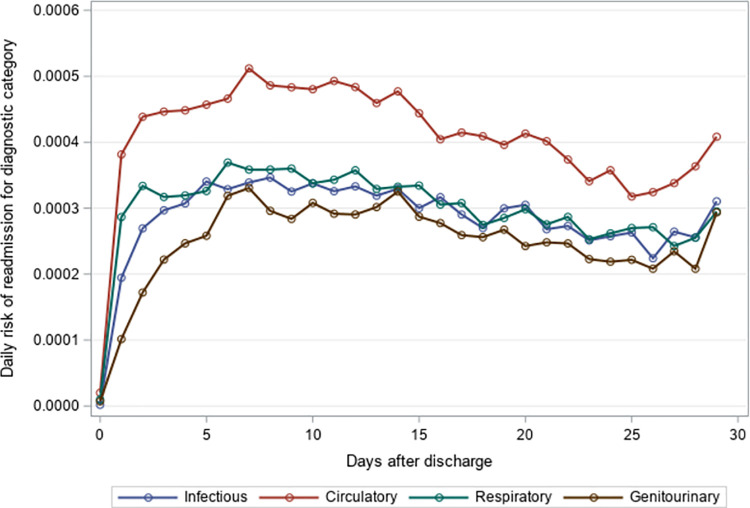
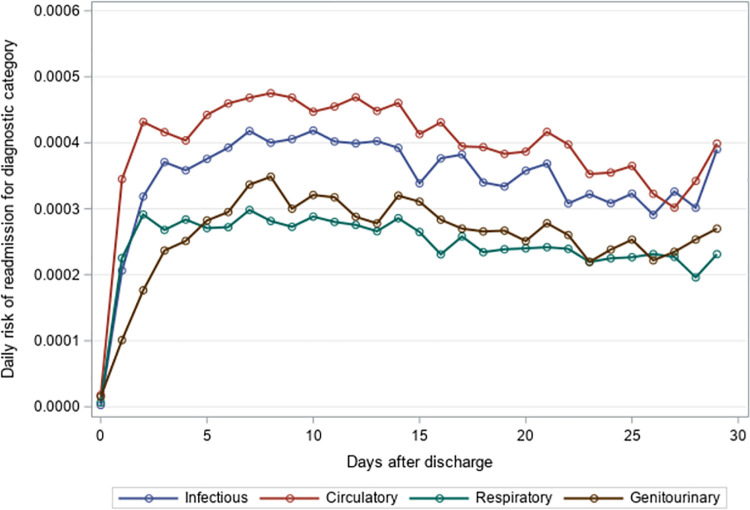
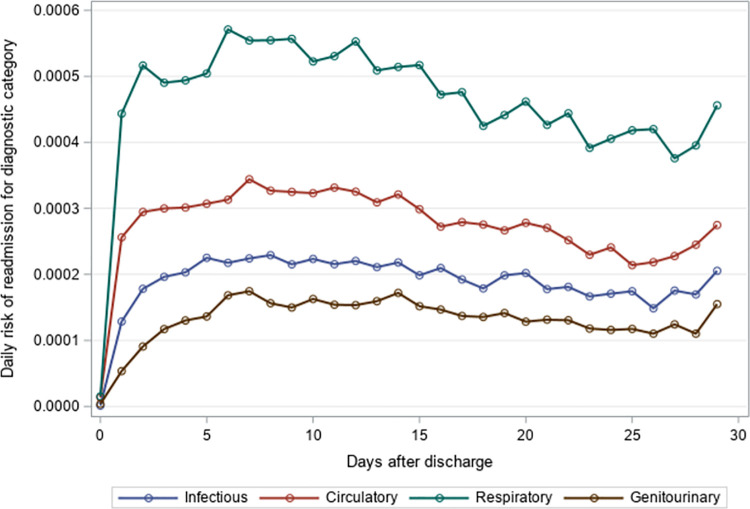
This national retrospective cohort study included adults ≥65 years who were hospitalized for pneumonia or sepsis and were discharged to a SNF between July 1, 2012 and July 4, 2015. We quantified the ten most common 30-day unplanned readmission diagnoses and estimated the daily risk of first unplanned rehospitalization for four causes of readmission (circulatory, infectious, respiratory, and genitourinary). The index hospitalization was pneumonia for 92,153 SNF stays and sepsis for 452,254 SNF stays. Of these SNF stays, 20.9% and 25.9%, respectively, resulted in a 30-day unplanned readmission. Overall, septicemia was the single most common readmission diagnosis for residents with an index hospitalization for pneumonia (16.7% of 30-day readmissions) and sepsis (22.4% of 30-day readmissions). The mean time to unplanned readmission was approximately 14 days overall. Respiratory causes displayed the highest daily risk of rehospitalization following index hospitalizations for pneumonia, while circulatory and infectious causes had the highest daily risk of rehospitalization following index hospitalizations for sepsis. The day of highest risk for readmission occurred within two weeks of the index hospitalization discharge, but the readmission risk persisted across the 30-day follow-up.

CONCLUSION

Among older adults discharged to SNFs following a hospitalization for pneumonia or sepsis, hospital readmissions for infectious, circulatory, respiratory, and genitourinary causes occurred frequently throughout the 30-day post-discharge period. Our data suggests further study is needed, perhaps on the value of closer monitoring in SNFs post-hospital discharge and improved communication between hospitals and SNFs, to reduce the risk of potentially preventable hospital readmissions.

摘要

背景

肺炎和败血症是美国最常见的住院原因之一,经常导致患者出院到康复护理机构(SNF)接受康复治疗。我们描述了因肺炎或败血症住院后 30 天内计划外再次住院的时间和最常见原因。

方法和发现

这是一项全国性回顾性队列研究,纳入了年龄≥65 岁、因肺炎或败血症住院并于 2012 年 7 月 1 日至 2015 年 7 月 4 日出院到 SNF 的患者。我们量化了 30 天内计划外再次住院的 10 种最常见诊断,并估计了四种再入院原因(循环系统、感染、呼吸系统和泌尿生殖系统)首次无计划再入院的日风险。索引住院为肺炎的 SNF 住院 92153 例,败血症的 SNF 住院 452254 例。这些 SNF 住院中,分别有 20.9%和 25.9%导致 30 天内计划外再次住院。总的来说,败血症是肺炎 SNF 住院患者(肺炎 30 天再入院的 16.7%)和败血症 SNF 住院患者(败血症 30 天再入院的 22.4%)的单一最常见再入院诊断。无计划再入院的平均时间约为 14 天。与肺炎索引住院相比,呼吸系统原因导致再住院的日风险最高,而与败血症索引住院相比,循环系统和感染原因导致再住院的日风险最高。再入院的最高风险日发生在索引住院出院后两周内,但再入院风险在 30 天随访期间持续存在。

结论

在因肺炎或败血症住院后出院到 SNF 的老年人中,因感染、循环、呼吸和泌尿生殖系统原因导致的医院再次入院在出院后 30 天内经常发生。我们的数据表明,需要进一步研究,也许需要研究在 SNF 出院后更密切监测和医院与 SNF 之间更好沟通的价值,以降低潜在可预防的医院再入院的风险。
https://cdn.ncbi.nlm.nih.gov/pmc/blobs/2272/8775208/ea02ee8be11c/pone.0260664.g006.jpg
https://cdn.ncbi.nlm.nih.gov/pmc/blobs/2272/8775208/20cd0a0b85fa/pone.0260664.g001.jpg
https://cdn.ncbi.nlm.nih.gov/pmc/blobs/2272/8775208/a670a2eb6708/pone.0260664.g002.jpg
https://cdn.ncbi.nlm.nih.gov/pmc/blobs/2272/8775208/39804684f8d8/pone.0260664.g003.jpg
https://cdn.ncbi.nlm.nih.gov/pmc/blobs/2272/8775208/408cf7a709ca/pone.0260664.g004.jpg
https://cdn.ncbi.nlm.nih.gov/pmc/blobs/2272/8775208/4aa52a59952a/pone.0260664.g005.jpg
https://cdn.ncbi.nlm.nih.gov/pmc/blobs/2272/8775208/ea02ee8be11c/pone.0260664.g006.jpg
https://cdn.ncbi.nlm.nih.gov/pmc/blobs/2272/8775208/20cd0a0b85fa/pone.0260664.g001.jpg
https://cdn.ncbi.nlm.nih.gov/pmc/blobs/2272/8775208/a670a2eb6708/pone.0260664.g002.jpg
https://cdn.ncbi.nlm.nih.gov/pmc/blobs/2272/8775208/39804684f8d8/pone.0260664.g003.jpg
https://cdn.ncbi.nlm.nih.gov/pmc/blobs/2272/8775208/408cf7a709ca/pone.0260664.g004.jpg
https://cdn.ncbi.nlm.nih.gov/pmc/blobs/2272/8775208/4aa52a59952a/pone.0260664.g005.jpg
https://cdn.ncbi.nlm.nih.gov/pmc/blobs/2272/8775208/ea02ee8be11c/pone.0260664.g006.jpg

相似文献

1
Causes and timing of 30-day rehospitalization from skilled nursing facilities after a hospital admission for pneumonia or sepsis.肺炎或败血症住院后,入住康复护理院 30 天内再次住院的原因和时间。
PLoS One. 2022 Jan 20;17(1):e0260664. doi: 10.1371/journal.pone.0260664. eCollection 2022.
2
Variation in Postsepsis Readmission Patterns: A Cohort Study of Veterans Affairs Beneficiaries.脓毒症后再入院模式的差异:一项针对退伍军人事务部受益人的队列研究。
Ann Am Thorac Soc. 2017 Feb;14(2):230-237. doi: 10.1513/AnnalsATS.201605-398OC.
3
High Risk of Readmission After THA Regardless of Functional Status in Patients Discharged to Skilled Nursing Facility.入住专业护理机构的患者,无论功能状态如何,全髋关节置换术后再入院风险均高。
Clin Orthop Relat Res. 2024 Jul 1;482(7):1185-1192. doi: 10.1097/CORR.0000000000002950. Epub 2024 Jan 16.
4
Home Health Care After Skilled Nursing Facility Discharge Following Heart Failure Hospitalization.心力衰竭住院后出院到专业护理机构后的家庭保健。
J Am Geriatr Soc. 2020 Jan;68(1):96-102. doi: 10.1111/jgs.16179. Epub 2019 Oct 11.
5
Risk of Readmission After Discharge From Skilled Nursing Facilities Following Heart Failure Hospitalization: A Retrospective Cohort Study.心力衰竭住院后从熟练护理设施出院后的再入院风险:一项回顾性队列研究。
J Am Med Dir Assoc. 2019 Apr;20(4):432-437. doi: 10.1016/j.jamda.2019.01.135.
6
Functional Status Is Associated With 30-Day Potentially Preventable Readmissions Following Skilled Nursing Facility Discharge Among Medicare Beneficiaries.在医疗保险受益人群中,从熟练护理机构出院后 30 天内潜在可预防的再入院与功能状态相关。
J Am Med Dir Assoc. 2018 Apr;19(4):348-354.e4. doi: 10.1016/j.jamda.2017.12.003. Epub 2018 Jan 19.
7
The Contribution of Skilled Nursing Facilities to Hospitals' Readmission Rate.专业护理机构对医院再入院率的影响
Health Serv Res. 2017 Apr;52(2):656-675. doi: 10.1111/1475-6773.12507. Epub 2016 May 18.
8
Use of a Computerized Algorithm to Evaluate the Proportion and Causes of Potentially Preventable Readmissions Among Patients Discharged to Skilled Nursing Facilities.使用计算机算法评估出院至护理机构患者中潜在可预防再入院的比例和原因。
J Am Med Dir Assoc. 2021 May;22(5):1060-1066. doi: 10.1016/j.jamda.2020.10.007. Epub 2020 Nov 24.
9
Potentially Avoidable Readmissions of Patients Discharged to Post-Acute Care: Perspectives of Hospital and Skilled Nursing Facility Staff.转入急性后期护理机构的患者中潜在可避免的再入院情况:医院及专业护理机构工作人员的观点
J Am Geriatr Soc. 2017 Feb;65(2):269-276. doi: 10.1111/jgs.14557. Epub 2016 Dec 16.
10
Association between skilled nursing facility quality indicators and hospital readmissions.专业护理机构质量指标与医院再入院之间的关联。
JAMA. 2014 Oct 15;312(15):1542-51. doi: 10.1001/jama.2014.13513.

引用本文的文献

1
Impact of skilled nursing facility discharge on inpatient oncology quality outcomes.熟练护理机构出院对住院肿瘤学质量结果的影响。
JNCI Cancer Spectr. 2025 Apr 30;9(3). doi: 10.1093/jncics/pkaf055.

本文引用的文献

1
Association Between Nursing Home Crowding and COVID-19 Infection and Mortality in Ontario, Canada.养老院拥挤与加拿大安大略省 COVID-19 感染和死亡率的关系。
JAMA Intern Med. 2021 Feb 1;181(2):229-236. doi: 10.1001/jamainternmed.2020.6466.
2
Nursing Home Design and COVID-19: Balancing Infection Control, Quality of Life, and Resilience.养老院设计与 COVID-19:平衡感染控制、生活质量和弹性。
J Am Med Dir Assoc. 2020 Nov;21(11):1519-1524. doi: 10.1016/j.jamda.2020.09.005.
3
Geriatric syndrome risk factors among hospitalized postacute Medicare patients.
住院后急性期 Medicare 患者老年综合征风险因素。
Am J Manag Care. 2020 Oct 1;26(10):e319-e326. doi: 10.37765/ajmc.2020.88505.
4
Sepsis trends: increasing incidence and decreasing mortality, or changing denominator?脓毒症趋势:发病率上升与死亡率下降,还是分母变化?
J Thorac Dis. 2020 Feb;12(Suppl 1):S89-S100. doi: 10.21037/jtd.2019.12.51.
5
Sepsis Among Medicare Beneficiaries: 1. The Burdens of Sepsis, 2012-2018.医疗保险受益人群中的败血症:1. 2012-2018 年败血症负担。
Crit Care Med. 2020 Mar;48(3):276-288. doi: 10.1097/CCM.0000000000004224.
6
Rate and risk factors for rehospitalisation in sepsis survivors: systematic review and meta-analysis.脓毒症幸存者再入院的比率和风险因素:系统评价和荟萃分析。
Intensive Care Med. 2020 Apr;46(4):619-636. doi: 10.1007/s00134-019-05908-3. Epub 2020 Jan 23.
7
Changes in coding of pneumonia and impact on the Hospital Readmission Reduction Program.肺炎编码的变化及其对医院再入院率降低计划的影响。
Health Serv Res. 2019 Dec;54(6):1326-1334. doi: 10.1111/1475-6773.13207. Epub 2019 Oct 10.
8
Quality Indicators for Appropriate Outpatient Parenteral Antimicrobial Therapy in Adults: A Systematic Review and RAND-modified Delphi Procedure.成人门诊患者适宜的肠外抗菌治疗质量指标:系统评价和 RAND 改良 Delphi 程序。
Clin Infect Dis. 2020 Mar 3;70(6):1075-1082. doi: 10.1093/cid/ciz362.
9
The Surviving Sepsis Campaign Bundle: 2018 Update.拯救脓毒症运动集束治疗:2018年更新版
Crit Care Med. 2018 Jun;46(6):997-1000. doi: 10.1097/CCM.0000000000003119.
10
Can Sepsis Be Detected in the Nursing Home Prior to the Need for Hospital Transfer?养老院中是否可以在需要转院之前检测出脓毒症?
J Am Med Dir Assoc. 2018 Jun;19(6):492-496.e1. doi: 10.1016/j.jamda.2018.02.001. Epub 2018 Mar 26.