Kahana Rotem, Kremer Shai, Dekel Dahari Merav, Kodesh Einat
Maccabi Healthcare Services, Southern Region, Beer-Sheva 8489312, Israel.
Physical Therapy Department, University of Haifa, Haifa 3498838, Israel.
Children (Basel). 2021 Dec 29;9(1):18. doi: 10.3390/children9010018.
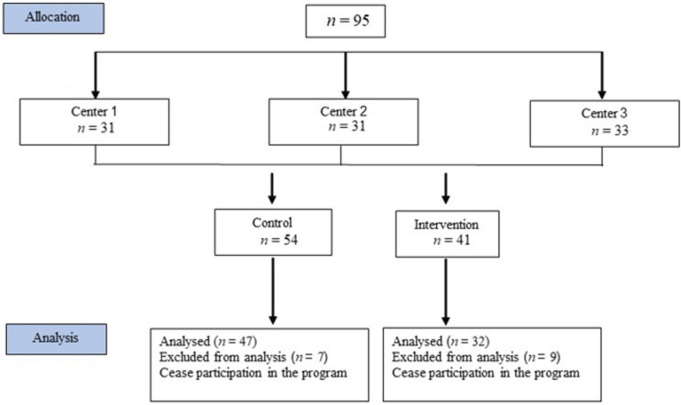
Children with overweight/obese (OW/OB) have low physical activity (PA) levels and excessive daily screen times. Although access to personal smartphones may complicate restricting sedentary screen time, these devices may be used to promote PA and improve fitness. Therefore, we aim to examine the impact of incorporating an exergame application (APP) into an existing weight management program on BMI, physical activity, fitness levels, and attitude toward PA among OW/OB children. Seventy-nine children (51% girls), median age 10 years, completed an established 5-month weight management program. The intervention included structured PA sessions (2/week), nutritional, and behavioral counseling. An exergame app was installed on the smartphones of the intervention group (APP, = 32). BMI, physical fitness, PA level, and attitudes toward PA were assessed before and after the intervention. BMI decreased ( < 0.0001) in both groups by 0.67 kg/m (Q1, Q3: -1.36-0.12). There were improvements in more fitness components in the APP group than controls, with significantly greater improvements in aerobic fitness ( = 0.038), speed and agility ( = 0.01), and leg strength endurance ( = 0.05) compared to controls. PA levels increased similarly in both groups during the intervention period. The incorporation of an exergame application leads to more significant improvements in fitness components. These findings support the use of exergame apps to improve fitness in OW/OB children.
超重/肥胖(OW/OB)儿童的身体活动(PA)水平较低,且每日屏幕使用时间过长。尽管使用个人智能手机可能会使限制久坐屏幕时间变得复杂,但这些设备可用于促进身体活动并改善健康状况。因此,我们旨在研究将一款健身游戏应用程序(APP)纳入现有的体重管理计划对OW/OB儿童的体重指数(BMI)、身体活动、健康水平以及对身体活动的态度的影响。79名儿童(51%为女孩),中位年龄10岁,完成了一个既定的为期5个月的体重管理计划。干预措施包括有组织的身体活动课程(每周2次)、营养和行为咨询。在干预组(APP组,n = 32)的智能手机上安装了一款健身游戏应用程序。在干预前后评估了BMI、身体素质、身体活动水平以及对身体活动的态度。两组的BMI均下降(P < 0.0001),下降了0.67 kg/m²(四分位数间距:-1.36 - 0.12)。与对照组相比,APP组在更多的健康成分方面有改善,有氧健身(P = 0.038)、速度和敏捷性(P = 0.01)以及腿部力量耐力(P = 0.05)的改善明显更大。在干预期内,两组的身体活动水平均有类似增加。纳入健身游戏应用程序能使健康成分得到更显著的改善。这些发现支持使用健身游戏应用程序来改善OW/OB儿童的健康状况。