Gębska Magdalena, Dalewski Bartosz, Pałka Łukasz, Kołodziej Łukasz, Sobolewska Ewa
Department of Rehabilitation Musculoskeletal System, Pomeranian Medical University, 70-204 Szczecin, Poland.
Department of Dental Prosthetics, Pomeranian Medical University, 70-204 Szczecin, Poland.
Brain Sci. 2021 Dec 27;12(1):28. doi: 10.3390/brainsci12010028.
a type D personality is a factor in a person's susceptibility to general mental stress, especially during the COVID-19 pandemic. Although many studies were conducted on the relationships among stressful situations, an individual's personality, depression, and the occurrence of various diseases, e.g., cardiovascular disease or cancer, there are no analogous data on people with temporomandibular disorders (TMDs).
the assessment of TMDs and depression symptoms in students with type D personality.
the research was carried out with the participation of 240 physiotherapy students. The study group (G1) consisted of 120 participants with type D personalities, the control group (G2) consisted of the same number of participants, without "stress" personalities. All subjects were assessed for the occurrence of TMD symptoms, as well as for depression and anxiety symptoms, using the Beck Depression Inventory (BDI), based on the proprietary questionnaire.
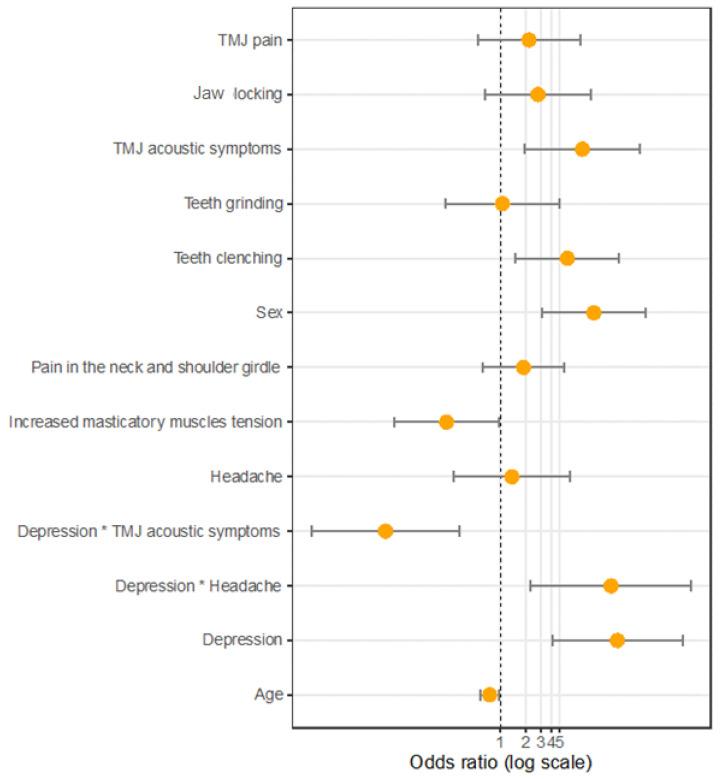
in students with type D personality symptoms, TMDs occurred significantly more often and in greater number ( = 0.00) than in those without stress personalities. The exception was the symptom of increased muscle tension, which showed no statistical difference ( = 0.22). Among the 240 respondents, depression was found in 128 people (53.3%). In the group of students with type D personalities, depression was significantly more frequent than in the group without type D personalities ( = 0.00). In participants with depression, TMD symptoms were more common, i.e., headaches, neck, and shoulder girdle pain, TMJ acoustic symptoms, increased masticatory muscle tension, teeth clenching, and teeth grinding. There was no significant difference between the incidence of depression and TMJ pain and jaw locking. There was a significant interaction between the occurrence of headaches and acoustic symptoms and the occurrence of depression. For headache and depression interactions, the OR was >1; based on the results, we may assume that a headache depends more on the occurrence of depression rather than it being a symptom of a TMJ disorder in people with type D personalities.
type D personality and depression may contribute to the development of TMD symptoms.
D型人格是一个人易受一般精神压力影响的因素,尤其是在新冠疫情期间。尽管针对压力情境、个体人格、抑郁以及各种疾病(如心血管疾病或癌症)的发生之间的关系进行了许多研究,但关于颞下颌关节紊乱症(TMD)患者却没有类似的数据。
评估D型人格学生的颞下颌关节紊乱症和抑郁症状。
该研究在240名物理治疗专业学生的参与下进行。研究组(G1)由120名具有D型人格的参与者组成,对照组(G2)由相同数量、无“压力”人格的参与者组成。使用贝克抑郁量表(BDI),基于专有问卷,对所有受试者的颞下颌关节紊乱症症状以及抑郁和焦虑症状进行评估。
有D型人格症状的学生中,颞下颌关节紊乱症的发生频率和数量显著高于无压力人格的学生(P = 0.00)。肌肉紧张增加这一症状除外,其无统计学差异(P = 0.22)。在240名受访者中,有128人(53.3%)存在抑郁。在有D型人格的学生组中,抑郁明显比无D型人格的学生组更频繁(P = 0.00)。在有抑郁的参与者中,颞下颌关节紊乱症症状更常见,即头痛、颈部和肩带疼痛、颞下颌关节声学症状、咀嚼肌紧张增加、紧咬牙和磨牙。抑郁的发生率与颞下颌关节疼痛和关节绞锁之间无显著差异。头痛和声学症状的发生与抑郁的发生之间存在显著交互作用。对于头痛与抑郁的交互作用,比值比大于1;基于这些结果,我们可以假设,在有D型人格的人中,头痛更多地取决于抑郁的发生,而不是颞下颌关节紊乱症的症状。
D型人格和抑郁可能导致颞下颌关节紊乱症症状的发展。