Doctorado en Genética Humana, Departamento de Biología Molecular y Genómica, Universidad de Guadalajara, Guadalajara 44340, Mexico.
Laboratorio de Inmunodeficiencias y Retrovirus Humanos, Centro de Investigación Biomédica de Occidente, Instituto Mexicano del Seguro Social, Guadalajara 44340, Mexico.
Int J Mol Sci. 2022 Jan 7;23(2):643. doi: 10.3390/ijms23020643.
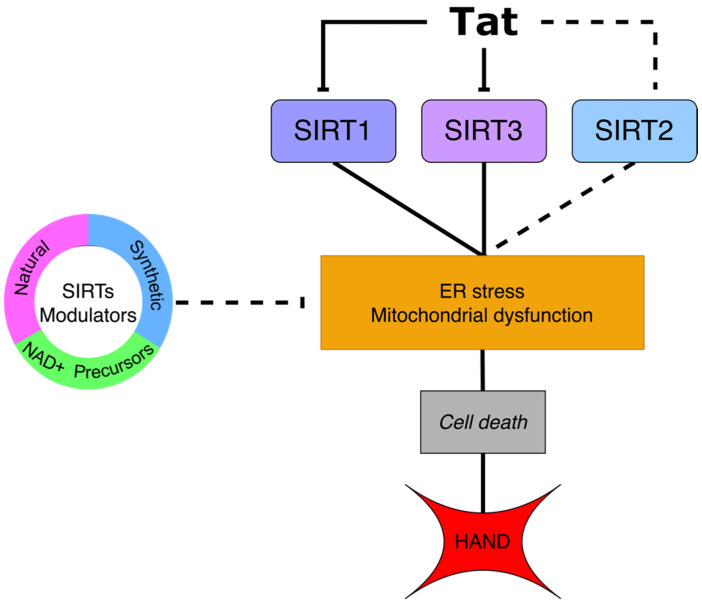
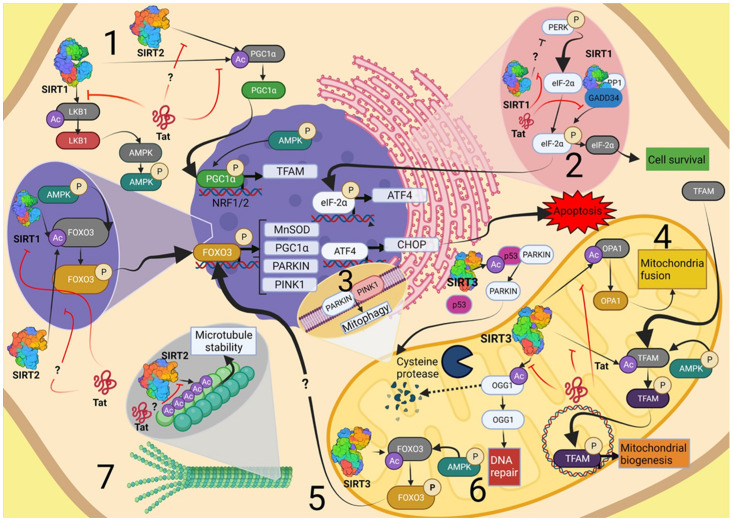
HIV-Associated neurocognitive disorder (HAND) is one of the major concerns since it persists in 40% of this population. Nowadays, HAND neuropathogenesis is considered to be caused by the infected cells that cross the brain-blood barrier and produce viral proteins that can be secreted and internalized into neurons leading to disruption of cellular processes. The evidence points to viral proteins such as Tat as the causal agent for neuronal alteration and thus HAND. The hallmarks in Tat-induced neurodegeneration are endoplasmic reticulum stress and mitochondrial dysfunction. Sirtuins (SIRTs) are NAD+-dependent deacetylases involved in mitochondria biogenesis, unfolded protein response, and intrinsic apoptosis pathway. Tat interaction with these deacetylases causes inhibition of SIRT1 and SIRT3. Studies revealed that SIRTs activation promotes neuroprotection in neurodegenerative diseases such Alzheimer's and Parkinson's disease. Therefore, this review focuses on Tat-induced neurotoxicity mechanisms that involve SIRTs as key regulators and their modulation as a therapeutic strategy for tackling HAND and thereby improving the quality of life of people living with HIV.
HIV 相关的神经认知障碍(HAND)是主要关注点之一,因为它在该人群中仍然存在于 40%。如今,HAND 的神经发病机制被认为是由感染细胞穿过血脑屏障并产生可分泌和内化到神经元中的病毒蛋白引起的,从而导致细胞过程的破坏。证据表明,Tat 等病毒蛋白是导致神经元改变从而引发 HAND 的原因。Tat 诱导的神经退行性变的特征是内质网应激和线粒体功能障碍。沉默信息调节因子 2 相关酶 1 和 3(SIRTs)是 NAD+依赖性去乙酰化酶,参与线粒体生物发生、未折叠蛋白反应和内在凋亡途径。Tat 与这些去乙酰化酶的相互作用导致 SIRT1 和 SIRT3 的抑制。研究表明,SIRTs 的激活可促进阿尔茨海默病和帕金森病等神经退行性疾病中的神经保护作用。因此,本综述重点介绍了 Tat 诱导的神经毒性机制,其中 SIRTs 作为关键调节剂,其调节作为治疗 HAND 的一种策略,从而提高 HIV 感染者的生活质量。