• 文献检索
  • 文档翻译
  • 深度研究
  • 学术资讯
  • Suppr Zotero 插件Zotero 插件
  • 邀请有礼
  • 套餐&价格
  • 历史记录
应用&插件
Suppr Zotero 插件Zotero 插件浏览器插件Mac 客户端Windows 客户端微信小程序
定价
高级版会员购买积分包购买API积分包
服务
文献检索文档翻译深度研究API 文档MCP 服务
关于我们
关于 Suppr公司介绍联系我们用户协议隐私条款
关注我们

Suppr 超能文献

核心技术专利:CN118964589B侵权必究
粤ICP备2023148730 号-1Suppr @ 2026

文献检索

告别复杂PubMed语法,用中文像聊天一样搜索,搜遍4000万医学文献。AI智能推荐,让科研检索更轻松。

立即免费搜索

文件翻译

保留排版,准确专业,支持PDF/Word/PPT等文件格式,支持 12+语言互译。

免费翻译文档

深度研究

AI帮你快速写综述,25分钟生成高质量综述,智能提取关键信息,辅助科研写作。

立即免费体验

弥合 COVID-19 疫苗接种差距:增强信任。

Closing the Gap on COVID-19 Vaccinations in First Responders and Beyond: Increasing Trust.

机构信息

Department of Biomedical Informatics, College of Medicine, The Ohio State University, Columbus, OH 43210, USA.

The Center for the Advancement of Team Science, Analytics, and Systems Thinking in Health Services and Implementation Science Research (CATALYST), College of Medicine, The Ohio State University, Columbus, OH 43210, USA.

出版信息

Int J Environ Res Public Health. 2022 Jan 6;19(2):644. doi: 10.3390/ijerph19020644.

DOI:10.3390/ijerph19020644
PMID:35055463
原文链接:https://pmc.ncbi.nlm.nih.gov/articles/PMC8776085/
Abstract

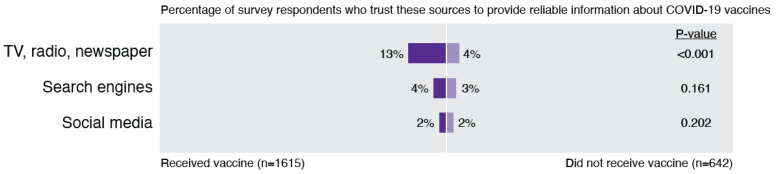
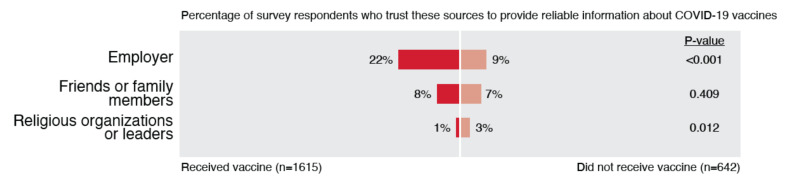
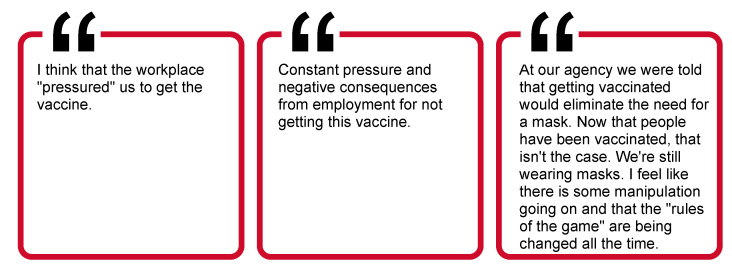
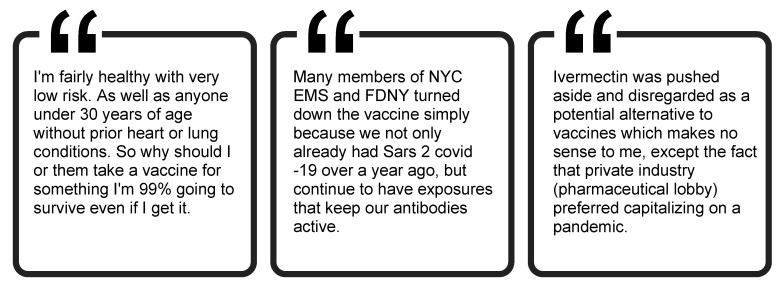
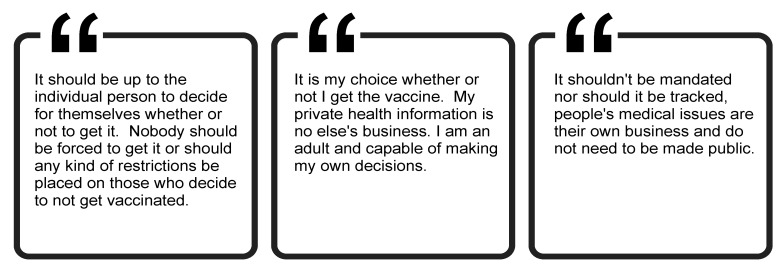
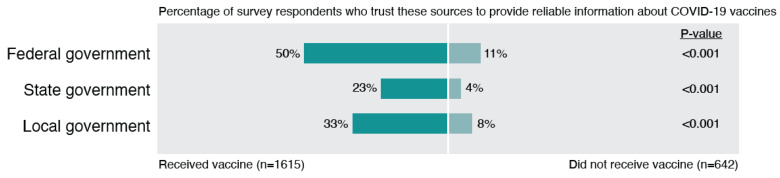
Although COVID-19 vaccines are widely available in the U.S. and much of the world, many have chosen to forgo this vaccination. Emergency medical services (EMS) professionals, despite their role on the frontlines and interactions with COVID-positive patients, are not immune to vaccine hesitancy. Via a survey conducted in April 2021, we investigated the extent to which first responders in the U.S. trusted various information sources to provide reliable information about COVID-19 vaccines. Those vaccinated generally trusted healthcare providers as a source of information, but unvaccinated first responders had fairly low trust in this information source-a group to which they, themselves, belong. Additionally, regardless of vaccination status, trust in all levels of government, employers, and their community as sources of information was low. Free-response explanations provided some context to these findings, such as preference for other COVID-19 management options, including drugs proven ineffective. A trusted source of COVID-19 vaccination information is not readily apparent. Individuals expressed a strong desire for the autonomy to make vaccination decisions for themselves, as opposed to mandates. Potential reasons for low trust, possible solutions to address them, generalizability to the broader public, and implications of low trust in official institutions are discussed.

摘要

尽管 COVID-19 疫苗在美国和世界上许多地方都广泛供应,但许多人选择不接种这种疫苗。尽管急救医疗服务(EMS)专业人员在前线工作并与 COVID-19 阳性患者接触,但他们也不能免除对疫苗的犹豫。通过 2021 年 4 月进行的一项调查,我们调查了美国急救人员在多大程度上信任各种信息来源来提供有关 COVID-19 疫苗的可靠信息。那些接种疫苗的人通常信任医疗保健提供者作为信息来源,但未接种疫苗的急救人员对这一信息来源的信任度相当低——他们自己就是属于这个群体。此外,无论接种疫苗与否,急救人员对各级政府、雇主和社区作为信息来源的信任度都很低。自由回答的解释为这些发现提供了一些背景,例如对其他 COVID-19 管理选项的偏好,包括已证明无效的药物。一个值得信赖的 COVID-19 疫苗接种信息来源并不明显。个人表达了强烈的愿望,希望自己能够自主做出接种疫苗的决定,而不是强制接种。讨论了信任度低的潜在原因、可能的解决方案、对更广泛公众的普遍性以及对官方机构信任度低的影响。
https://cdn.ncbi.nlm.nih.gov/pmc/blobs/8e2e/8776085/86b0b4fec451/ijerph-19-00644-g013.jpg
https://cdn.ncbi.nlm.nih.gov/pmc/blobs/8e2e/8776085/d671bb5689ca/ijerph-19-00644-g001.jpg
https://cdn.ncbi.nlm.nih.gov/pmc/blobs/8e2e/8776085/c8476a4cad27/ijerph-19-00644-g002.jpg
https://cdn.ncbi.nlm.nih.gov/pmc/blobs/8e2e/8776085/4333b70521c0/ijerph-19-00644-g003.jpg
https://cdn.ncbi.nlm.nih.gov/pmc/blobs/8e2e/8776085/003dd37af3ae/ijerph-19-00644-g004.jpg
https://cdn.ncbi.nlm.nih.gov/pmc/blobs/8e2e/8776085/3f49d6b4c763/ijerph-19-00644-g005.jpg
https://cdn.ncbi.nlm.nih.gov/pmc/blobs/8e2e/8776085/7d88a027339b/ijerph-19-00644-g006.jpg
https://cdn.ncbi.nlm.nih.gov/pmc/blobs/8e2e/8776085/1c5fe380b6dc/ijerph-19-00644-g007.jpg
https://cdn.ncbi.nlm.nih.gov/pmc/blobs/8e2e/8776085/3d11bc36b9b8/ijerph-19-00644-g008.jpg
https://cdn.ncbi.nlm.nih.gov/pmc/blobs/8e2e/8776085/2e75af53ada3/ijerph-19-00644-g009.jpg
https://cdn.ncbi.nlm.nih.gov/pmc/blobs/8e2e/8776085/262d1df131dd/ijerph-19-00644-g010.jpg
https://cdn.ncbi.nlm.nih.gov/pmc/blobs/8e2e/8776085/8efc13daf061/ijerph-19-00644-g011.jpg
https://cdn.ncbi.nlm.nih.gov/pmc/blobs/8e2e/8776085/6c24cde9c261/ijerph-19-00644-g012.jpg
https://cdn.ncbi.nlm.nih.gov/pmc/blobs/8e2e/8776085/86b0b4fec451/ijerph-19-00644-g013.jpg
https://cdn.ncbi.nlm.nih.gov/pmc/blobs/8e2e/8776085/d671bb5689ca/ijerph-19-00644-g001.jpg
https://cdn.ncbi.nlm.nih.gov/pmc/blobs/8e2e/8776085/c8476a4cad27/ijerph-19-00644-g002.jpg
https://cdn.ncbi.nlm.nih.gov/pmc/blobs/8e2e/8776085/4333b70521c0/ijerph-19-00644-g003.jpg
https://cdn.ncbi.nlm.nih.gov/pmc/blobs/8e2e/8776085/003dd37af3ae/ijerph-19-00644-g004.jpg
https://cdn.ncbi.nlm.nih.gov/pmc/blobs/8e2e/8776085/3f49d6b4c763/ijerph-19-00644-g005.jpg
https://cdn.ncbi.nlm.nih.gov/pmc/blobs/8e2e/8776085/7d88a027339b/ijerph-19-00644-g006.jpg
https://cdn.ncbi.nlm.nih.gov/pmc/blobs/8e2e/8776085/1c5fe380b6dc/ijerph-19-00644-g007.jpg
https://cdn.ncbi.nlm.nih.gov/pmc/blobs/8e2e/8776085/3d11bc36b9b8/ijerph-19-00644-g008.jpg
https://cdn.ncbi.nlm.nih.gov/pmc/blobs/8e2e/8776085/2e75af53ada3/ijerph-19-00644-g009.jpg
https://cdn.ncbi.nlm.nih.gov/pmc/blobs/8e2e/8776085/262d1df131dd/ijerph-19-00644-g010.jpg
https://cdn.ncbi.nlm.nih.gov/pmc/blobs/8e2e/8776085/8efc13daf061/ijerph-19-00644-g011.jpg
https://cdn.ncbi.nlm.nih.gov/pmc/blobs/8e2e/8776085/6c24cde9c261/ijerph-19-00644-g012.jpg
https://cdn.ncbi.nlm.nih.gov/pmc/blobs/8e2e/8776085/86b0b4fec451/ijerph-19-00644-g013.jpg

相似文献

1
Closing the Gap on COVID-19 Vaccinations in First Responders and Beyond: Increasing Trust.弥合 COVID-19 疫苗接种差距:增强信任。
Int J Environ Res Public Health. 2022 Jan 6;19(2):644. doi: 10.3390/ijerph19020644.
2
Addressing vaccine hesitancy and resistance for COVID-19 vaccines.应对 COVID-19 疫苗的犹豫和抵制。
Int J Nurs Stud. 2022 Jul;131:104241. doi: 10.1016/j.ijnurstu.2022.104241. Epub 2022 Apr 1.
3
Mistrust in public health institutions is a stronger predictor of vaccine hesitancy and uptake than Trust in Trump.对公共卫生机构的不信任比对特朗普的信任更能预测疫苗犹豫和接种率。
Soc Sci Med. 2022 Dec;314:115440. doi: 10.1016/j.socscimed.2022.115440. Epub 2022 Oct 13.
4
COVID-19 Vaccinations in EMS Professionals: Prevalence and Predictors.EMS 专业人员中的 COVID-19 疫苗接种:流行率和预测因素。
Prehosp Emerg Care. 2022 Sep-Oct;26(5):632-640. doi: 10.1080/10903127.2021.1993391. Epub 2021 Nov 3.
5
COVID-19 Vaccine Hesitancy and How to Address It.新冠病毒疫苗犹豫及其应对措施。
Workplace Health Saf. 2022 Feb;70(2):56-62. doi: 10.1177/21650799211073525. Epub 2022 Jan 25.
6
Identifying trusted local sources and predicting behavior change pathways according to COVID-19 vaccination status: Results of a 2022 statewide survey of Alaskan adults.根据 COVID-19 疫苗接种状况确定可信赖的当地信息源并预测行为变化途径:2022 年对阿拉斯加成年人进行的全州范围调查的结果。
Vaccine. 2024 Apr 11;42(10):2592-2607. doi: 10.1016/j.vaccine.2024.03.027. Epub 2024 Mar 14.
7
Trust of Italian healthcare professionals in COVID-19 (anti-SARS-COV-2) vaccination.意大利医疗保健专业人员对 COVID-19(抗 SARS-COV-2)疫苗的信任。
Ann Ig. 2022 May-June;34(3):217-226. doi: 10.7416/ai.2021.2463. Epub 2021 Aug 3.
8
Exploring First Responder Beliefs and Decisions to Vaccinate Against SARS-COV-2.探索急救人员对 SARS-COV-2 疫苗接种的信念和决策。
Health Commun. 2023 Dec;38(14):3316-3325. doi: 10.1080/10410236.2022.2149065. Epub 2023 Jan 12.
9
Information trust and COVID-19 vaccine hesitancy amongst middle-aged and older adults in Singapore: A latent class analysis Approach.新加坡中年和老年人对信息信任和对 COVID-19 疫苗的犹豫:潜在类别分析方法。
Soc Sci Med. 2022 Mar;296:114767. doi: 10.1016/j.socscimed.2022.114767. Epub 2022 Feb 3.
10
A matter of trust: a qualitative comparison of the determinants of COVID-19 vaccine hesitancy in Taiwan, the United States, the Netherlands, and Haiti.信任问题:对台湾、美国、荷兰和海地 COVID-19 疫苗犹豫的决定因素进行定性比较。
Hum Vaccin Immunother. 2022 Nov 30;18(5):2050121. doi: 10.1080/21645515.2022.2050121. Epub 2022 Mar 29.

引用本文的文献

1
Emergency Medical Services Clinicians and COVID-19 Booster Behavior-A Cross-Sectional National Evaluation.紧急医疗服务临床医生与新冠病毒加强针接种行为——一项全国性横断面评估
Vaccines (Basel). 2025 Apr 25;13(5):457. doi: 10.3390/vaccines13050457.
2
Prevalence and Predictors of Medical Mistrust Among Socioeconomically and Racially Diverse Cancer Patients in Philadelphia.费城社会经济和种族多样化癌症患者中医疗不信任的患病率及预测因素
Cancers (Basel). 2025 Feb 14;17(4):649. doi: 10.3390/cancers17040649.
3
Identifying trusted local sources and predicting behavior change pathways according to COVID-19 vaccination status: Results of a 2022 statewide survey of Alaskan adults.

本文引用的文献

1
COVID-19 Vaccinations in EMS Professionals: Prevalence and Predictors.EMS 专业人员中的 COVID-19 疫苗接种:流行率和预测因素。
Prehosp Emerg Care. 2022 Sep-Oct;26(5):632-640. doi: 10.1080/10903127.2021.1993391. Epub 2021 Nov 3.
2
Safety of the BNT162b2 mRNA Covid-19 Vaccine in a Nationwide Setting.BNT162b2 mRNA 新冠疫苗在全国范围内使用的安全性。
N Engl J Med. 2021 Sep 16;385(12):1078-1090. doi: 10.1056/NEJMoa2110475. Epub 2021 Aug 25.
3
Impact of Vax-a-Million Lottery on COVID-19 Vaccination Rates in Ohio.俄亥俄州“百万疫苗抽奖”活动对 COVID-19 疫苗接种率的影响。
根据 COVID-19 疫苗接种状况确定可信赖的当地信息源并预测行为变化途径:2022 年对阿拉斯加成年人进行的全州范围调查的结果。
Vaccine. 2024 Apr 11;42(10):2592-2607. doi: 10.1016/j.vaccine.2024.03.027. Epub 2024 Mar 14.
4
Views of Nigerian civil servants about compulsory COVID-19 vaccination: A qualitative study.尼日利亚公务员对强制性 COVID-19 疫苗接种的看法:一项定性研究。
Afr J Prim Health Care Fam Med. 2024 Feb 23;16(1):e1-e8. doi: 10.4102/phcfm.v16i1.4208.
5
Use of the socio-ecological model to explore trusted sources of COVID-19 information in Black and Latinx communities in Michigan.利用社会生态模型探索密歇根州黑人和拉丁裔社区中可信赖的 COVID-19 信息来源。
J Commun Healthc. 2023 Dec;16(4):389-400. doi: 10.1080/17538068.2023.2277499. Epub 2023 Dec 14.
6
Advancements in the development of nucleic acid vaccines for syphilis prevention and control.核酸疫苗在梅毒防控中的研发进展。
Hum Vaccin Immunother. 2023 Aug 1;19(2):2234790. doi: 10.1080/21645515.2023.2234790.
7
COVID-19 risk perception, cognitive dissonance, and vaccine hesitancy.COVID-19 风险感知、认知失调与疫苗犹豫
Hum Vaccin Immunother. 2023 Dec 31;19(1):2180217. doi: 10.1080/21645515.2023.2180217. Epub 2023 Feb 27.
8
Perspectives of Volunteer Firefighters during the COVID-19 Pandemic: Stumbling Blocks and Silver Linings.新冠疫情期间志愿消防员的观点:绊脚石与一线希望
Challenges (Basel). 2022 Dec;13(2). doi: 10.3390/challe13020046. Epub 2022 Sep 9.
9
COVID-19 Booster Uptake among First Responders and Their Household Members May Be Lower than Anticipated.急救人员及其家庭成员中新冠病毒加强针的接种率可能低于预期。
Vaccines (Basel). 2022 Jun 24;10(7):1011. doi: 10.3390/vaccines10071011.
10
Pandemic Experience of First Responders: Fear, Frustration, and Stress.一线工作者的大流行经历:恐惧、挫败和压力。
Int J Environ Res Public Health. 2022 Apr 13;19(8):4693. doi: 10.3390/ijerph19084693.
Am J Med. 2021 Nov;134(11):1424-1426. doi: 10.1016/j.amjmed.2021.06.032. Epub 2021 Jul 30.
4
Long covid-mechanisms, risk factors, and management.长新冠的发病机制、危险因素和管理。
BMJ. 2021 Jul 26;374:n1648. doi: 10.1136/bmj.n1648.
5
Lottery-Based Incentive in Ohio and COVID-19 Vaccination Rates.俄亥俄州的彩票激励与 COVID-19 疫苗接种率。
JAMA. 2021 Aug 24;326(8):766-767. doi: 10.1001/jama.2021.11048.
6
Acceptance of COVID-19 Vaccination among Front-Line Health Care Workers: A Nationwide Survey of Emergency Medical Services Personnel from Germany.一线医护人员对新冠疫苗的接受情况:一项对德国紧急医疗服务人员的全国性调查
Vaccines (Basel). 2021 Apr 23;9(5):424. doi: 10.3390/vaccines9050424.
7
Lessons learned from frontline skilled nursing facility staff regarding COVID-19 vaccine hesitancy.从一线熟练护理机构工作人员那里吸取的关于 COVID-19 疫苗犹豫的经验教训。
J Am Geriatr Soc. 2021 May;69(5):1140-1146. doi: 10.1111/jgs.17136. Epub 2021 Mar 26.
8
Attributes and predictors of long COVID.长新冠的特征和预测因素。
Nat Med. 2021 Apr;27(4):626-631. doi: 10.1038/s41591-021-01292-y. Epub 2021 Mar 10.
9
No Jab, No Job? Ethical Issues in Mandatory COVID-19 Vaccination of Healthcare Personnel.不接种疫苗就不能工作?医护人员强制接种新冠疫苗的伦理问题。
BMJ Glob Health. 2021 Feb;6(2). doi: 10.1136/bmjgh-2020-004877.
10
The coronavirus is here to stay - here's what that means.新冠病毒将长期存在——以下是这意味着什么。
Nature. 2021 Feb;590(7846):382-384. doi: 10.1038/d41586-021-00396-2.