Frey Jennifer A, Bachmann Daniel J, Anghelina Mirela, Sircelj Valerie, Saadoon Osama, Stevens Patrick, Pietrzak Maciej, Fernández Soledad, McAlearney Ann Scheck, Panchal Ashish R
Department of Emergency Medicine, The Ohio State University Wexner Medical Center, Columbus, OH 43210, USA.
Center to STOP-COVID, The Ohio State University, Columbus, OH 43210, USA.
Vaccines (Basel). 2022 Jun 24;10(7):1011. doi: 10.3390/vaccines10071011.
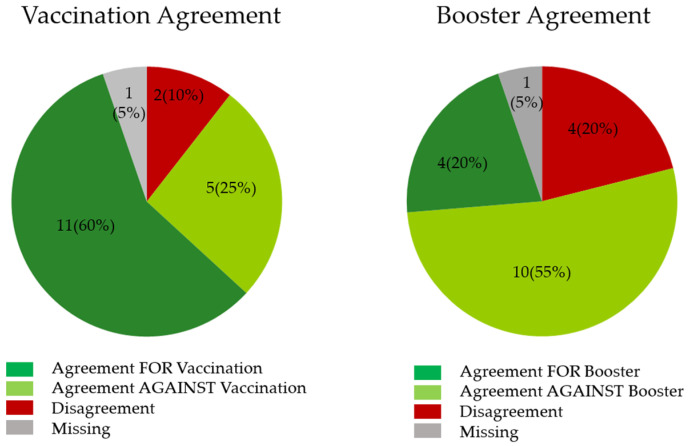
(1) Background: COVID-19 vaccination status varies widely among law enforcement and emergency medical services professionals. Though at high risk of exposure, these first responders have demonstrated significant vaccine hesitancy, with only 70% reportedly vaccinated. We sought to understand whether similar vaccine hesitancy exists for first responders and their household contacts around COVID-19 boosters. (2) Methods: In a prospective longitudinal cohort of first responders and their household contacts, survey data was collected, including demographics, medical history, COVID-19 exposure risks, and vaccination and/or booster status. The statistical analysis focused on primary vaccination and booster rates of both the first responders and their household contacts. (3) Results: Across 119 study participants, 73% reported having received some combination of vaccine and/or booster, and 26% were unvaccinated. Vaccinated individuals were older, reported less prior exposure to COVID-19 and had more comorbidities. Only 23% reported having received a COVID-19 booster. Pairing of the data for household contacts demonstrated a 60% agreement to receive primary vaccination but only a 20% agreement for boosters within households. (4) Conclusions: This study provides insight into the vaccination and booster rates of first responders and household contacts. Focused efforts to enhance vaccinations is essential for the protection and maintenance of this critical workforce.
(1)背景:执法人员和紧急医疗服务专业人员的新冠疫苗接种状况差异很大。尽管这些一线急救人员面临高暴露风险,但他们表现出明显的疫苗犹豫情绪,据报道只有70%的人接种了疫苗。我们试图了解一线急救人员及其家庭接触者在新冠疫苗加强针方面是否也存在类似的疫苗犹豫情况。(2)方法:在一个一线急救人员及其家庭接触者的前瞻性纵向队列中,收集了调查数据,包括人口统计学信息、病史、新冠病毒暴露风险以及疫苗接种和/或加强针接种状况。统计分析重点关注一线急救人员及其家庭接触者的初次疫苗接种率和加强针接种率。(3)结果:在119名研究参与者中,73%的人报告接种了某种组合的疫苗和/或加强针,26%的人未接种疫苗。接种疫苗的个体年龄较大,报告的既往新冠病毒暴露较少,且合并症较多。只有23%的人报告接种了新冠疫苗加强针。对家庭接触者的数据配对显示,在接受初次疫苗接种方面家庭内部的一致性为60%,但在加强针接种方面家庭内部的一致性仅为20%。(4)结论:本研究深入了解了一线急救人员及其家庭接触者的疫苗接种率和加强针接种率。集中精力加强疫苗接种对于保护和维持这支关键劳动力队伍至关重要。