Department of Public Health and Infectious Diseases, Sapienza University, Rome, Italy.
Italian Society of Migration Medicine (SIMM), Rome, Italy.
BMC Public Health. 2022 Jan 20;22(1):143. doi: 10.1186/s12889-021-12466-1.
Migrants and ethnic minorities have suffered a disproportionate impact of the COVID-19 pandemic compared to the general population from different perspectives. Our aim was to assess specifically their risk of infection in the 53 countries belonging to the World Health Organization European Region, during the first year of the pandemic.
We conducted a systematic review following Preferred Reporting Items for Systematic Reviews and Meta-Analyses guidelines (PROSPERO CRD42021247326). We searched multiple databases for peer-reviewed literature, published on Medline, Embase, Scisearch, Biosis and Esbiobase in 2020 and preprints from PubMed up to 29/03/2021. We included cross-sectional, case-control, cohort, intervention, case-series, prevalence or ecological studies, reporting the risk of SARS-CoV-2 infection among migrants, refugees, and ethnic minorities.
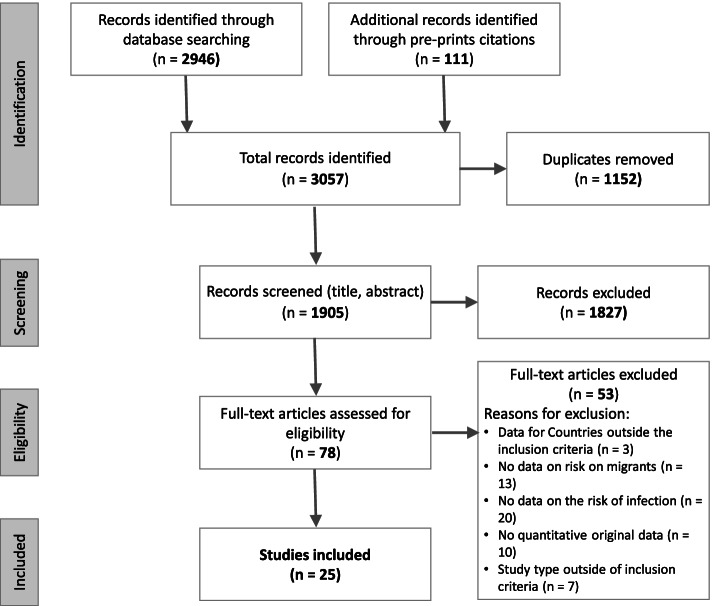
Among the 1905 records screened, 25 met our inclusion criteria and were included in the final analysis. We found that migrants and ethnic minorities during the first wave of the pandemic were at increased exposure and risk of infection and were disproportionately represented among COVID-19 cases. However, the impact of COVID-19 on minorities does not seem homogeneous, since some ethnic groups seem to be more at risk than others. Risk factors include high-risk occupations, overcrowded accommodations, geographic distribution, social deprivation, barriers to access to information concerning preventive measures (due to the language barrier or to their marginality), together with biological and genetic susceptibilities.
Although mixed methods studies will be required to fully understand the complex interplay between the various biological, social, and cultural factors underlying these findings, the impact of structural determinants of health is evident. Our findings corroborate the need to collect migration and ethnicity-disaggregated data and contribute to advocacy for inclusive policies and programmatic actions tailored to reach migrants and ethnic minorities.
移民和少数族裔在 COVID-19 大流行中遭受的影响与总人口相比存在不成比例的情况,从不同角度来看都是如此。我们的目的是评估大流行第一年期间,在属于世界卫生组织欧洲区域的 53 个国家中,这些人群感染的风险。
我们根据系统评价和荟萃分析的首选报告项目 (PROSPERO CRD42021247326) 进行了系统评价。我们在 2020 年在 Medline、Embase、Scisearch、Biosis 和 Esbiobase 上发表的同行评审文献以及在 29/03/2021 之前在 PubMed 上发表的预印本中,使用多个数据库进行了搜索。我们纳入了横断面、病例对照、队列、干预、病例系列、流行率或生态学研究,报告了移民、难民和少数民族中 SARS-CoV-2 感染的风险。
在筛选出的 1905 条记录中,有 25 条符合我们的纳入标准,并纳入最终分析。我们发现,在大流行的第一波期间,移民和少数民族面临更高的暴露和感染风险,并且在 COVID-19 病例中不成比例地代表。然而,COVID-19 对少数民族的影响似乎并不均匀,因为一些族裔群体似乎比其他族裔群体面临更高的风险。风险因素包括高风险职业、过度拥挤的住宿条件、地理分布、社会贫困、获得有关预防措施的信息的障碍(由于语言障碍或边缘化),以及生物和遗传易感性。
尽管需要进行混合方法研究才能充分了解这些发现背后各种生物、社会和文化因素之间的复杂相互作用,但健康结构决定因素的影响是显而易见的。我们的研究结果证实了收集移民和族裔分类数据的必要性,并有助于倡导制定包容移民和少数民族的政策和计划行动。