Zahedan University of Medical Sciences, Zahedan, Iran.
Infectious Diseases Research Center, Birjand University of Medical Sciences, Birjand, Iran.
BMC Complement Med Ther. 2022 Jan 22;22(1):19. doi: 10.1186/s12906-022-03515-2.
Vitamin D has an established role in female reproduction. There is also evidence for an association between vitamin D levels and menstrual problems such as premenstrual syndrome (PMS) and dysmenorrhea. Curcumin, is a bioactive polyphenol constituent of turmeric, that can potentially interact with vitamin D receptors and its molecular targets. This study evaluated the effects of curcumin on vitamin D levels in young women with PMS and dysmenorrhea.
In this randomized, triple-blind, placebo-controlled trial, women with PMS and dysmenorrhea were divided randomly into experimental and control groups to receive one capsule (500 mg of curcuminoid+ 5 mg piperine, or placebo) daily, from approximately 7 days before until 3 days after menstruation for three consecutive menstrual cycles. Serum vitamin D levels, renal function, and liver enzymes were also measured before and after intervention.
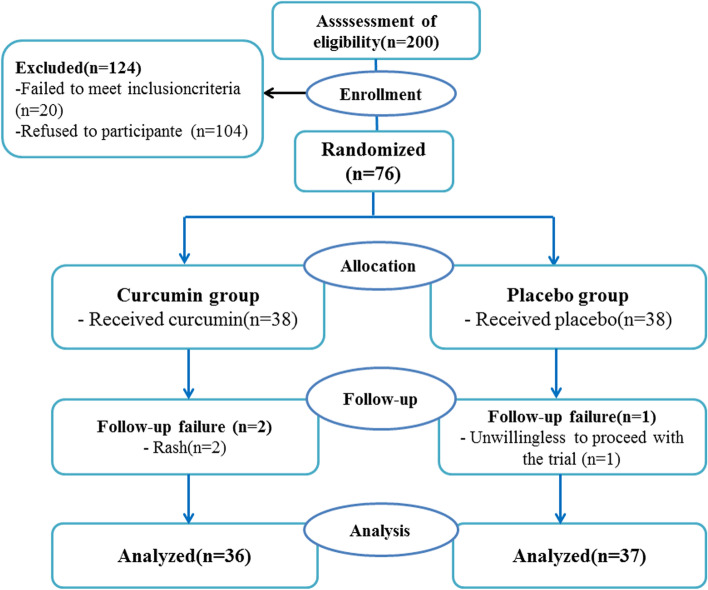
A total of 76 subjects (38 in each group) were recruited into the trial. Curcumin significantly increased the median (IQR) serum levels of vitamin D [from 12.8 ng/ml (7.0-24.6) to 16.2 ng/ml (6.4-28.8); P = 0.045], compared with placebo [from 18.6 ng/ml (2.2-26.8) to 21.3 ng/ml (5.2-27.1); P = 0.17]. Serum levels of aspartate aminotransferase and direct bilirubin were reduced by the end of trial in the curcumin group (p < 0.05), but did not change significantly in the control group (p > 0.05). Finally, no significant differences in levels of fasting blood glucose were detected between curcumin and placebo groups.
Curcumin supplementation in women with PMS and dysmenorrhea led to a significant improvement of vitamin D, liver function enzyme test, but did not affect blood glucose.
The trial was registered on Iranian Registry of Clinical Trials registry (Trial ID: IRCT20191112045424N1 on 23 January 2020; available at https://www.irct.ir ).
维生素 D 在女性生殖中具有重要作用。也有证据表明维生素 D 水平与经前期综合征(PMS)和痛经等月经问题之间存在关联。姜黄素是姜黄的一种生物活性多酚成分,它可能与维生素 D 受体及其分子靶标相互作用。本研究评估了姜黄素对 PMS 和痛经年轻女性维生素 D 水平的影响。
在这项随机、三盲、安慰剂对照试验中,将 PMS 和痛经的女性随机分为实验组和对照组,每天服用一粒(500mg 姜黄素+5mg 胡椒碱或安慰剂),从大约月经前 7 天开始,持续 3 个连续的月经周期,直到月经后 3 天。干预前后还测量了血清维生素 D 水平、肾功能和肝酶。
共有 76 名受试者(每组 38 名)入组试验。与安慰剂组相比(从 18.6ng/ml(2.2-26.8)增加至 21.3ng/ml(5.2-27.1),p=0.17),姜黄素组的血清维生素 D 水平中位数(IQR)明显升高[从 12.8ng/ml(7.0-24.6)增加至 16.2ng/ml(6.4-28.8);p=0.045]。姜黄素组的天冬氨酸转氨酶和直接胆红素在试验结束时降低(p<0.05),但对照组无明显变化(p>0.05)。最后,姜黄素组和安慰剂组的空腹血糖水平无显著差异。
在患有 PMS 和痛经的女性中补充姜黄素可显著改善维生素 D、肝功能酶试验,但对血糖无影响。
该试验于 2020 年 1 月 23 日在伊朗临床试验注册中心(试验 ID:IRCT20191112045424N1)注册;可在 https://www.irct.ir 上获取。