Department of Ophthalmology, College of Medicine, Soonchunhyang University, Cheonan, Republic of Korea.
Department of Ophthalmology, Soonchunhyang University Hospital Bucheon, Bucheon, Republic of Korea.
Sci Rep. 2022 Jan 24;12(1):1221. doi: 10.1038/s41598-022-05273-0.
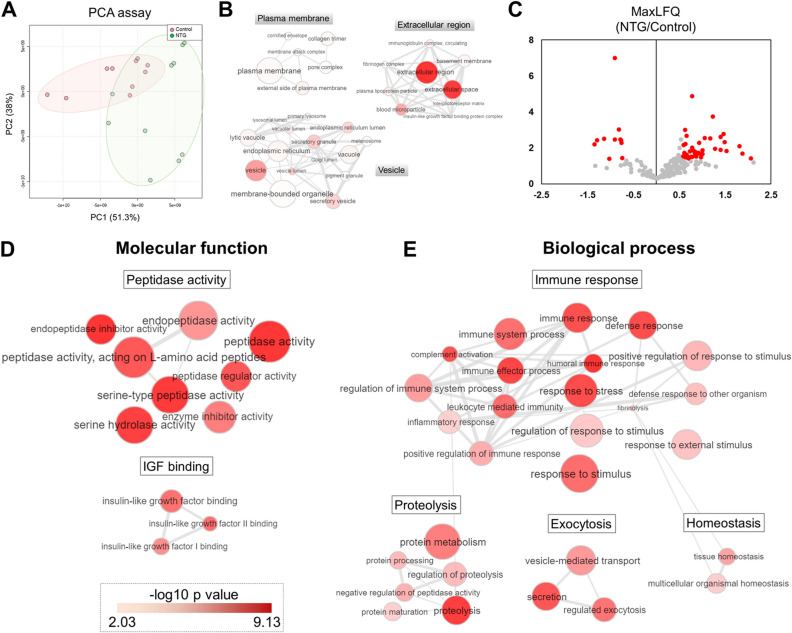
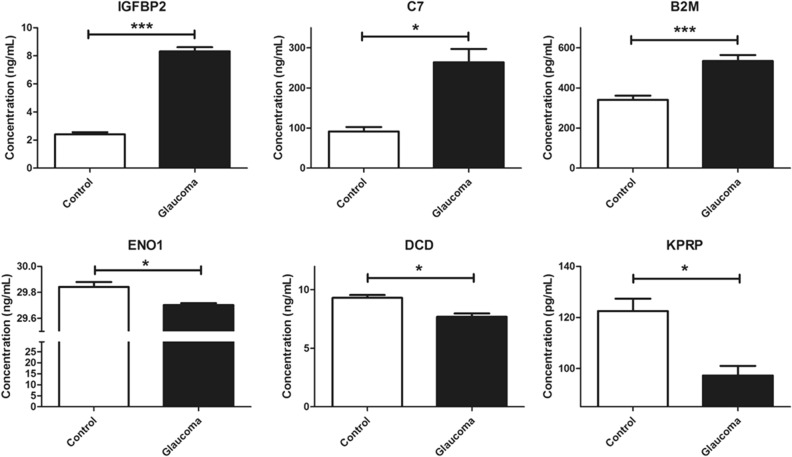
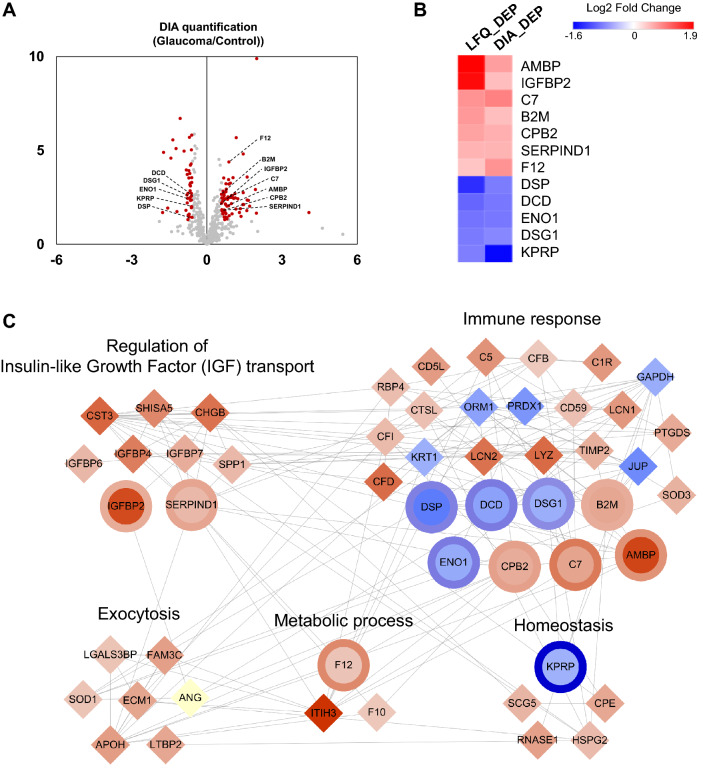
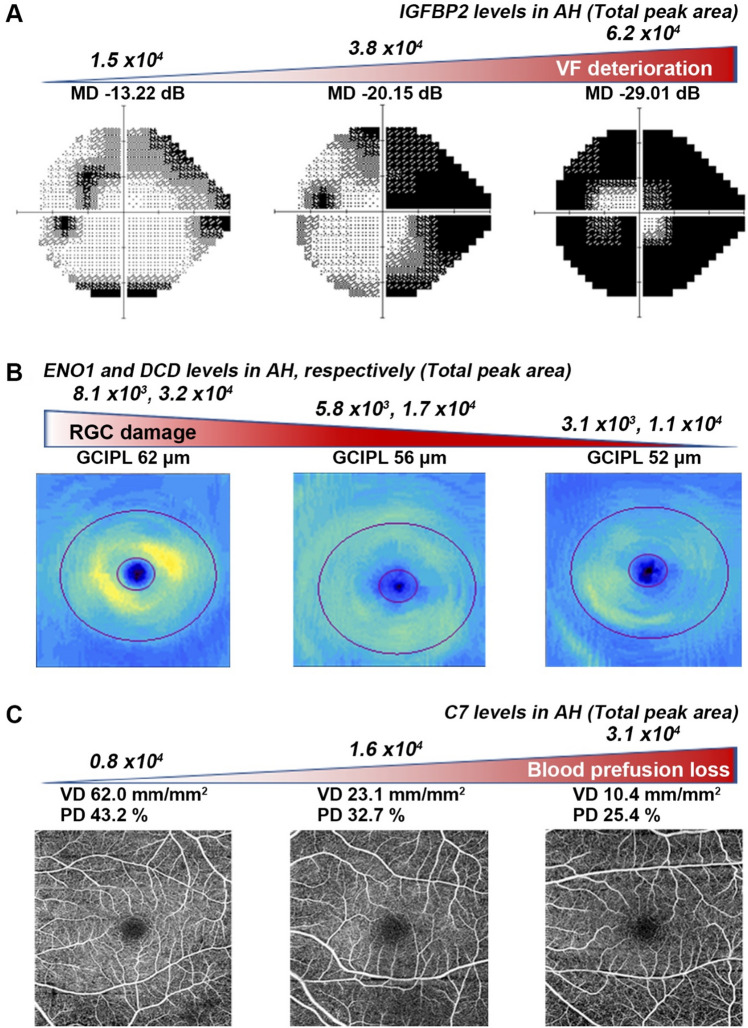
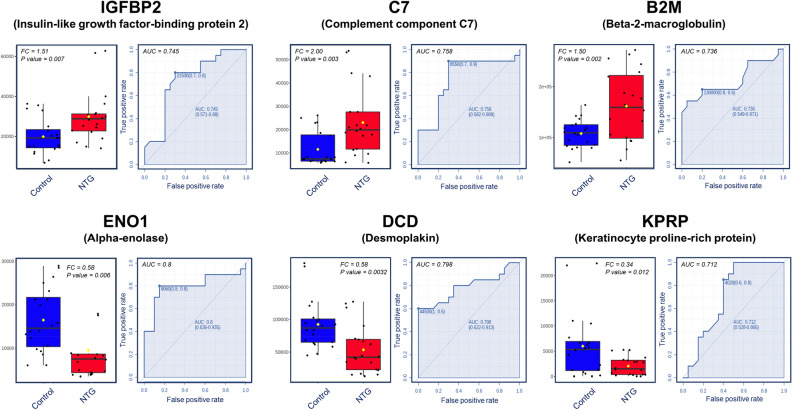
Previous reports have shown possible association between altered protein levels in aqueous humor (AH) and normal-tension glaucoma (NTG), but the underlying pathogenetic mechanism as well as specific molecular biomarkers for NTG remains still elusive. Here, we aimed to identify novel biomarkers for advanced NTG by analyzing the proteome of patient-derived AH and their correlation with various functional and structural parameters from the visual field test (VF), optical coherence tomography (OCT), and OCT angiography (OCTA). We determined differentially expressed proteins (DEPs) of the AH of patients with advanced NTG (n = 20) using label-free quantitative (LFQ) proteomics with pooled samples and data-independent acquisition (DIA) analysis with individual samples, and the roles of AH DEPs in biological pathways were evaluated using bioinformatics. We identified 603 proteins in the AH of patients with advanced NTG, and 61 of them were selected as DEPs via global proteome LFQ profiling. Individual DIA analyses identified a total of 12 DEPs as biomarker candidates, seven of which were upregulated, and five were downregulated. Gene ontology enrichment analysis revealed that those DEPs were mainly involved in the immune response. Moreover, IGFBP2, ENO1, C7, B2M, AMBP, DSP, and DCD showed a significant correlation with the mean deviation of VF and with peripapillary and macular parameters from OCT and OCTA. The present study provides possible molecular biomarkers for the diagnosis of advanced NTG.
先前的报告表明,房水中蛋白质水平的改变与正常眼压性青光眼(NTG)之间可能存在关联,但 NTG 的潜在发病机制以及特定的分子生物标志物仍难以确定。在这里,我们旨在通过分析患者来源的房水的蛋白质组,以及与视野测试(VF)、光学相干断层扫描(OCT)和 OCT 血管造影(OCTA)中的各种功能和结构参数的相关性,来鉴定用于晚期 NTG 的新型生物标志物。我们使用无标记定量(LFQ)蛋白质组学对晚期 NTG 患者的 AH 进行了差异表达蛋白(DEPs)的测定(n = 20),并使用 pooled samples 进行数据独立采集(DIA)分析,以及 individual samples 进行数据独立采集(DIA)分析,然后使用生物信息学评估 AH DEPs 在生物途径中的作用。我们在晚期 NTG 患者的 AH 中鉴定出 603 种蛋白质,通过全局蛋白质组 LFQ 分析鉴定出 61 种 DEP。通过单独的 DIA 分析共鉴定出 12 种 DEP 作为候选生物标志物,其中 7 种上调,5 种下调。基因本体富集分析表明,这些 DEPs 主要参与免疫反应。此外,IGFBP2、ENO1、C7、B2M、AMBP、DSP 和 DCD 与 VF 的平均偏差以及来自 OCT 和 OCTA 的视盘和黄斑参数显著相关。本研究为晚期 NTG 的诊断提供了可能的分子生物标志物。