The Nightingale Breast Cancer Centre, Wythenshawe Hospital, Manchester University NHS Foundation Trust, Manchester, UK.
Department of Medical Statistics, Manchester University Hospitals NHS Foundation Trust, Wythenshawe Hospital, Manchester, UK.
Br J Surg. 2022 Feb 24;109(3):274-282. doi: 10.1093/bjs/znab443.
Wire localization is historically the most common method for guiding excision of non-palpable breast lesions, but there are limitations to the technique. Newer technologies such as magnetic seeds may allow some of these challenges to be overcome. The aim was to compare safety and effectiveness of wire and magnetic seed localization techniques.
Women undergoing standard wire or magnetic seed localization for non-palpable lesions between August 2018 and August 2020 were recruited prospectively to this IDEAL stage 2a/2b platform cohort study. The primary outcome was effectiveness defined as accurate localization and removal of the index lesion. Secondary endpoints included safety, specimen weight and reoperation rate for positive margins.
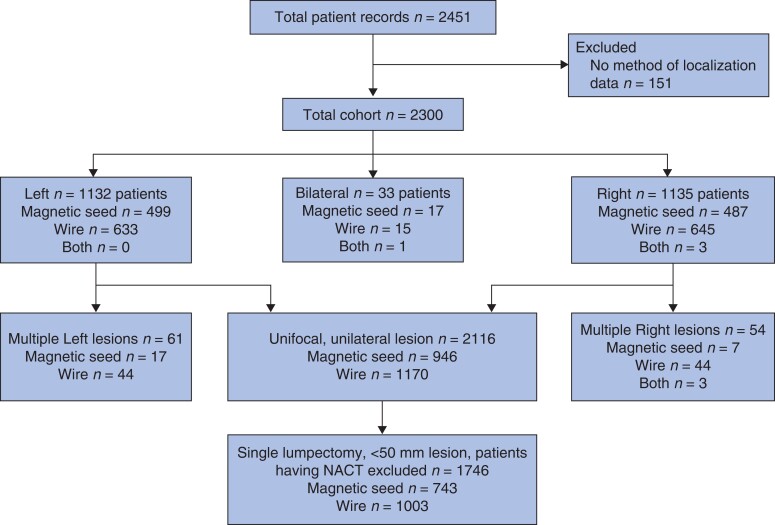
Data were accrued from 2300 patients in 35 units; 2116 having unifocal, unilateral breast lesion localization. Identification of the index lesion in magnetic-seed-guided (946 patients) and wire-guided excisions (1170 patients) was 99.8 versus 99.1 per cent (P = 0.048). There was no difference in overall complication rate. For a subset of patients having a single lumpectomy only for lesions less than 50 mm (1746 patients), there was no difference in median closest margin (2 mm versus 2 mm, P = 0.342), re-excision rate (12 versus 13 per cent, P = 0.574) and specimen weight in relation to lesion size (0.15 g/mm2versus 0.138 g/mm2, P = 0.453).
Magnetic seed localization demonstrated similar safety and effectiveness to those of wire localization. This study has established a robust platform for the comparative evaluation of new localization devices.
在历史上,导丝定位是引导切除不可触及的乳腺病变最常用的方法,但该技术存在局限性。一些新技术,如磁性种子,可能会克服其中的一些挑战。本研究旨在比较导丝和磁性种子定位技术的安全性和有效性。
本 IDEAL 阶段 2a/2b 平台队列研究前瞻性招募了 2018 年 8 月至 2020 年 8 月期间因不可触及病变而行标准导丝或磁性种子定位的女性。主要结局为准确性定义为准确定位和切除索引病变。次要终点包括安全性、标本重量和阳性切缘的再手术率。
共从 35 个单位的 2300 名患者中收集数据;2116 名患者为单侧乳腺单发病变定位。在磁性种子引导组(946 例)和导丝引导组(1170 例)中,索引病变的检出率分别为 99.8%和 99.1%(P = 0.048)。总体并发症发生率无差异。对于仅为小于 50 mm 病变行单个肿块切除术的患者亚组(1746 例),中位最近切缘无差异(2 mm 与 2 mm,P = 0.342),再次切除率(12%与 13%,P = 0.574)和标本重量与病变大小的关系(0.15 g/mm2与 0.138 g/mm2,P = 0.453)。
磁性种子定位与导丝定位具有相似的安全性和有效性。本研究为新的定位设备的比较评估建立了一个强大的平台。