Department of Infectious Disease Epidemiology, School of Public Health, Faculty of Medicine, Imperial College London, London, United Kingdom.
The Natural History Museum, Department of Life Sciences, London, United Kingdom.
PLoS Negl Trop Dis. 2022 Jan 31;16(1):e0010088. doi: 10.1371/journal.pntd.0010088. eCollection 2022 Jan.
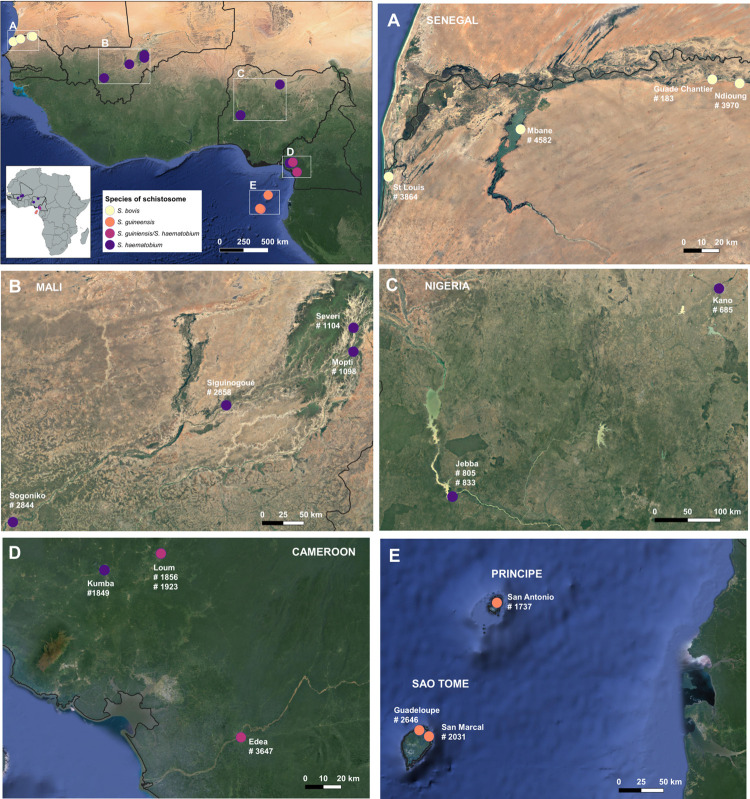
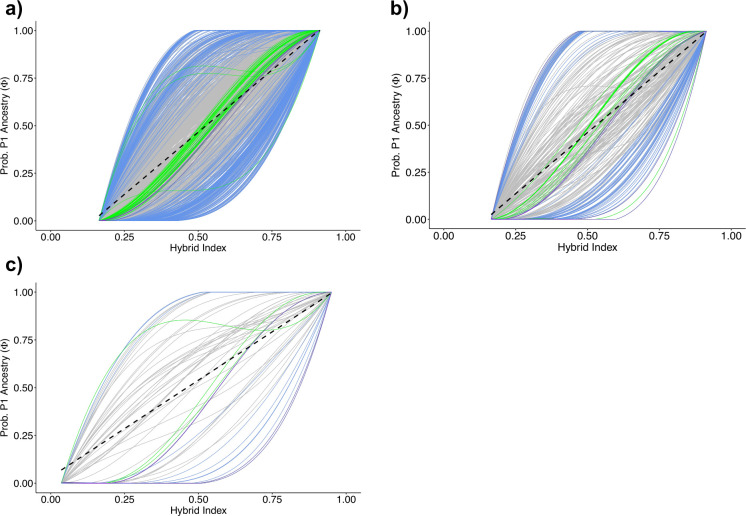
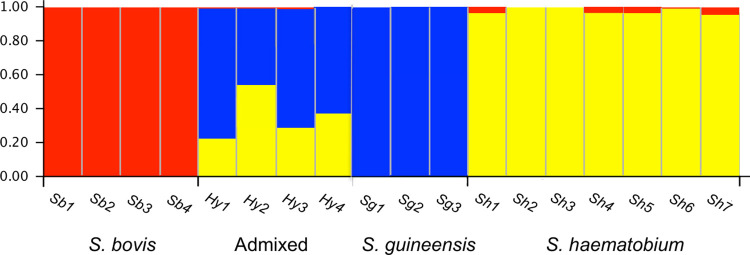
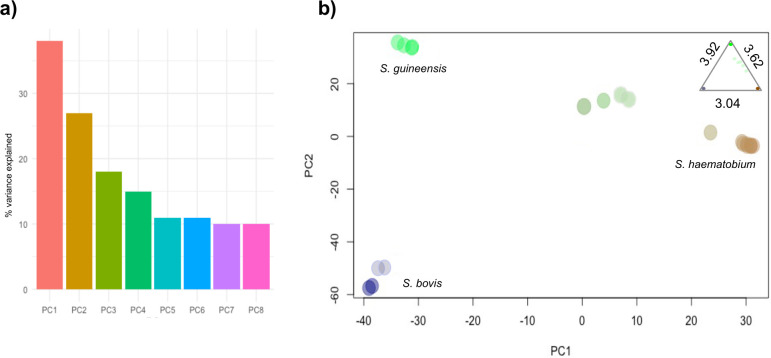
Schistosomiasis remains a public health concern across sub-Saharan Africa; current control programmes rely on accurate mapping and high mass drug administration (MDA) coverage to attempt disease elimination. Inter-species hybridisation can occur between certain species, changing epidemiological dynamics within endemic regions, which has the potential to confound control interventions. The impact of hybridisation on disease dynamics is well illustrated in areas of Cameroon where urogenital schistosomiasis, primarily due to Schistosoma haematobium and hybrid infections, now predominate over intestinal schistosomiasis caused by Schistosoma guineensis. Genetic markers have shown the ability to identify hybrids, however the underlying genomic architecture of divergence and introgression between these species has yet to be established. In this study, restriction site associated DNA sequencing (RADseq) was used on archived adult worms initially identified as; Schistosoma bovis (n = 4), S. haematobium (n = 9), S. guineensis (n = 3) and S. guineensis x S. haematobium hybrids (n = 4) from Mali, Senegal, Niger, São Tomé and Cameroon. Genome-wide evidence supports the existence of S. guineensis and S. haematobium hybrid populations across Cameroon. The hybridisation of S. guineensis x S. haematobium has not been demonstrated on the island of São Tomé, where all samples showed no introgression with S. haematobium. Additionally, all S. haematobium isolates from Nigeria, Mali and Cameroon indicated signatures of genomic introgression from S. bovis. Adaptive loci across the S. haematobium group showed that voltage-gated calcium ion channels (Cav) could play a key role in the ability to increase the survivability of species, particularly in host systems. Where admixture has occurred between S. guineensis and S. haematobium, the excess introgressive influx of tegumental (outer helminth body) and antigenic genes from S. haematobium has increased the adaptive response in hybrids, leading to increased hybrid population fitness and viability.
血吸虫病仍然是撒哈拉以南非洲的一个公共卫生问题;目前的控制方案依赖于准确的绘图和高大规模药物管理(MDA)覆盖率,以试图消除疾病。某些物种之间可能会发生种间杂交,改变流行地区的流行病学动态,从而有可能使控制干预措施复杂化。在喀麦隆的一些地区,杂交对疾病动态的影响得到了很好的说明,那里的泌尿生殖系统血吸虫病主要由曼氏血吸虫和杂交感染引起,现在超过了由几内亚血吸虫引起的肠道血吸虫病。遗传标记已显示出识别杂种的能力,但这些物种之间的分歧和基因渐渗的潜在基因组结构尚未确定。在这项研究中,使用限制性位点相关 DNA 测序(RADseq)对最初鉴定为来自马里、塞内加尔、尼日尔、圣多美和喀麦隆的曼氏血吸虫(n = 4)、埃及血吸虫(n = 9)、几内亚血吸虫(n = 3)和几内亚血吸虫 x 埃及血吸虫杂种(n = 4)的存档成虫进行了研究。全基因组证据支持喀麦隆存在几内亚血吸虫和埃及血吸虫杂交种群。在圣多美岛,没有证明几内亚血吸虫 x 埃及血吸虫的杂交,所有样本均未与埃及血吸虫发生基因渐渗。此外,来自尼日利亚、马里和喀麦隆的所有埃及血吸虫分离株均表明存在从曼氏血吸虫基因组渐渗的迹象。整个埃及血吸虫组的适应性基因座表明,电压门控钙离子通道(Cav)可能在提高物种生存能力方面发挥关键作用,尤其是在宿主系统中。在几内亚血吸虫和埃及血吸虫之间发生混合时,来自埃及血吸虫的过度基因渐渗流入表皮(寄生虫外体)和抗原基因增加了杂种的适应性反应,导致杂种种群适应性和活力增加。