Health Management Center, Department of Gastroenterology, Zhejiang Provincial People's Hospital, Affiliated People's Hospital, Hangzhou Medical College, Hangzhou, 310014, Zhejiang Province, China.
Mol Med. 2022 Jan 31;28(1):12. doi: 10.1186/s10020-021-00428-7.
The increasing incidence of non-alcoholic fatty liver disease (NAFLD) has been reported worldwide, which urges understanding of its pathogenesis and development of more effective therapeutical methods for this chronic disease. In this study, we aimed to investigate the effects of a LIM homeodomain transcription factor, islet1 (ISL1) on NAFLD.
Male C57BL/6J mice were fed with a diet high in fat content to produce NAFLD models. These models were then treated with overexpressed ISL1 (oe-ISL1), oe-Lysine-specific demethylase 6B (KDM6B), oe-SNAI1, or short hairpin RNA against SNAI1. We assessed triglyceride and cholesterol contents in the plasma and liver tissues and determined the expressions of ISL1, KDM6B and SNAI1 in liver tissues. Moreover, the in vitro model of lipid accumulation was constructed using fatty acids to explore the in vitro effect of ISL1/KDM6B/SNAI1 in NAFLD.
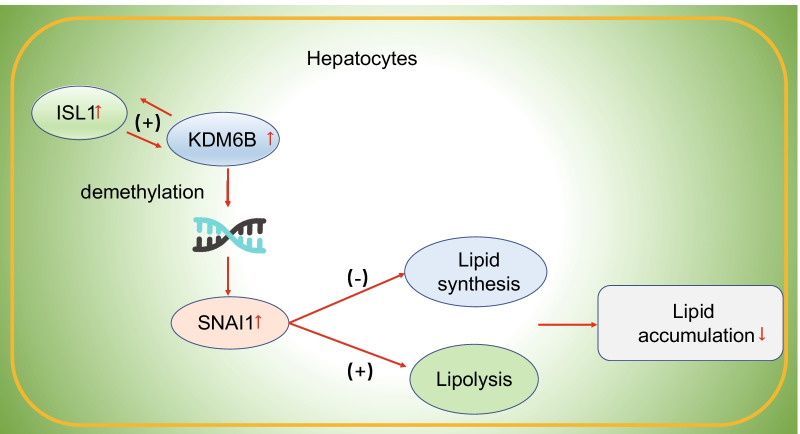
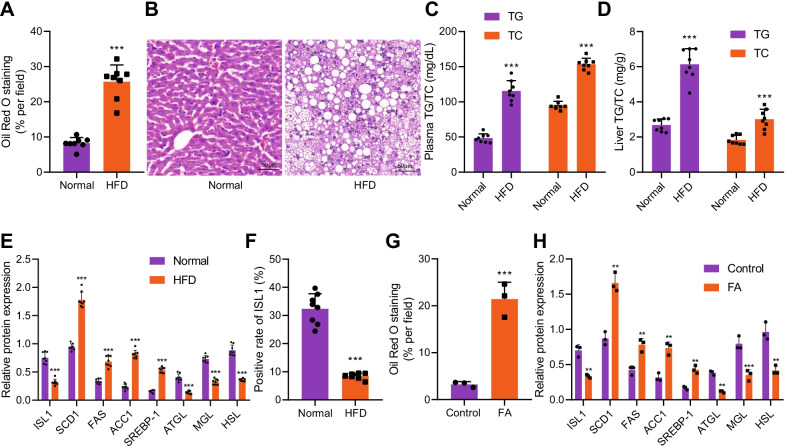
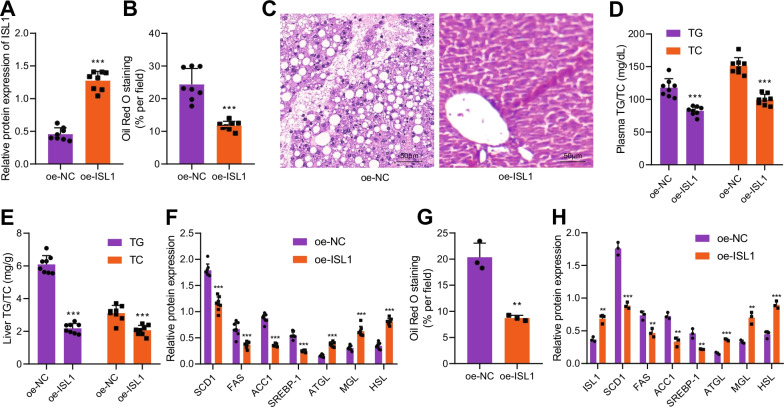
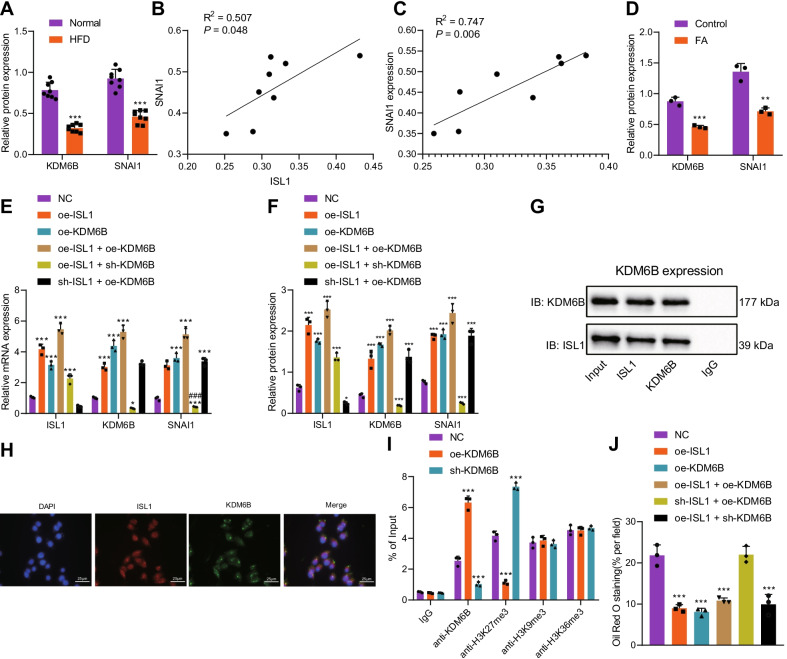
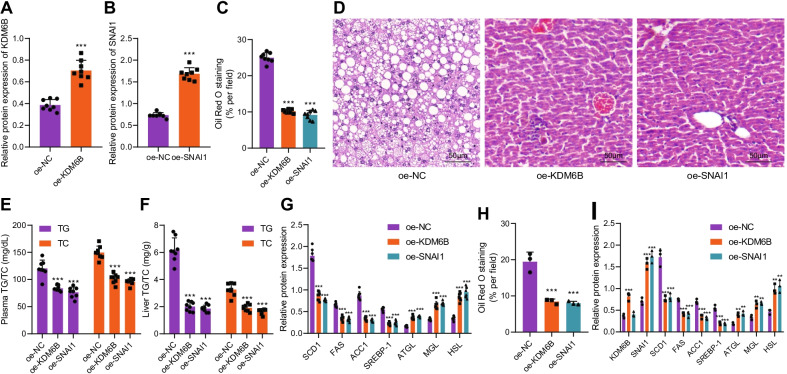
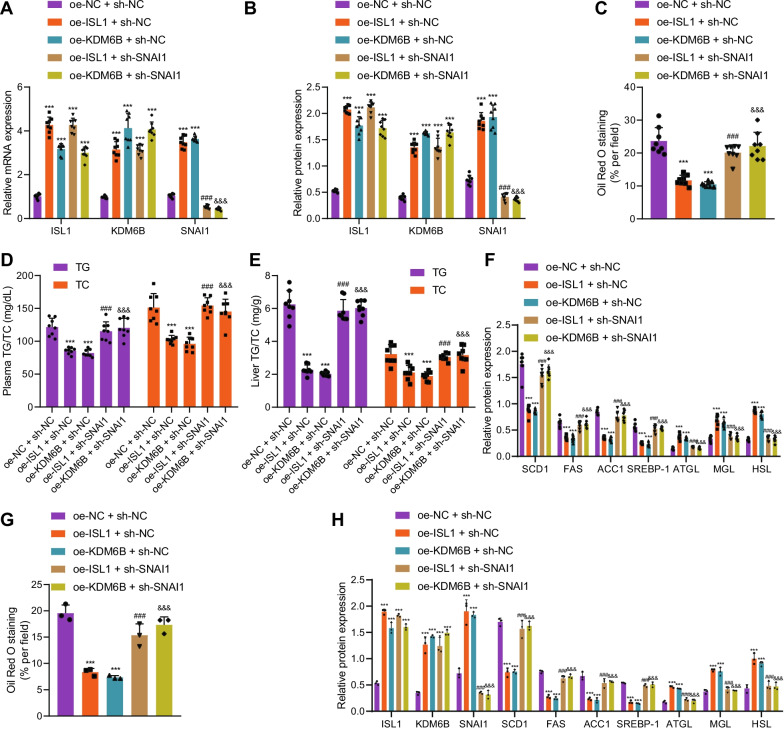
The results showed that the expressions of ISL1, KDM6B, and SNAI1 where decreased, but contents of triglyceride and cholesterol increased in mice exposed to high-fat diet. ISL1 inhibited lipogenesis and promoted lipolysis and exhibited a synergizing effect with KDM6B to upregulate the expression of SNAI1. Moreover, both KDM6B and SNAI1 could inhibit lipogenesis and induce lipolysis. Importantly, the therapeutic effects of ISL1 on in vitro model of lipid accumulations was also confirmed through the modulation of KDM6B and SNAI1.
Taken together, these findings highlighted that ISL1 effectively ameliorated NAFLD by inducing the expressions of KDM6B and SNAI1, which might be a promising drug for the treatment of NAFLD.
非酒精性脂肪性肝病(NAFLD)的发病率在全球范围内不断上升,这促使人们对其发病机制和开发更有效的治疗方法有了更深入的了解。本研究旨在探讨 LIM 同源结构域转录因子胰岛 1(ISL1)对 NAFLD 的影响。
雄性 C57BL/6J 小鼠喂食高脂肪饮食以建立 NAFLD 模型。然后,用过表达 ISL1(oe-ISL1)、赖氨酸特异性去甲基酶 6B(KDM6B)、oe-SNAI1 或 SNAI1 短发夹 RNA 处理这些模型。我们评估了血浆和肝组织中的甘油三酯和胆固醇含量,并测定了肝组织中 ISL1、KDM6B 和 SNAI1 的表达。此外,我们还使用脂肪酸构建了体外脂肪堆积模型,以探讨 ISL1/KDM6B/SNAI1 在 NAFLD 中的体外作用。
结果表明,高脂饮食暴露的小鼠中 ISL1、KDM6B 和 SNAI1 的表达降低,而甘油三酯和胆固醇含量增加。ISL1 抑制脂肪生成,促进脂肪分解,并与 KDM6B 协同上调 SNAI1 的表达。此外,KDM6B 和 SNAI1 均可抑制脂肪生成并诱导脂肪分解。重要的是,通过调节 KDM6B 和 SNAI1,也证实了 ISL1 对体外脂肪堆积模型的治疗效果。
总之,这些发现强调了 ISL1 通过诱导 KDM6B 和 SNAI1 的表达有效改善了 NAFLD,这可能是治疗 NAFLD 的一种有前途的药物。