Georgia Institute of Technology, Parker H. Petit Institute for Bioengineering and Bioscience, Atlant, United States.
Georgia Institute of Technology, George W. Woodruff School of Mechanical Engineering, Atlanta, Georg, United States.
J Biomed Opt. 2022 Jan;27(1). doi: 10.1117/1.JBO.27.1.016003.
Intravascular photoacoustic (IVPA) imaging can identify native lipid in atherosclerotic plaques in vivo. However, the large number of laser pulses required to produce 3D images is a safety concern that has not been fully addressed.
We aim to evaluate if irradiation at wavelengths and dosages relevant to IVPA imaging causes target vessel damage.
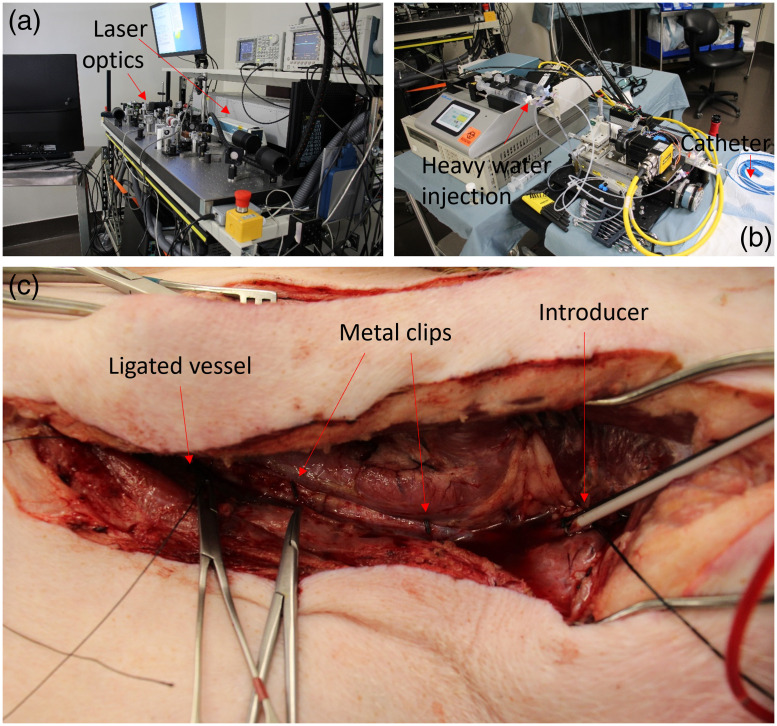
We irradiate the carotid artery of swine at one of several energy dosages using radiation at 1064 or 1720 nm and use histological evaluation by a pathologist to identify dose-dependent damage.
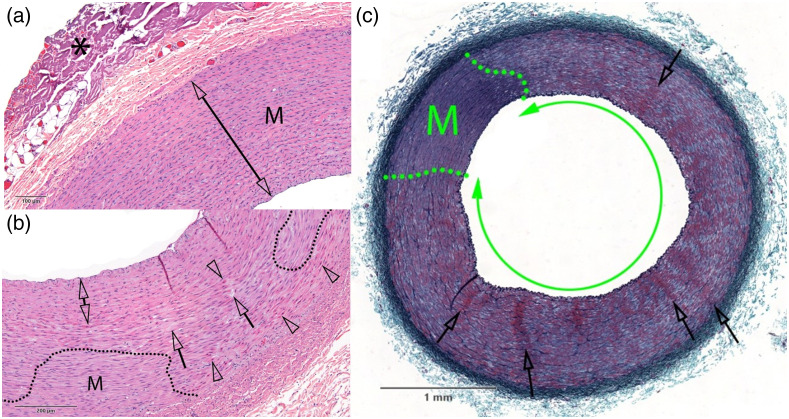
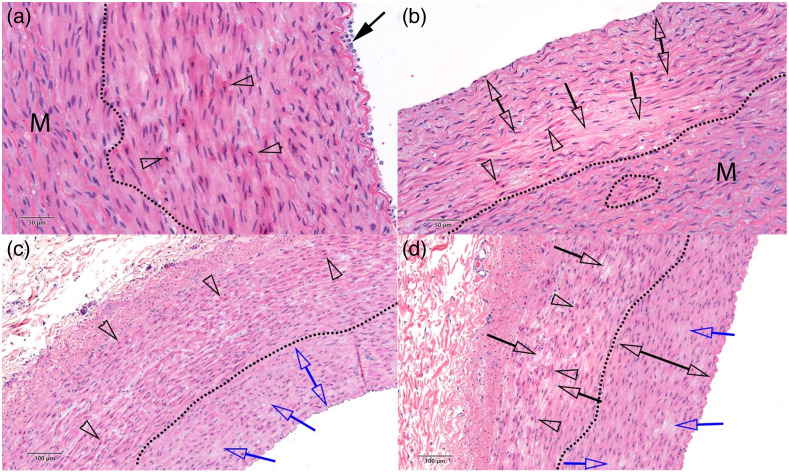
Media necrosis was the only dose-dependent form of injury. Damage was present at a cumulative fluence of 50 J / cm2 when using 1720 nm light. Damage was more equivocally identified at 700 J / cm2 using 1064 nm.
In prior work, IVPA imaging of native lipid in swine has been successfully conducted below the damage thresholds identified. This indicates that it will be possible to use IVPA imaging in a clinical setting without damaging vessel tissue. Future work should determine if irradiation causes an increase in blood thrombogenicity and confirm whether damaged tissue will heal over longer time points.
血管内光声(IVPA)成像可以在体内识别动脉粥样硬化斑块中的天然脂质。然而,产生 3D 图像所需的大量激光脉冲是一个尚未完全解决的安全问题。
我们旨在评估在与 IVPA 成像相关的波长和剂量下进行辐照是否会导致靶血管损伤。
我们使用 1064nm 或 1720nm 的辐射,在几种能量剂量下辐照猪的颈动脉,并由病理学家进行组织学评估,以确定剂量依赖性损伤。
只有中膜坏死是唯一的剂量依赖性损伤形式。当使用 1720nm 光时,累积通量为 50J/cm2 时出现损伤。当使用 1064nm 时,在 700J/cm2 时更不确定地识别出损伤。
在之前的工作中,已经成功地在确定的损伤阈值以下进行了猪体内天然脂质的 IVPA 成像。这表明,在临床环境中使用 IVPA 成像而不会损伤血管组织是可行的。未来的工作应确定辐照是否会导致血液血栓形成增加,并确认受损组织是否会在更长的时间点内愈合。