Brasca Francesco Maria Angelo, Casale Maria Carla, Canevese Fabio Lorenzo, Tortora Giovanni, Pagano Giulia, Botto Giovanni Luca
Department of Electrophysiology and Clinical Arrhythmology, Azienda Socio Sanitaria Territoriale Rhodense, Milano, Italy.
JMIR Cardio. 2022 Apr 19;6(1):e30661. doi: 10.2196/30661.
The COVID-19 pandemic forced several European governments to impose severe lockdown measures. The reduction of physical activity during the lockdown could have been deleterious.
The aim of this observational, retrospective study was to investigate the effect of the lockdown strategy on the physical activity burden and subsequent reassessment in a group of patients with heart failure who were followed by means of remote monitoring.
We analyzed remote monitoring transmissions during the 3-month period immediately preceding the lockdown, 69 days of lockdown, and 3-month period after the first lockdown in a cohort of patients with heart failure from a general hospital in Lombardy, Italy. We compared variation of daily physical activity measured by cardiac implantable electrical devices with clinical variables collected in a hospital database.
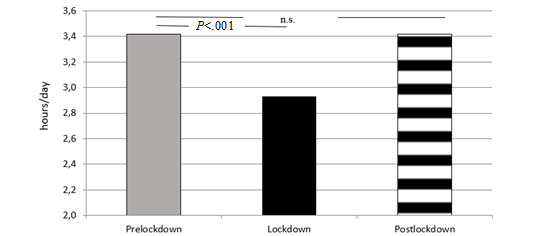
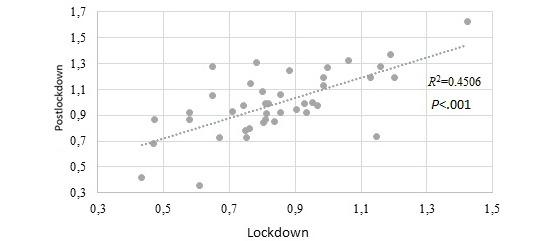
We enrolled 41 patients with heart failure that sent 176 transmissions. Physical activity decreased during the lockdown period (mean 3.4, SD 1.9 vs mean 2.9, SD 1.8 hours/day; P<.001) but no significant difference was found when comparing the period preceding and following the lockdown (-0.0007 hours/day; P=.99). We found a significant correlation between physical activity reduction during and after the lockdown (R=0.45, P<.001). The only significant predictor of exercise variation in the postlockdown period was the lockdown to prelockdown physical activity ratio.
An excessive reduction of exercise in patients with heart failure decreased the tolerance to exercise, especially in patients with more comorbidities. Remote monitoring demonstrated exercise reduction, suggesting its potential utility to encourage patients to maintain their usual physical activity levels.
新冠疫情迫使多个欧洲国家政府实施严格的封锁措施。封锁期间身体活动的减少可能产生有害影响。
这项观察性回顾性研究旨在调查封锁策略对一组通过远程监测随访的心力衰竭患者身体活动负担及后续重新评估的影响。
我们分析了意大利伦巴第一家综合医院的一组心力衰竭患者在封锁前3个月、69天封锁期以及首次封锁后的3个月期间的远程监测传输数据。我们将心脏植入式电子设备测量的日常身体活动变化与医院数据库中收集的临床变量进行了比较。
我们纳入了41例心力衰竭患者,他们共发送了176次传输数据。封锁期间身体活动减少(平均3.4小时/天,标准差1.9 vs平均2.9小时/天,标准差1.8;P<0.001),但在比较封锁前后期间时未发现显著差异(-0.0007小时/天;P=0.99)。我们发现封锁期间及之后身体活动减少之间存在显著相关性(R=0.45,P<0.001)。封锁后时期运动变化的唯一显著预测因素是封锁期与封锁前身体活动比率。
心力衰竭患者运动过度减少会降低运动耐量,尤其是合并症较多的患者。远程监测显示运动减少,表明其在鼓励患者维持日常身体活动水平方面具有潜在效用。