School of Architecture, Planning and Environmental Policy, University College Dublin Richview, Clonskeagh, Dublin, D14 E099, Ireland.
School of Architecture, Planning and Environmental Policy, University College Dublin Richview, Clonskeagh, Dublin, D14 E099, Ireland.
Environ Res. 2022 Jul;210:112818. doi: 10.1016/j.envres.2022.112818. Epub 2022 Jan 29.
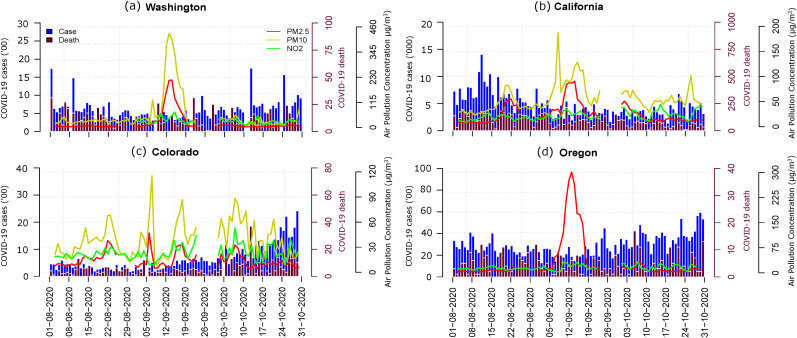
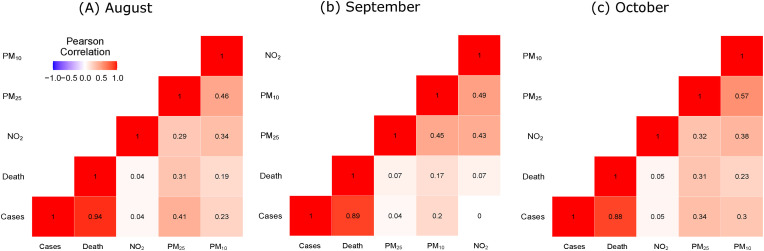
Forest fires impact on soil, water, and biota resources. The current forest fires in the West Coast of the United States (US) profoundly impacted the atmosphere and air quality across the ecosystems and have caused severe environmental and public health burdens. Forest fire led emissions could significantly exacerbate the air pollution level and, therefore, would play a critical role if the same occurs together with any epidemic and pandemic health crisis. Limited research is done so far to examine its impact in connection to the current pandemic. As of October 21, nearly 8.2 million acres of forest area were burned, with more than 25 casualties reported so far. In-situ air pollution data were utilized to examine the effects of the 2020 forest fire on atmosphere and coronavirus (COVID-19) casualties. The spatial-temporal concentrations of particulate matter (PM and PM) and Nitrogen Dioxide (NO) were collected from August 1 to October 30 for 2020 (the fire year) and 2019 (the reference year). Both spatial (Multiscale Geographically Weighted Regression) and non-spatial (Negative Binomial Regression) analyses were performed to assess the adverse effects of fire emission on human health. The in-situ data-led measurements showed that the maximum increases in PM, PM, and NO concentrations (μg/m) were clustered in the West Coastal fire-prone states during August 1 - October 30, 2020. The average concentration (μg/m) of particulate matter (PM and PM) and NO was increased in all the fire states severely affected by forest fires. The average PM concentrations (μg/m) over the period were recorded as 7.9, 6.3, 5.5, and 5.2 for California, Colorado, Oregon, and Washington in 2019, increasing up to 24.9, 13.4, 25.0, and 17.0 in 2020. Both spatial and non-spatial regression models exhibited a statistically significant association between fire emission and COVID-19 incidents. Such association has been demonstrated robust and stable by a total of 30 models developed for analyzing the spatial non-stationary and local association. More in-depth research is needed to better understand the complex relationship between forest fire emission and human health.
森林火灾对土壤、水和生物资源造成影响。目前美国西海岸的森林火灾对整个生态系统的大气和空气质量造成了深远影响,并造成了严重的环境和公共健康负担。森林火灾导致的排放物可能会显著加剧空气污染水平,因此,如果在任何流行病和大流行健康危机期间发生同样的情况,将发挥关键作用。目前,针对其与当前大流行相关影响的研究还很有限。截至 10 月 21 日,近 820 万英亩的森林面积被烧毁,目前已报告超过 25 人死亡。本研究利用现场空气污染数据来检验 2020 年森林火灾对大气和冠状病毒(COVID-19)死亡人数的影响。收集了 2020 年(火灾年)和 2019 年(参照年) 8 月 1 日至 10 月 30 日期间的 PM 和 PM 及二氧化氮(NO)的时空浓度数据。采用空间(多尺度地理加权回归)和非空间(负二项回归)分析方法来评估火灾排放对人类健康的不利影响。现场数据驱动的测量结果表明,2020 年 8 月 1 日至 10 月 30 日期间,PM、PM 和 NO 浓度(μg/m)的最大增加量聚集在西海岸火灾多发州。所有受森林火灾严重影响的火灾州的 PM 和 PM 及 NO 的平均浓度(μg/m)均有所增加。在此期间,2019 年加利福尼亚州、科罗拉多州、俄勒冈州和华盛顿州的 PM 平均浓度(μg/m)分别记录为 7.9、6.3、5.5 和 5.2,而 2020 年分别增加到 24.9、13.4、25.0 和 17.0。空间和非空间回归模型均显示火灾排放与 COVID-19 事件之间存在统计学上的显著关联。通过总共为分析空间非平稳性和局部关联而开发的 30 个模型,证明了这种关联是稳健且稳定的。需要开展更深入的研究以更好地了解森林火灾排放与人类健康之间的复杂关系。