David Geffen School of Medicine at UCLA, Los Angeles, California, United States of America.
Kelley School of Business, Indiana University, Bloomington, Indiana, United States of America.
PLoS One. 2022 Feb 2;17(2):e0262659. doi: 10.1371/journal.pone.0262659. eCollection 2022.
Little information exists on how COVID-19 testing influences intentions to engage in risky behavior. Understanding the behavioral effects of diagnostic testing may highlight the role of adequate testing on controlling viral transmission. In order to evaluate these effects, simulated scenarios were conducted evaluating participant intentions to self-isolate based on COVID-19 diagnostic testing availability and results.
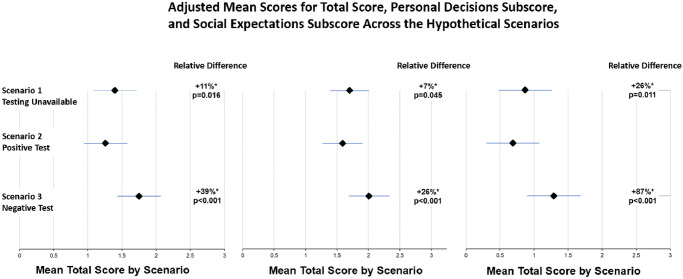
Participants from the United States were recruited through an online survey platform (Amazon Mechanical Turk) and randomized to one of three hypothetical scenarios. Each scenario asked participants to imagine having symptoms consistent with COVID-19 along with a clinical diagnosis from their physician. However, scenarios differed in either testing availability (testing available v. unavailable) or testing result (positive v. negative test). The primary outcome was intention to engage in high-risk COVID-19 behaviors, measured using an 11-item mean score (range 1-7) that was pre-registered prior to data collection. Multi-variable linear regression was used to compare the mean composite scores between conditions. The randomized survey was conducted between July 23rd to July 29th, 2020.
A total of 1400 participants were recruited through a national, online, opt-in survey. Out of 1194 respondents (41.6% male, 58.4% female) with a median age of 38.5 years, participants who had no testing available in their clinical scenario showed significantly greater intentions to engage in behavior facilitating COVID-19 transmission compared to those who received a positive confirmatory test result scenario (mean absolute difference (SE): 0.14 (0.06), P = 0.016), equating to an 11.1% increase in mean score risky behavior intentions. Intention to engage in behaviors that can spread COVID-19 were also positively associated with male gender, poor health status, and Republican party affiliation.
Testing availability appears to play an independent role in influencing behaviors facilitating COVID-19 transmission. Such findings shed light on the possible negative externalities of testing unavailability.
Effect of Availability of COVID-19 Testing on Choice to Isolate and Socially Distance, NCT04459520, https://clinicaltrials.gov/ct2/show/NCT04459520.
关于 COVID-19 检测如何影响人们从事危险行为的意愿,相关信息有限。了解诊断检测的行为效果可能突出了充分检测在控制病毒传播方面的作用。为了评估这些影响,本研究通过模拟场景评估了参与者在 COVID-19 诊断检测可用性和结果的基础上自我隔离的意愿。
本研究通过在线调查平台(亚马逊土耳其机器人)招募了来自美国的参与者,并将其随机分配到三个假设场景之一。每个场景都要求参与者想象自己出现了与 COVID-19 一致的症状,并收到了医生的临床诊断。但是,场景在检测可用性(可检测与不可检测)或检测结果(阳性与阴性检测)方面存在差异。主要结果是通过预先注册的 11 项平均得分(范围 1-7)衡量的参与高风险 COVID-19 行为的意愿。多变量线性回归用于比较条件之间的平均综合得分。随机调查于 2020 年 7 月 23 日至 7 月 29 日进行。
本研究通过全国性在线选择加入调查共招募了 1400 名参与者。在 1194 名应答者(41.6%为男性,58.4%为女性)中,有 11.9%的人报告说,在他们的临床场景中没有检测可用,他们表现出明显更大的意愿从事促进 COVID-19 传播的行为,而那些收到阳性确认检测结果场景的人则没有(平均绝对差异(SE):0.14(0.06),P=0.016),这相当于平均得分的风险行为意愿增加了 11.1%。参与可能传播 COVID-19 的行为的意愿也与男性性别、健康状况不佳和共和党党员身份呈正相关。
检测可用性似乎在影响促进 COVID-19 传播的行为方面发挥了独立作用。这些发现揭示了检测不可用可能带来的负面外部性。
COVID-19 检测可用性对隔离和社交距离选择的影响,NCT04459520,https://clinicaltrials.gov/ct2/show/NCT04459520。