National Institute of Parasitic Diseases, Chinese Center for Disease Control and Prevention, (Chinese Center for Tropical Diseases Research); Key Laboratory of Parasite and Vector Biology, National Health Commission of People's Republic of China; World Health Organization Collaborating Center for Tropical Diseases, Shanghai, China.
Shanghai University of Medicine & Health Sciences, Shanghai, China.
PLoS Pathog. 2022 Feb 2;18(2):e1010233. doi: 10.1371/journal.ppat.1010233. eCollection 2022 Feb.
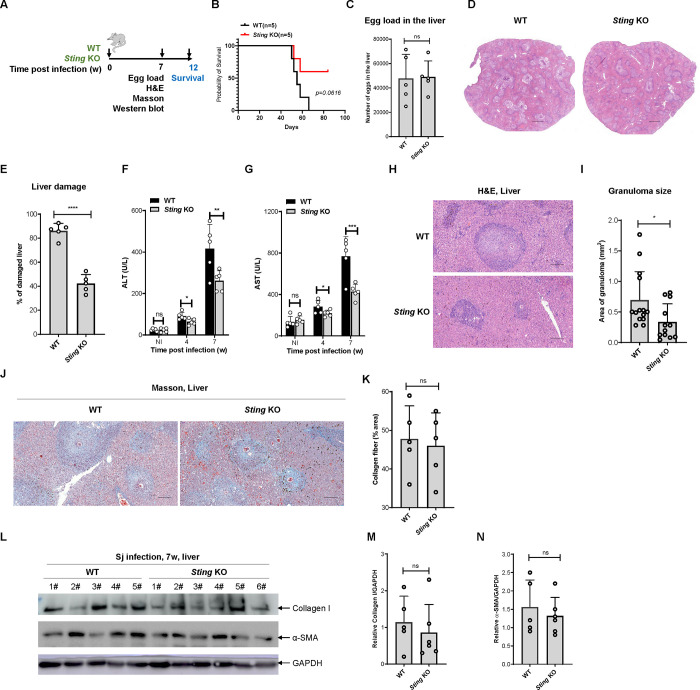
Schistosomiasis, which is caused by infection with Schistosoma spp., is characterized by granuloma and fibrosis in response to egg deposition. Pattern recognition receptors are important to sense invading Schistosoma, triggering an innate immune response, and subsequently shaping adaptive immunity. Cyclic GMP-AMP synthase (cGAS) was identified as a major cytosolic DNA sensor, which catalyzes the formation of cyclic GMP-AMP (cGAMP), a critical second messenger for the activation of the adaptor protein stimulator of interferon genes (STING). The engagement of STING by cGAMP leads to the activation of TANK-binding kinase 1 (TBK1), interferon regulatory factor 3 (IRF3), and the subsequent type I interferon (IFN) response. cGAS is suggested to regulate infectious diseases, autoimmune diseases, and cancer. However, the function of cGAS in helminth infection is unclear. In this study, we found that Cgas deficiency enhanced the survival of mice infected with S. japonicum markedly, without affecting the egg load in the liver. Consistently, Cgas deletion alleviated liver pathological impairment, reduced egg granuloma formation, and decreased fibrosis severity. In contrast, Sting deletion reduced the formation of egg granulomas markedly, but not liver fibrosis. Notably, Cgas or Sting deficiency reduced the production of IFNβ drastically in mice infected with S. japonicum. Intriguingly, intravenous administration of recombinant IFNβ exacerbated liver damage and promoted egg granuloma formation, without affecting liver fibrosis. Clodronate liposome-mediated depletion of macrophages indicated that macrophages are the major type of cells contributing to the induction of the type I IFN response during schistosome infection. Moreover, cGAS is important for type I IFN production and phosphorylation of TBK1 and IRF3 in response to stimulation with S. japonicum egg- or adult worm-derived DNA in macrophages. Our results clarified the immunomodulatory effect of cGAS in the regulation of liver granuloma formation during S. japonicum infection, involving sensing schistosome-derived DNA and producing type I IFN. Additionally, we showed that cGAS regulates liver fibrosis in a STING-type I-IFN-independent manner.
血吸虫病是由血吸虫属感染引起的,其特征是卵沉积后形成肉芽肿和纤维化。模式识别受体对于感知入侵的血吸虫、触发先天免疫反应以及随后塑造适应性免疫至关重要。环鸟苷酸-腺苷酸合酶(cGAS)被鉴定为主要的细胞质 DNA 传感器,它催化环鸟苷酸-腺苷酸(cGAMP)的形成,cGAMP 是激活干扰素基因刺激物(STING)衔接蛋白的关键第二信使。cGAMP 与 STING 的结合导致 TANK 结合激酶 1(TBK1)、干扰素调节因子 3(IRF3)的激活,以及随后的 I 型干扰素(IFN)反应。cGAS 被认为可以调节传染病、自身免疫性疾病和癌症。然而,cGAS 在寄生虫感染中的功能尚不清楚。在这项研究中,我们发现 Cgas 缺陷显著增强了日本血吸虫感染小鼠的存活率,而不影响肝脏中的卵负荷。一致地,Cgas 缺失减轻了肝病理损伤,减少了卵肉芽肿的形成,并降低了纤维化的严重程度。相比之下,Sting 缺失显著减少了卵肉芽肿的形成,但对肝纤维化没有影响。值得注意的是,Cgas 或 Sting 缺失使感染日本血吸虫的小鼠 IFNβ 的产生明显减少。有趣的是,静脉内给予重组 IFNβ 加剧了肝损伤并促进了卵肉芽肿的形成,而不影响肝纤维化。氯膦酸脂质体介导的巨噬细胞耗竭表明,在日本血吸虫感染过程中,巨噬细胞是诱导 I 型 IFN 反应的主要细胞类型。此外,cGAS 对于刺激日本血吸虫卵或成虫来源的 DNA 后,巨噬细胞中 I 型 IFN 的产生和 TBK1 和 IRF3 的磷酸化是重要的。我们的研究结果阐明了 cGAS 在日本血吸虫感染期间调节肝肉芽肿形成中的免疫调节作用,涉及感知寄生虫来源的 DNA 和产生 I 型 IFN。此外,我们表明 cGAS 在 STING-I 型 IFN 非依赖性方式下调节肝纤维化。