CCU Translational Immunology, Department of Internal Medicine, UKT, Tubingen, Germany.
Cluster of Excellence iFIT (EXC 2180) Image-Guided and Functionally Instructed Tumor Therapies, University of Tübingen, Tubingen, Germany.
J Immunother Cancer. 2022 Feb;10(2). doi: 10.1136/jitc-2021-003655.
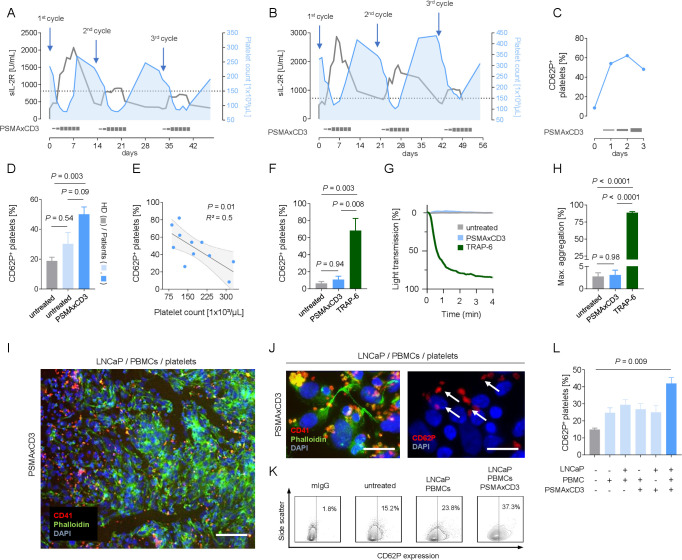
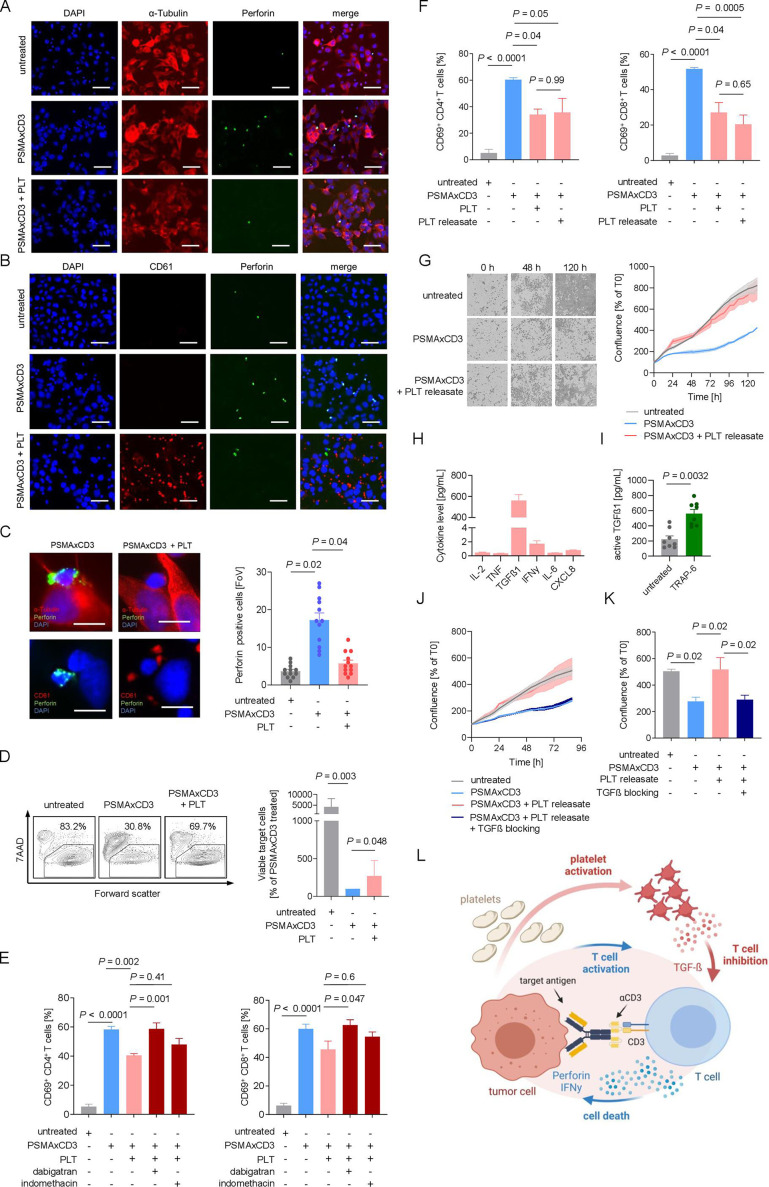
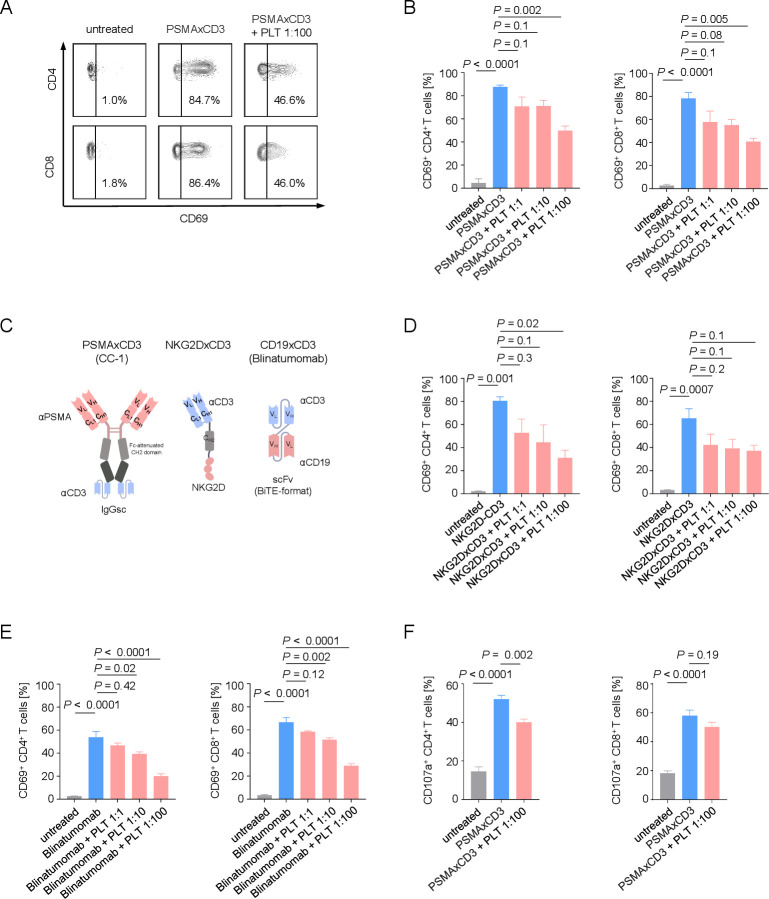
T cell-based immunotherapy, for example, with T cell-recruiting bispecific antibody (bsAb), has revolutionized oncological treatment. However, many patients do not respond to treatment, and long-term remissions are still rare. Several tumor immune evasion mechanisms have been reported to counteract efficiency of T cell-engaging therapeutics. Platelets largely affect cancer pathophysiology by mediating tumor invasion, metastasis, and immune evasion. On treatment of patients in a clinical trial with a PSMA×CD3 bsAb (NCT04104607), we observed profound treatment-associated platelet activation, mirrored by a decrease of total platelet count. On modeling the treatment setting, we found that platelet activation significantly reduced bsAb-mediated CD4 and CD8 T-cell reactivity as revealed by impaired T-cell degranulation, secretion of perforin, and ultimately, inhibition of target cell lysis. This effect occurred in a transforming growth factor beta (TGF-β)-dependent manner and was not restricted to PSMA×CD3 bsAb, but rather observed with various CD3-directed bispecific constructs, including the approved CD19×CD3 bsAb blinatumomab. BsAb-mediated T-cell reactivity could be restored by platelet inhibition and specifically by blocking the TGF-β axis. Together, our findings demonstrate that platelets undermine the efficacy of T cell-recruiting bsAb and identify modulation of platelet function as a means to reinforce the effectiveness of bsAb treatment.
以 T 细胞为基础的免疫疗法,例如利用 T 细胞募集双特异性抗体(bsAb),已经彻底改变了肿瘤学的治疗方法。然而,许多患者对治疗没有反应,长期缓解仍然很少见。已经报道了几种肿瘤免疫逃逸机制来对抗 T 细胞结合治疗的疗效。血小板通过介导肿瘤侵袭、转移和免疫逃逸,在很大程度上影响癌症的病理生理学。在一项用 PSMA×CD3 bsAb(NCT04104607)治疗患者的临床试验中,我们观察到治疗相关的血小板显著激活,表现为血小板总数减少。在模拟治疗环境时,我们发现血小板激活显著降低了 bsAb 介导的 CD4 和 CD8 T 细胞反应性,表现为 T 细胞脱颗粒、穿孔素分泌受损,最终靶细胞裂解受到抑制。这种效应是 TGF-β依赖性的,不仅限于 PSMA×CD3 bsAb,而且观察到各种 CD3 定向双特异性构建体,包括已批准的 CD19×CD3 bsAbblinatumomab。通过血小板抑制,特别是通过阻断 TGF-β 轴,可以恢复 bsAb 介导的 T 细胞反应性。综上所述,我们的研究结果表明,血小板削弱了 T 细胞募集 bsAb 的疗效,并确定了调节血小板功能是增强 bsAb 治疗效果的一种手段。