Department of Anesthesiology and Intensive Care, Hamamatsu University School of Medicine, 1-20-1 Handayama, Hamamatsu, Shizuoka 431-3192, Japan.
Exp Anim. 2022 Aug 5;71(3):281-287. doi: 10.1538/expanim.21-0186. Epub 2022 Feb 3.
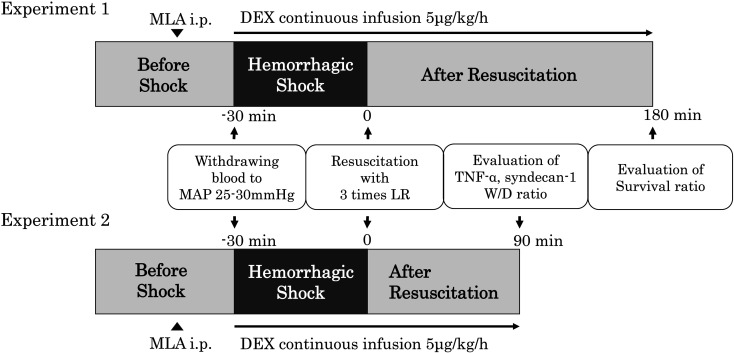
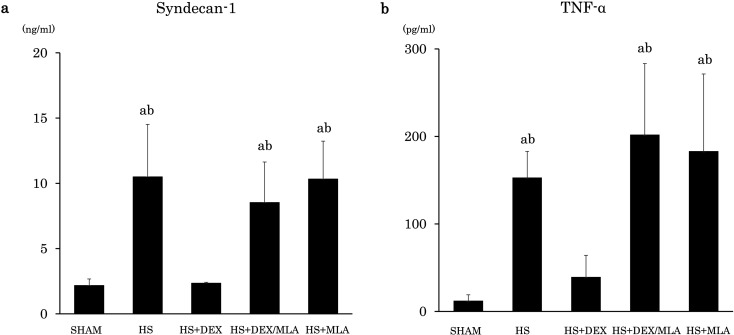
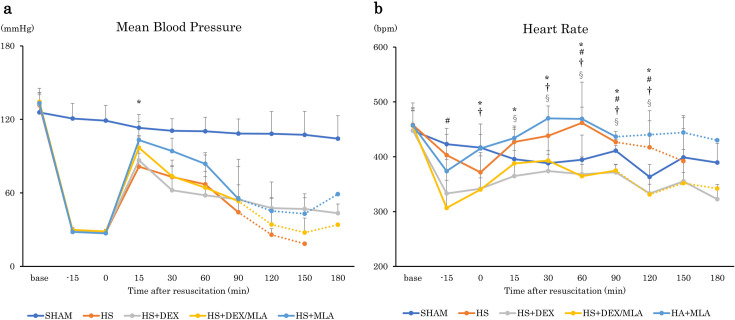
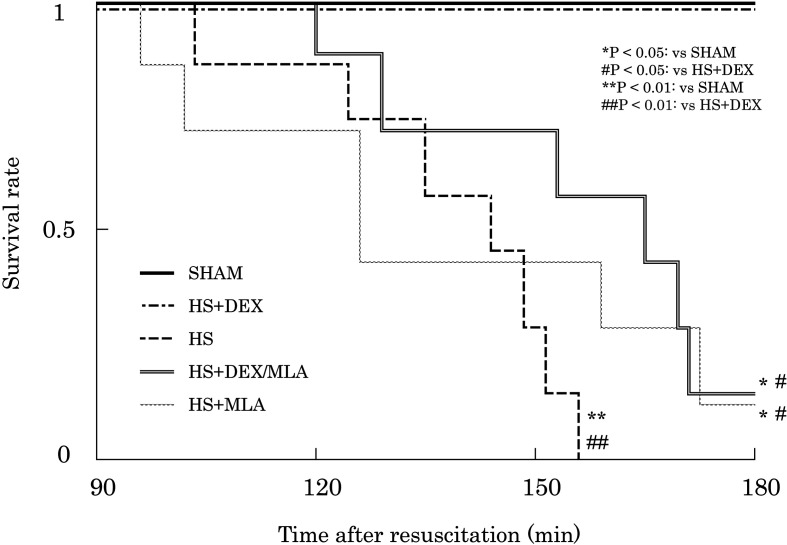
Hemorrhagic shock causes vascular endothelial glycocalyx (EGCX) damage and systemic inflammation. Dexmedetomidine (DEX) has anti-inflammatory and EGCX-protective effects, but its effect on hemorrhagic shock has not been investigated. Therefore, we investigated whether DEX reduces inflammation and protects EGCX during hemorrhagic shock. Anesthetized Sprague-Dawley rats were randomly assigned to five groups (n=7 per group): no shock (SHAM), hemorrhagic shock (HS), hemorrhagic shock with DEX (HS+DEX), hemorrhagic shock with DEX and the α7 nicotinic type acetylcholine receptor antagonist methyllycaconitine citrate (HS+DEX/MLA), and hemorrhagic shock with MLA (HS+MLA). HS was induced by shedding blood to a mean blood pressure of 25-30 mmHg, which was maintained for 30 min, after which rats were resuscitated with Ringer's lactate solution at three times the bleeding volume. The survival rate was assessed up to 3 h after the start of fluid resuscitation. Serum tumor necrosis factor-alpha (TNF-α) and syndecan-1 concentrations, and wet-to-dry ratio of the heart were measured 90 min after the start of fluid resuscitation. The survival rate after 3 h was significantly higher in the HS+DEX group than in the HS group. Serum TNF-α and syndecan-1 concentrations, and the wet-to-dry ratio of heart were elevated by HS, but significantly decreased by DEX. These effects were antagonized by MLA. DEX suppressed the inflammatory response and serum syndecan-1 elevation, and prolonged survival in rats with HS.
失血性休克导致血管内皮糖萼(EGCX)损伤和全身炎症。右美托咪定(DEX)具有抗炎和 EGCX 保护作用,但尚未研究其对失血性休克的影响。因此,我们研究了 DEX 是否在失血性休克期间减轻炎症并保护 EGCX。麻醉的 Sprague-Dawley 大鼠随机分为五组(每组 n=7):无休克(SHAM)、失血性休克(HS)、失血性休克加 DEX(HS+DEX)、失血性休克加 α7 烟碱型乙酰胆碱受体拮抗剂柠檬酸甲基金刚烷(HS+DEX/MLA)和 MLA 引起的失血性休克(HS+MLA)。HS 通过将血压降至 25-30 mmHg 并维持 30 min 来诱导,然后用三倍于出血量的乳酸林格氏液进行复苏。评估液体复苏开始后 3 h 的存活率。在液体复苏开始后 90 min 测量血清肿瘤坏死因子-α(TNF-α)和 syndecan-1 浓度以及心脏的湿干比。HS+DEX 组的存活率明显高于 HS 组。HS 导致血清 TNF-α和 syndecan-1 浓度以及心脏的湿干比升高,但 DEX 显著降低。MLA 拮抗了这些作用。DEX 抑制了炎症反应和血清 syndecan-1 升高,并延长了 HS 大鼠的存活时间。