Koutroulis Ioannis, Velez Tom, Wang Tony, Yohannes Seife, Galarraga Jessica E, Morales Joseph A, Freishtat Robert J, Chamberlain James M
Emergency Medicine Children's National Hospital/George Washington University School of Medicine and Health Sciences Washington District of Columbia USA.
Computer Technology Associates Cardiff California USA.
J Am Coll Emerg Physicians Open. 2022 Jan 25;3(1):e12660. doi: 10.1002/emp2.12660. eCollection 2022 Feb.
The heterogeneity of pediatric sepsis patients suggests the potential benefits of clustering analytics to derive phenotypes with distinct host response patterns that may help guide personalized therapeutics. We evaluate the relative performance of latent class analysis (LCA) and K-means, 2 commonly used clustering methods toward the derivation of clinically useful pediatric sepsis phenotypes.
Data were extracted from anonymized medical records of 6446 pediatric patients that presented to 1 of 6 emergency departments (EDs) between 2013 and 2018 and were thereafter admitted. Using International Classification of Diseases (ICD)-9 and ICD-10 discharge codes, 151 patients were identified with a sepsis continuum diagnosis that included septicemia, sepsis, severe sepsis, and septic shock. Using feature sets used in related clustering studies, LCA and K-means algorithms were used to derive 4 distinct phenotypic pediatric sepsis segmentations. Each segmentation was evaluated for phenotypic homogeneity, separation, and clinical use.
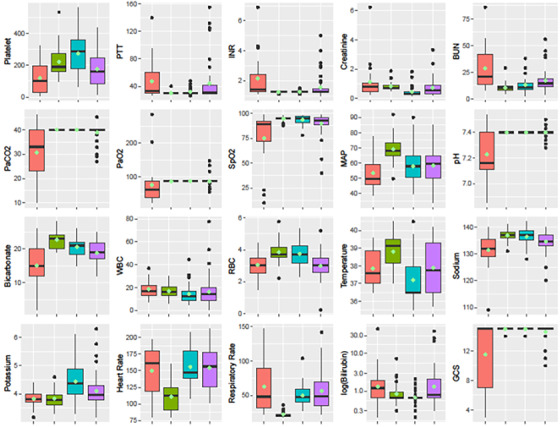
Using the 2 feature sets, LCA clustering resulted in 2 similar segmentations of 4 clinically distinct phenotypes, while K-means clustering resulted in segmentations of 3 and 4 phenotypes. All 4 segmentations identified at least 1 high severity phenotype, but LCA-identified phenotypes reflected superior stratification, high entropy approaching 1 (eg, 0.994) indicating excellent separation between estimated phenotypes, and differential treatment/treatment response, and outcomes that were non-randomly distributed across phenotypes ( < 0.001).
Compared to K-means, which is commonly used in clustering studies, LCA appears to be a more robust, clinically useful statistical tool in analyzing a heterogeneous pediatric sepsis cohort toward informing targeted therapies. Additional prospective studies are needed to validate clinical utility of predictive models that target derived pediatric sepsis phenotypes in emergency department settings.
儿童脓毒症患者的异质性表明聚类分析可能有助于识别具有不同宿主反应模式的表型,从而指导个性化治疗。我们评估了潜在类别分析(LCA)和K均值这两种常用聚类方法在推导具有临床实用性的儿童脓毒症表型方面的相对性能。
数据来自2013年至2018年间在6个急诊科之一就诊并随后入院的6446例儿科患者的匿名医疗记录。使用国际疾病分类(ICD)-9和ICD-10出院编码,确定了151例患有脓毒症连续诊断的患者,包括败血症、脓毒症、严重脓毒症和感染性休克。使用相关聚类研究中使用的特征集,LCA和K均值算法用于推导4种不同的儿童脓毒症表型分类。对每个分类进行表型同质性、分离度和临床实用性评估。
使用这2个特征集,LCA聚类产生了2个相似的分类,包含4种临床不同的表型,而K均值聚类产生了3种和4种表型的分类。所有4种分类都识别出至少1种高严重度表型,但LCA识别出的表型显示出更好的分层,高熵接近1(例如0.994),表明估计表型之间的分离良好,以及不同的治疗/治疗反应,并且结果在各表型之间非随机分布(<0.001)。
与聚类研究中常用的K均值相比,LCA似乎是一种更强大、具有临床实用性的统计工具,可用于分析异质性儿童脓毒症队列以指导靶向治疗。需要更多前瞻性研究来验证针对急诊科环境中推导的儿童脓毒症表型的预测模型的临床实用性。