Innovation Research & Training, 5316 Highgate Drive, Suite 125, Durham, NC, 27713, USA.
J Youth Adolesc. 2022 Apr;51(4):708-723. doi: 10.1007/s10964-021-01567-0. Epub 2022 Feb 3.
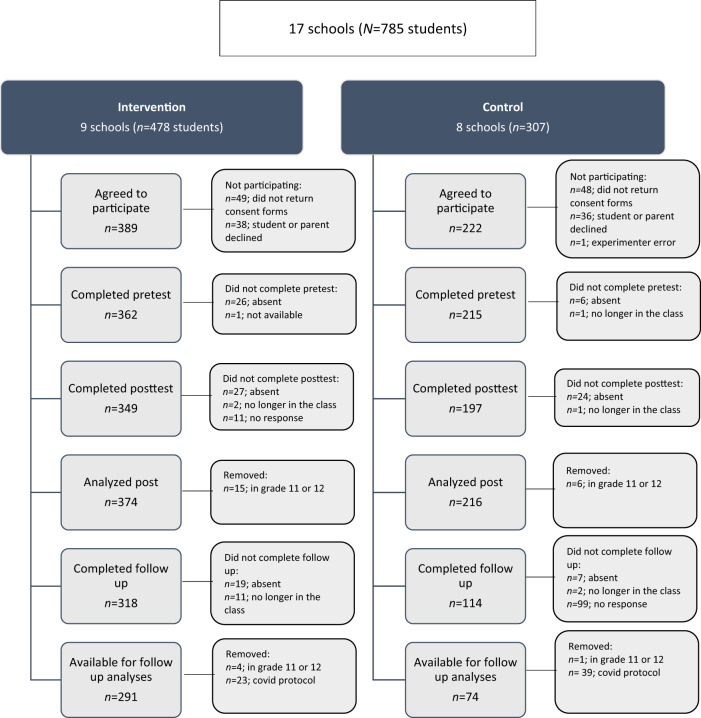
Media may function as sex educators for adolescents; unfortunately, media messages often glamorize risky sexual behaviors and unhealthy relationships and neglect sexual health behaviors and communication. Media Aware is a web-based comprehensive sexual health program for high school students that uses a media literacy education approach. It is designed to improve adolescents' critical thinking about media messages and provide medically-accurate information and skills building related to sexual health and communication. A randomized controlled trial was conducted in 2019-2020 with students (grades 9 and 10; n = 590) from 17 high schools across the United States. The sample was 53% female, 58% white/Caucasian; and 13% Hispanic/Latinx. One high school teacher per school and all of their 9th and 10th grade students were randomly assigned to either the intervention or delayed-intervention (control) condition. The study assessed the immediate (posttest) and short-term (3-month) effects of Media Aware on adolescents' media, sexual health, and communication outcomes. For 9 of the 17 schools, students were home from school due to the beginning of the COVID-19 pandemic during the time of their 3-month data collection, which left the short-term analyses underpowered. However, several impacts of the program were found in the immediate posttest analyses. Media Aware was found to improve sexual health knowledge and redress inaccurate normative beliefs about the frequency of risky teen sex. Media Aware also improved critical thinking about media messages with demonstrated improvements in media message deconstruction skills and decreases in the perceived realism of media messages. Moderator analyses found some differential immediate effects of the program attributable to gender. Media Aware reduced girls' normative beliefs about teen sex, generally, and increased their sexual health communication with parents as well as reduced boys' acceptance of dating violence. Students gave positive feedback about Media Aware, especially related to the online format of the program. The results from this study provide evidence that Media Aware is an effective web-based program for positively enhancing high school students' media, sexual health, and sexual health communication outcomes.
媒体可以充当青少年的性教育者;但遗憾的是,媒体信息往往美化冒险性行为和不健康的关系,而忽略了性健康行为和沟通。Media Aware 是一个面向高中生的基于网络的综合性性健康计划,它采用媒体素养教育方法。它旨在提高青少年对媒体信息的批判性思维,并提供与性健康和沟通相关的医学准确信息和技能建设。一项随机对照试验于 2019-2020 年在美国 17 所高中的学生(9 年级和 10 年级;n=590)中进行。样本中 53%为女性,58%为白种人/高加索人;13%为西班牙裔/拉丁裔。每所学校一名高中教师和他们所有的 9 年级和 10 年级学生被随机分配到干预组或延迟干预组(对照组)。该研究评估了 Media Aware 对青少年媒体、性健康和沟通结果的即时(后测)和短期(3 个月)影响。对于 17 所学校中的 9 所,由于 COVID-19 大流行开始,学生在 3 个月数据收集期间离开学校,这使得短期分析的能力不足。然而,在即时后测分析中发现了该计划的几个影响。Media Aware 提高了性健康知识,并纠正了关于青少年风险性行为频率的不准确规范信念。Media Aware 还提高了对媒体信息的批判性思维,表现为媒体信息解构技能的提高和媒体信息感知真实性的降低。调节分析发现,由于性别差异,该计划有一些即时的影响。Media Aware 减少了女孩对青少年性的一般规范信念,并增加了她们与父母的性健康沟通,同时减少了男孩对约会暴力的接受。学生对 Media Aware 给予了积极的反馈,尤其是对该计划的在线格式。这项研究的结果提供了证据,表明 Media Aware 是一个有效的基于网络的计划,可以积极提高高中生的媒体、性健康和性健康沟通结果。