Department of Biochemical Engineering, School of Chemical Engineering and Technology, Tianjin University, Tianjin, China.
Frontiers Science Center for Synthetic Biology and Key Laboratory of Systems Bioengineering (Ministry of Education), Tianjin University, Tianjin, China.
Front Immunol. 2022 Jan 18;12:838082. doi: 10.3389/fimmu.2021.838082. eCollection 2021.
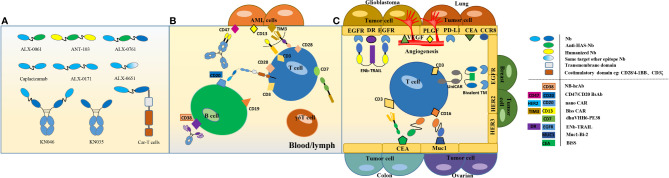
Recombinant antibodies such as nanobodies are progressively demonstrating to be a valid alternative to conventional monoclonal antibodies also for clinical applications. Furthermore, they do not solely represent a substitute for monoclonal antibodies but their unique features allow expanding the applications of biotherapeutics and changes the pattern of disease treatment. Nanobodies possess the double advantage of being small and simple to engineer. This combination has promoted extremely diversified approaches to design nanobody-based constructs suitable for particular applications. Both the format geometry possibilities and the functionalization strategies have been widely explored to provide macromolecules with better efficacy with respect to single nanobodies or their combination. Nanobody multimers and nanobody-derived reagents were developed to image and contrast several cancer diseases and have shown their effectiveness in animal models. Their capacity to block more independent signaling pathways simultaneously is considered a critical advantage to avoid tumor resistance, whereas the mass of these multimeric compounds still remains significantly smaller than that of an IgG, enabling deeper penetration in solid tumors. When applied to CAR-T cell therapy, nanobodies can effectively improve the specificity by targeting multiple epitopes and consequently reduce the side effects. This represents a great potential in treating malignant lymphomas, acute myeloid leukemia, acute lymphoblastic leukemia, multiple myeloma and solid tumors. Apart from cancer treatment, multispecific drugs and imaging reagents built with nanobody blocks have demonstrated their value also for detecting and tackling neurodegenerative, autoimmune, metabolic, and infectious diseases and as antidotes for toxins. In particular, multi-paratopic nanobody-based constructs have been developed recently as drugs for passive immunization against SARS-CoV-2 with the goal of impairing variant survival due to resistance to antibodies targeting single epitopes. Given the enormous research activity in the field, it can be expected that more and more multimeric nanobody molecules will undergo late clinical trials in the next future. Systematic Review Registration.
重组抗体,如纳米抗体,逐渐证明是传统单克隆抗体的有效替代品,也适用于临床应用。此外,它们不仅是单克隆抗体的替代品,而且其独特的特性还可以扩展生物治疗药物的应用并改变疾病治疗模式。纳米抗体具有小而易于工程设计的双重优势。这种组合促进了设计基于纳米抗体的构建体的多样化方法,这些构建体适用于特定的应用。不仅格式几何可能性,而且功能化策略都得到了广泛的探索,以提供相对于单个纳米抗体或其组合具有更好疗效的大分子。纳米抗体多聚体和纳米抗体衍生试剂已被开发用于成像和对比几种癌症,并在动物模型中显示出其有效性。它们能够同时阻断更多独立的信号通路,这被认为是避免肿瘤耐药的关键优势,而这些多聚体化合物的质量仍然明显小于 IgG,从而能够更深入地渗透到实体肿瘤中。当应用于 CAR-T 细胞疗法时,纳米抗体可以通过靶向多个表位有效地提高特异性,从而降低副作用。这在治疗恶性淋巴瘤、急性髓细胞白血病、急性淋巴细胞白血病、多发性骨髓瘤和实体瘤方面具有巨大的潜力。除了癌症治疗,使用纳米抗体构建的多特异性药物和成像试剂还证明了它们在检测和治疗神经退行性、自身免疫、代谢和传染病以及作为毒素解毒剂方面的价值。特别是,最近已经开发了多价纳米抗体基构建体作为针对 SARS-CoV-2 的被动免疫药物,目的是由于针对单个表位的抗体的耐药性而损害变体的存活。鉴于该领域的巨大研究活动,可以预期在未来的不久将会有越来越多的多聚体纳米抗体分子进入后期临床试验。系统评价注册。