Yuan Li-Qun, Zhang Tan, Xu Liang, Han Hui, Liu Shi-Hai
Neurosurgery Department, The Second Affiliated Hospital of Soochow University, Suzhou, China.
Transl Cancer Res. 2021 Jan;10(1):337-348. doi: 10.21037/tcr-19-2957.
Glioma is a highly malignant brain tumor, characterized by the poor prognosis and high recurrence rates. Previous studies have confirmed that miRNA-30c-5p is closely associated with tumor cell biological properties. The present study explored the biological role of miR-30c-5p in human glioma malignant behavior and underlying mechanisms.
Levels of miR-30c-5p were detected in glioma tissues and adjacent normal tissues. Two glioma cell lines including U87 and U251 were transfected with miR-30c-5p mimic or inhibitors. Cell proliferation was evaluated by MTT assay and colony formation assay. Cell apoptosis and invasive potential of glioma cells were assessed by flow cytometry and transwell assays, respectively. Luciferase reporter assay was performed to validate the target gene of miR-30c-5p.
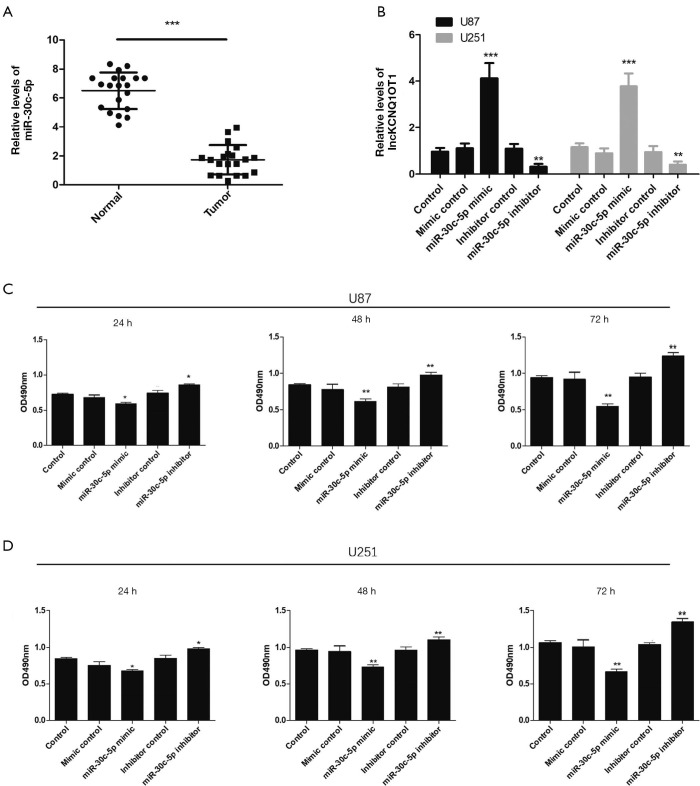
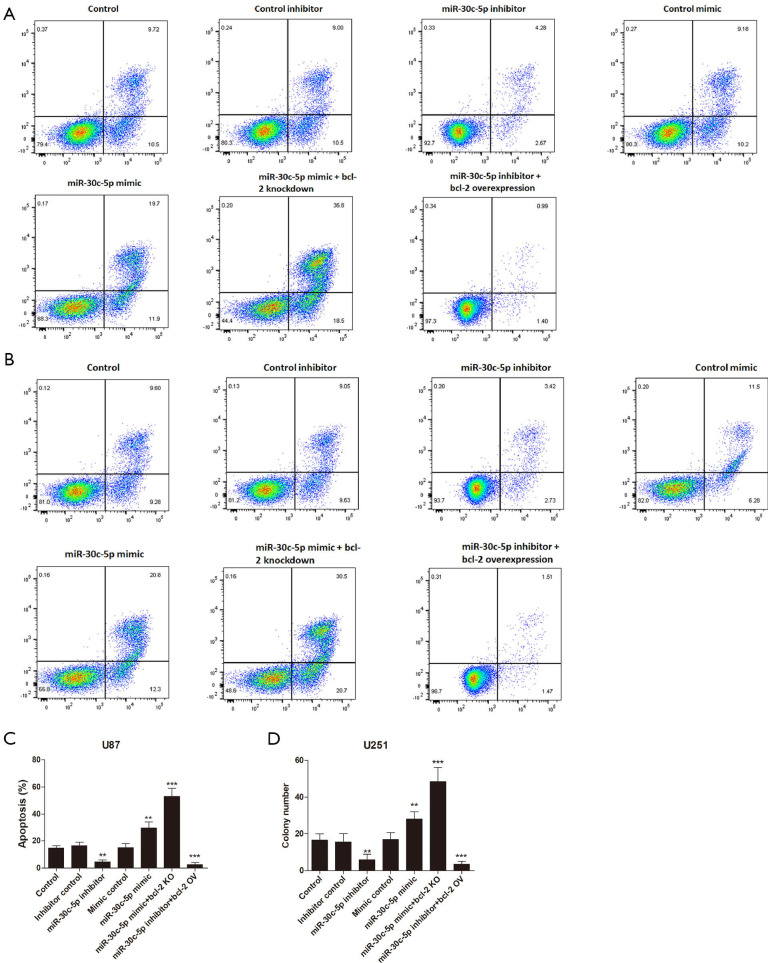
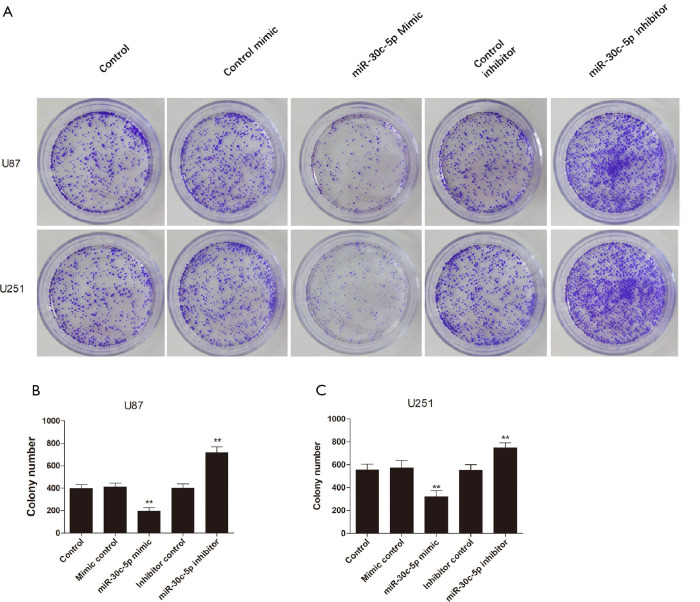
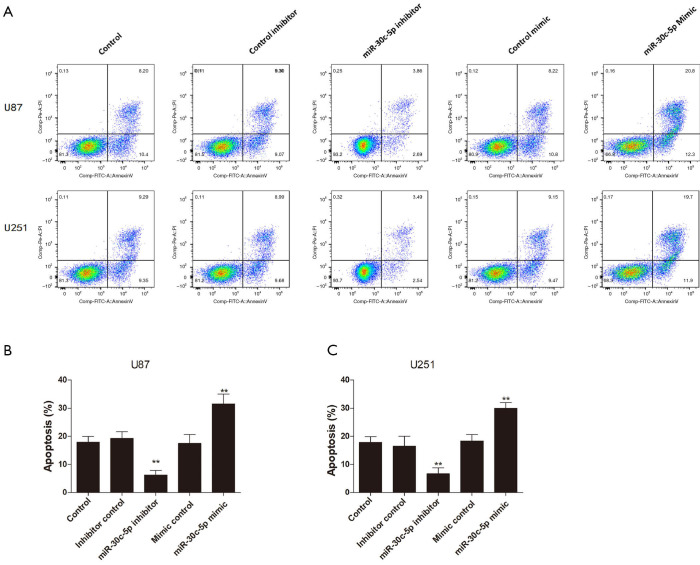
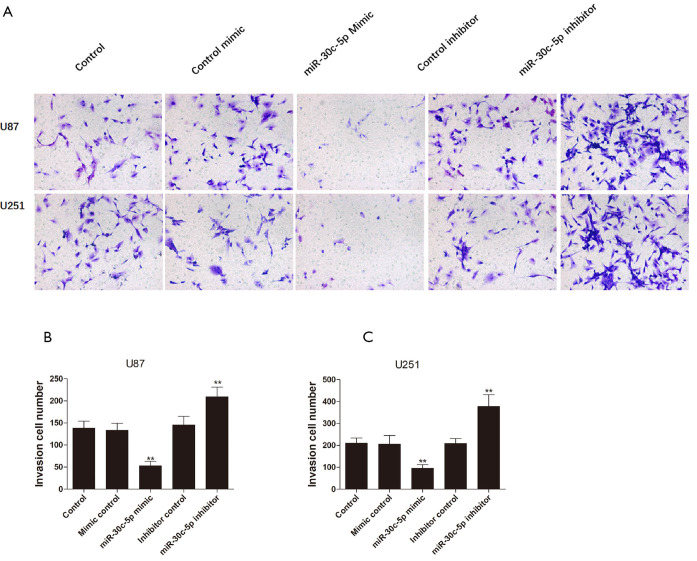
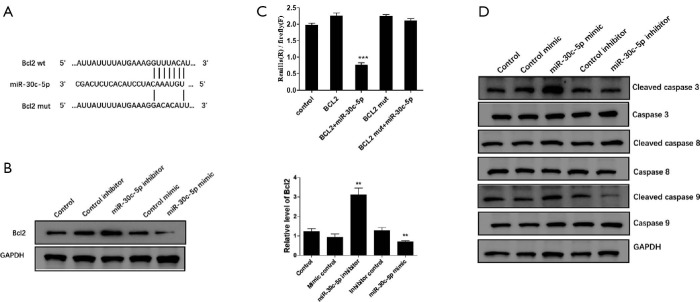
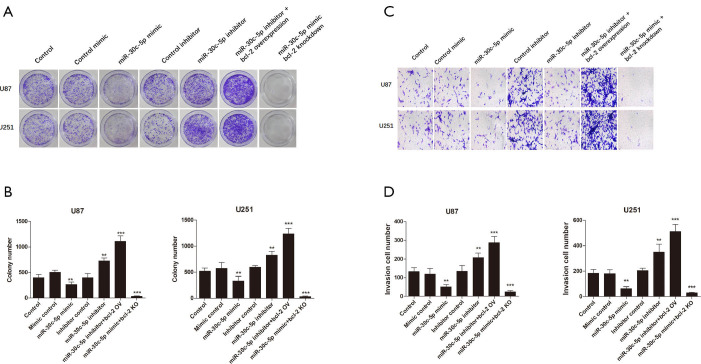
Levels of miR-30c-5p were dramatically decreased in glioma tissues as compared to the adjacent normal tissues. Upregulation of miR-30c-5p significantly suppressed cell growth and colony formation, and induced apoptosis in glioma cells. In contrast, inhibition of miR-30c-5p promoted the proliferation and inhibited apoptosis in tumor cells. Furthermore, miR-30c-5p strongly suppresses the invasion of glioma cells. Western blot showed that Bcl-2 was significantly decreased following treatment with miR-30c-5p mimics and increased after miR-30c-5p inhibitor treatment. Moreover, luciferase reporter assays indicated that transfection of miR-30c-5p led to a marked reduction of luciferase activity, but had no effect on Bcl-2 3'-UTR mutated fragment. Mechanically, miR-30c-5p promoted the activation of caspase 3 and caspase 9 in glioma cells. Furthermore, miR-30c-5p promoted apoptosis and inhibited colony formation and migration, and knockdown of Bcl2 further increased the number of apoptotic cells and suppressed colony formation and migration of glioma cells. By contrast, miR-30c-5p inhibitors decreased apoptosis and increased colony formation and migration, and restored Bcl2 expression further suppressed glioma cell apoptosis and enhanced colony formation and migration.
These results demonstrated that miR-30c-5p regulated growth, apoptosis and migration in glioma cells by targeting Bcl2, suggesting that miR-30c-5p might serve as a novel target for glioma therapy.
胶质瘤是一种高度恶性的脑肿瘤,预后差且复发率高。既往研究证实,miRNA-30c-5p与肿瘤细胞生物学特性密切相关。本研究探讨miR-30c-5p在人胶质瘤恶性行为中的生物学作用及其潜在机制。
检测胶质瘤组织及癌旁正常组织中miR-30c-5p的水平。将miR-30c-5p模拟物或抑制剂转染至U87和U251两种胶质瘤细胞系。通过MTT法和集落形成试验评估细胞增殖。分别采用流式细胞术和Transwell试验评估胶质瘤细胞的凋亡和侵袭能力。进行荧光素酶报告基因试验以验证miR-30c-5p的靶基因。
与癌旁正常组织相比,胶质瘤组织中miR-30c-5p水平显著降低。上调miR-30c-5p可显著抑制胶质瘤细胞的生长和集落形成,并诱导其凋亡。相反,抑制miR-30c-5p可促进肿瘤细胞增殖并抑制其凋亡。此外,miR-30c-5p强烈抑制胶质瘤细胞的侵袭。蛋白质印迹法显示,用miR-30c-5p模拟物处理后Bcl-2显著降低,而用miR-30c-5p抑制剂处理后Bcl-2升高。此外,荧光素酶报告基因试验表明,转染miR-30c-5p导致荧光素酶活性显著降低,但对Bcl-2 3'-UTR突变片段无影响。机制上,miR-30c-5p促进胶质瘤细胞中caspase 3和caspase 9的激活。此外,miR-30c-5p促进凋亡并抑制集落形成和迁移,敲低Bcl2进一步增加凋亡细胞数量并抑制胶质瘤细胞的集落形成和迁移。相反,miR-30c-5p抑制剂降低凋亡并增加集落形成和迁移,恢复Bcl2表达进一步抑制胶质瘤细胞凋亡并增强集落形成和迁移。
这些结果表明,miR-30c-5p通过靶向Bcl2调节胶质瘤细胞的生长、凋亡和迁移,提示miR-30c-5p可能成为胶质瘤治疗的新靶点。