Takemoto Genta, Matsushita Masaki, Okamoto Takaaki, Ito Toshinari, Matsuura Yuki, Takashima Chieko, Chen-Yoshikawa Toyofumi Fengshi, Ebi Hiromichi, Imagama Shiro, Kitoh Hiroshi, Ohno Kinji, Hosono Yasuyuki
Department of Orthopaedic Surgery, Nagoya University Graduate School of Medicine, Nagoya, Japan.
Division of Neurogenetics, Center for Neurological Diseases and Cancer, Nagoya University Graduate School of Medicine, Nagoya, Japan.
Front Cell Dev Biol. 2022 Jan 18;9:694018. doi: 10.3389/fcell.2021.694018. eCollection 2021.
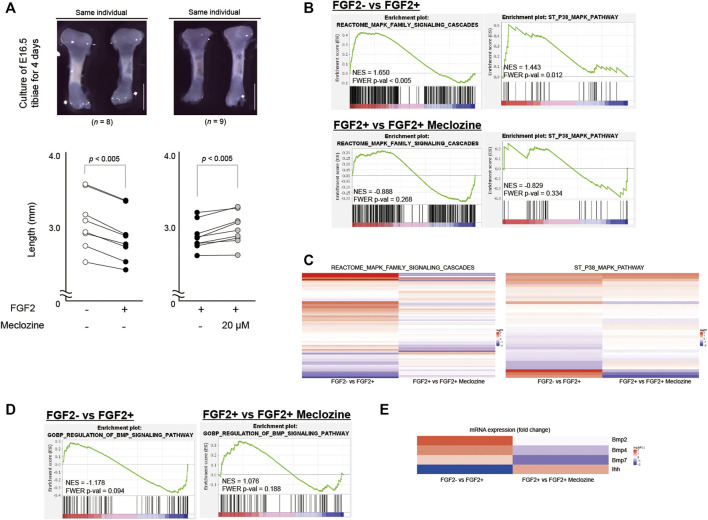
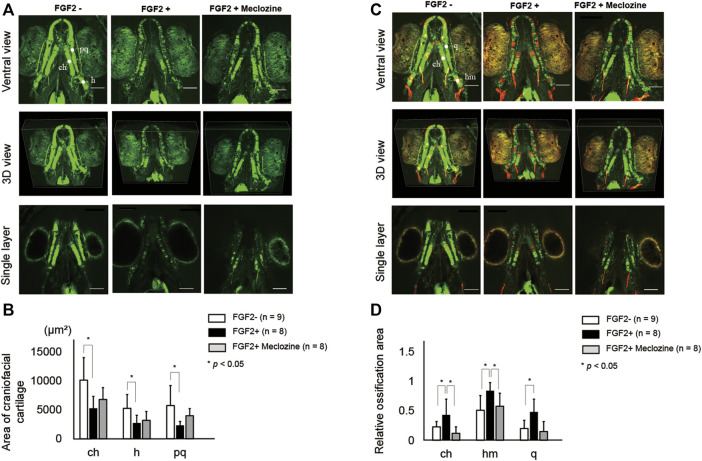
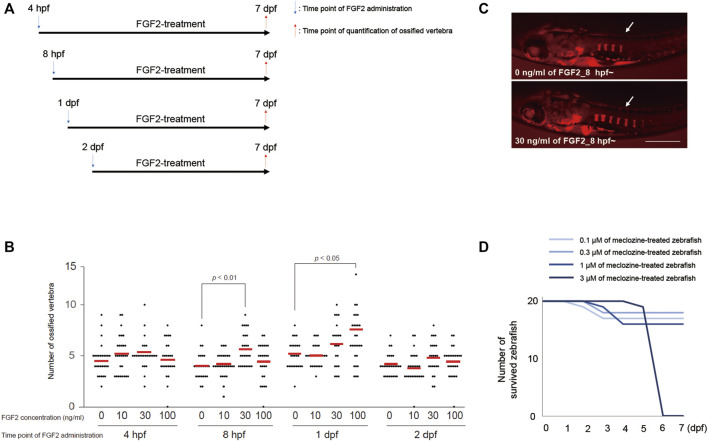
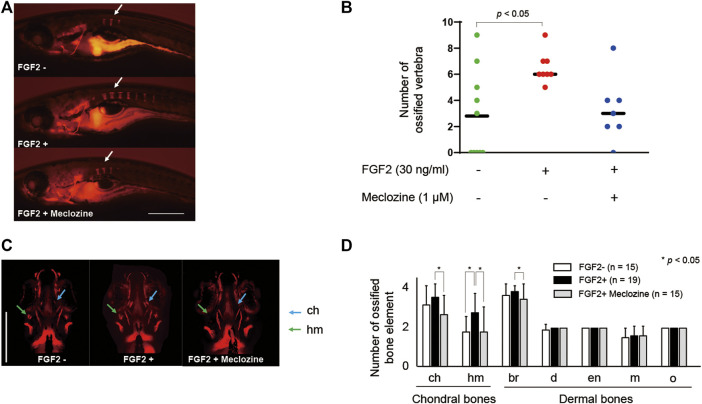
Meclozine has been developed as an inhibitor of fibroblast growth factor receptor 3 (FGFR3) to treat achondroplasia (ACH). Extracellular signal regulated kinase (ERK) phosphorylation was attenuated by meclozine in FGF2-treated chondrocyte cell line, but the site of its action has not been elucidated. Although orally administered meclozine promoted longitudinal bone growth in a mouse model of ACH, its effect on craniofacial bone development during the early stage remains unknown. Herein, RNA-sequencing analysis was performed using murine chondrocytes from FGF2-treated cultured tibiae, which was significantly elongated by meclozine treatment. Gene set enrichment analysis demonstrated that FGF2 significantly increased the enrichment score of mitogen-activated protein kinase (MAPK) family signaling cascades in chondrocytes; however, meclozine reduced this enrichment. Next, we administered meclozine to FGF2-treated larval zebrafish from 8 h post-fertilization (hpf). We observed that FGF2 significantly increased the number of ossified vertebrae in larval zebrafish at 7 days post-fertilization (dpf), while meclozine delayed vertebral ossification in FGF2-induced zebrafish. Meclozine also reversed the FGF2-induced upregulation of ossified craniofacial bone area, including ceratohyal, hyomandibular, and quadrate. The current study provided additional evidence regarding the inhibitory effect of meclozine on the FGF2-induced upregulation of MAPK signaling in chondrocytes and FGF2-induced development of craniofacial and vertebral bones.
美克洛嗪已被开发为成纤维细胞生长因子受体3(FGFR3)抑制剂,用于治疗软骨发育不全(ACH)。在FGF2处理的软骨细胞系中,美克洛嗪可减弱细胞外信号调节激酶(ERK)的磷酸化,但尚未阐明其作用位点。尽管口服美克洛嗪可促进ACH小鼠模型的纵向骨生长,但其对早期颅面骨发育的影响仍不清楚。在此,我们对来自FGF2处理的培养胫骨的小鼠软骨细胞进行了RNA测序分析,美克洛嗪处理显著延长了该胫骨。基因集富集分析表明,FGF2显著增加了软骨细胞中有丝分裂原活化蛋白激酶(MAPK)家族信号级联的富集分数;然而,美克洛嗪降低了这种富集。接下来,我们从受精后8小时(hpf)开始对FGF2处理的斑马鱼幼体施用美克洛嗪。我们观察到,FGF2显著增加了受精后7天(dpf)斑马鱼幼体的骨化椎骨数量,而美克洛嗪延迟了FGF2诱导的斑马鱼的椎体骨化。美克洛嗪还逆转了FGF2诱导的包括角舌骨、鳃盖骨和方骨在内的颅面骨骨化面积的上调。本研究提供了额外的证据,证明美克洛嗪对FGF2诱导的软骨细胞中MAPK信号上调以及FGF2诱导的颅面骨和椎骨发育具有抑制作用。