Yang Dan, Liu Han-Qing, Liu Fang-Yuan, Guo Zhen, An Peng, Wang Ming-Yu, Yang Zheng, Fan Di, Tang Qi-Zhu
Department of Cardiology, Renmin Hospital of Wuhan University, Wuhan, China.
Hubei Key Laboratory of Metabolic and Chronic Diseases, Wuhan, China.
Front Cardiovasc Med. 2022 Jan 18;8:822969. doi: 10.3389/fcvm.2021.822969. eCollection 2021.
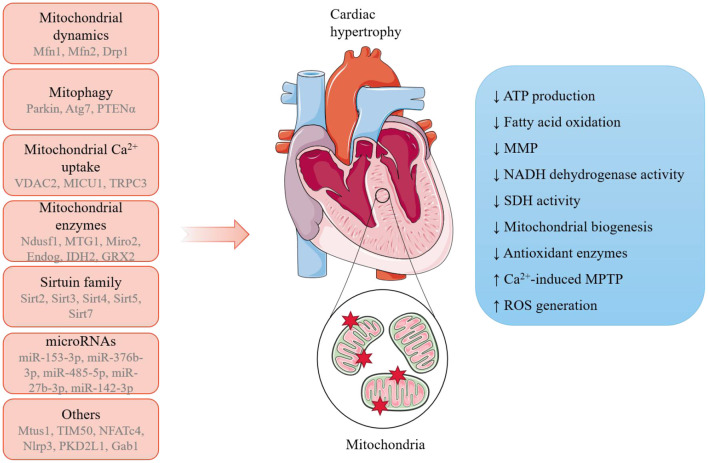
Cardiac hypertrophy, a stereotypic cardiac response to increased workload, ultimately progresses to severe contractile dysfunction and uncompensated heart failure without appropriate intervention. Sustained cardiac overload inevitably results in high energy consumption, thus breaking the balance between mitochondrial energy supply and cardiac energy demand. In recent years, accumulating evidence has indicated that mitochondrial dysfunction is implicated in pathological cardiac hypertrophy. The significant alterations in mitochondrial energetics and mitochondrial proteome composition, as well as the altered expression of transcripts that have an impact on mitochondrial structure and function, may contribute to the initiation and progression of cardiac hypertrophy. This article presents a summary review of the morphological and functional changes of mitochondria during the hypertrophic response, followed by an overview of the latest research progress on the significant modulatory roles of mitochondria in cardiac hypertrophy. Our article is also to summarize the strategies of mitochondria-targeting as therapeutic targets to treat cardiac hypertrophy.
心脏肥大是心脏对增加的工作负荷的一种典型反应,如果没有适当干预,最终会发展为严重的收缩功能障碍和失代偿性心力衰竭。持续的心脏负荷过重不可避免地导致高能量消耗,从而打破线粒体能量供应与心脏能量需求之间的平衡。近年来,越来越多的证据表明线粒体功能障碍与病理性心脏肥大有关。线粒体能量代谢和线粒体蛋白质组组成的显著变化,以及影响线粒体结构和功能的转录本表达改变,可能有助于心脏肥大的发生和发展。本文对肥大反应过程中线粒体的形态和功能变化进行了综述,随后概述了线粒体在心脏肥大中的重要调节作用的最新研究进展。我们的文章还总结了将线粒体作为治疗心脏肥大的治疗靶点的策略。