De Ryck Iris, Sarakinou Eleanna, Nakakana Usman, Cilio Giulia Luna, Ndiaye Augustin, Vella Venanzio, Auerbach Joachim, Granada Juan-Paolo, Conti Valentino, Podda Audino
GSK, Siena, Italy.
GSK Vaccines Institute for Global Health, Via Fiorentina 1, 53100, Siena, Italy.
Infect Dis Ther. 2022 Apr;11(2):757-770. doi: 10.1007/s40121-022-00596-x. Epub 2022 Feb 3.
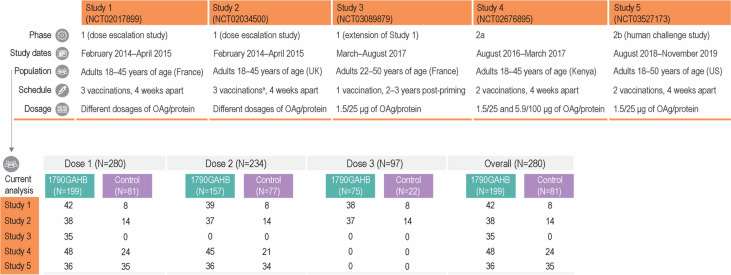
Shigellosis is a major health concern among children < 5 years of age from developing countries, and there are no widely available vaccines to prevent it. The GMMA-based 1790GAHB investigational vaccine against Shigella sonnei was well tolerated and immunogenic in phase 1 and 2 studies conducted in healthy adults from Shigella endemic and non-endemic populations. Based on pooled data of five individual trials, we assessed the association between vaccine administration and the risk of neutropenia as well as the overall safety profile of 1790GAHB.
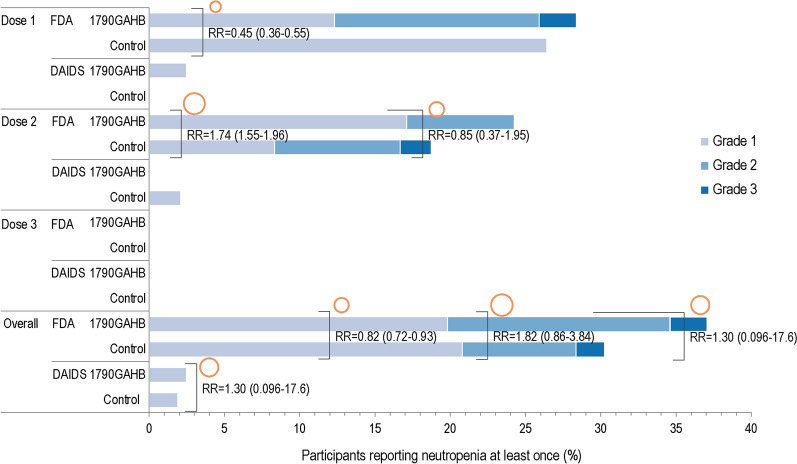
The risk ratio (RR) of neutropenia was evaluated between participants receiving 1790GAHB (vaccinees) and active comparator/placebo (controls) using different ethnicity-specific absolute neutrophil count (ANC) thresholds established to define neutropenia. Safety was assessed in terms of solicited, unsolicited, and serious adverse events (AEs).
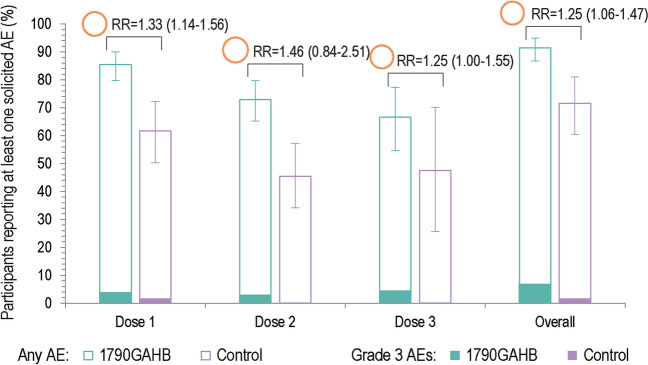
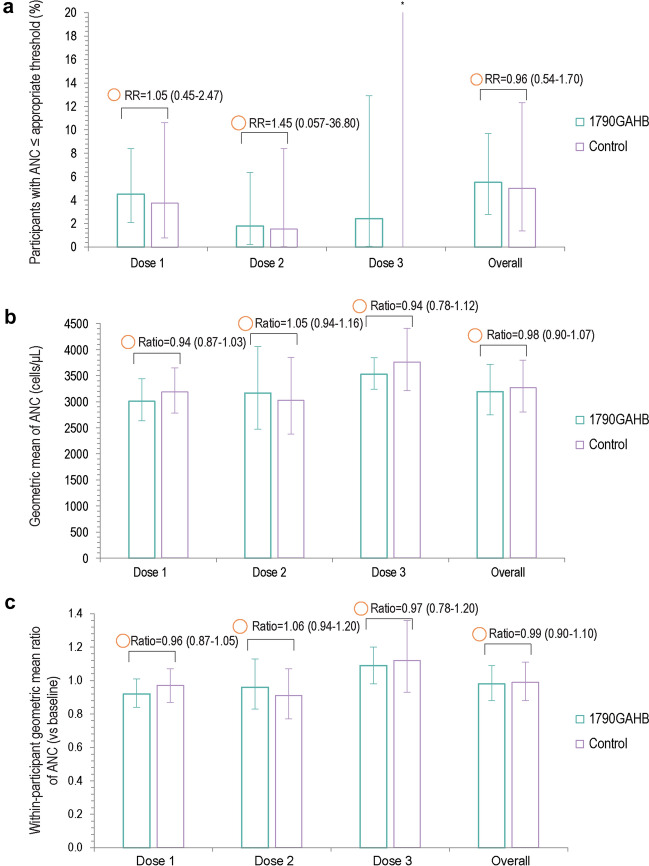
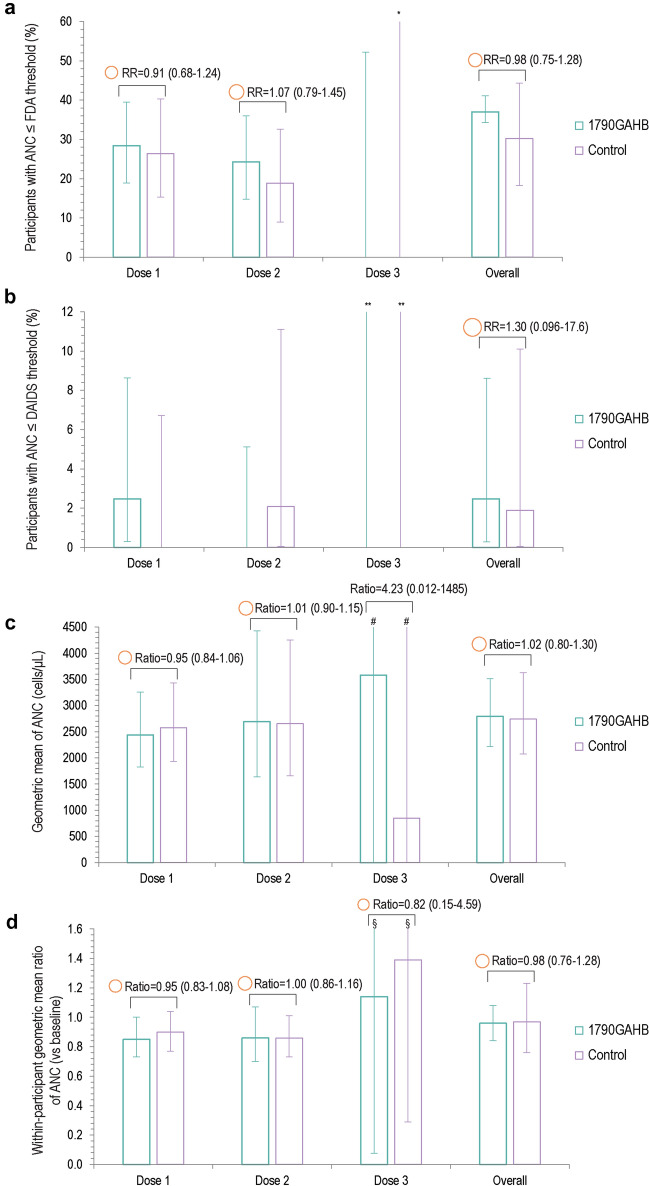
Of the 279 participants, 11 (5.5%) vaccinees and 4 (5.0%) controls had ANC below the appropriate threshold within 7 days post-vaccination. RR was 0.96 [95% confidence interval (CI) 0.54-1.70]. When neutrophil counts of participants of African descent were measured against an ethnicity non-specific threshold, they resulted in neutropenia episodes in 30 (37.0%) vaccinees and 16 (30.2%) controls, while only 2 (2.5%) vaccinees and 1 (1.9%) control had neutropenia when the ethnicity-specific threshold was applied. RRs were 0.98 (95% CI 0.75-1.28) and 1.30 (95% CI 0.1-17.6), respectively. Solicited and unsolicited AEs were slightly more frequent among vaccinees than controls. No serious AEs, other than neutropenia cases, were recorded in the vaccine group.
By applying the appropriate threshold, no increased risk of neutropenia was identified in vaccinees compared with the controls. The frequency of neutropenia events varied drastically when ethnicity-appropriate thresholds were applied. This observation highlights the importance of selecting appropriate cut-off values according to the correct population reference. Overall, the 1790GAHB vaccine demonstrated an acceptable safety profile.
志贺氏菌病是发展中国家5岁以下儿童的主要健康问题,目前尚无广泛可用的预防疫苗。在针对志贺氏菌流行和非流行人群的健康成年人中进行的1期和2期研究中,基于颗粒性巨噬细胞甘露糖结合凝集素(GMMA)的1790GAHB志贺氏菌试验性疫苗耐受性良好且具有免疫原性。基于五项独立试验的汇总数据,我们评估了疫苗接种与中性粒细胞减少风险之间的关联以及1790GAHB的总体安全性。
使用为定义中性粒细胞减少而设定的不同种族特异性绝对中性粒细胞计数(ANC)阈值,评估接受1790GAHB的参与者(接种疫苗者)与活性对照/安慰剂(对照组)之间中性粒细胞减少的风险比(RR)。根据主动报告、被动报告和严重不良事件(AE)评估安全性。
在279名参与者中,11名(5.5%)接种疫苗者和4名(5.0%)对照组在接种疫苗后7天内ANC低于适当阈值。RR为0.96[95%置信区间(CI)0.54 - 1.70]。当以非种族特异性阈值测量非洲裔参与者的中性粒细胞计数时,30名(37.0%)接种疫苗者和16名(30.2%)对照组出现中性粒细胞减少发作,而应用种族特异性阈值时,只有2名(2.5%)接种疫苗者和1名(1.9%)对照组出现中性粒细胞减少。RR分别为0.98(95%CI 0.75 - 1.28)和1.30(95%CI 0.1 - 17.6)。接种疫苗者中主动报告和被动报告的AE比对照组略多。疫苗组除中性粒细胞减少病例外未记录到严重AE。
通过应用适当的阈值,与对照组相比,未发现接种疫苗者中性粒细胞减少风险增加。应用种族适当阈值时,中性粒细胞减少事件的频率差异很大。这一观察结果突出了根据正确的人群参考选择适当临界值的重要性。总体而言,1790GAHB疫苗显示出可接受的安全性。