GSK Vaccines Institute for Global Health, Siena, Italy.
Faculté de Médecine Paris Descartes, Université de Paris, Paris, France.
Front Immunol. 2021 May 4;12:671325. doi: 10.3389/fimmu.2021.671325. eCollection 2021.
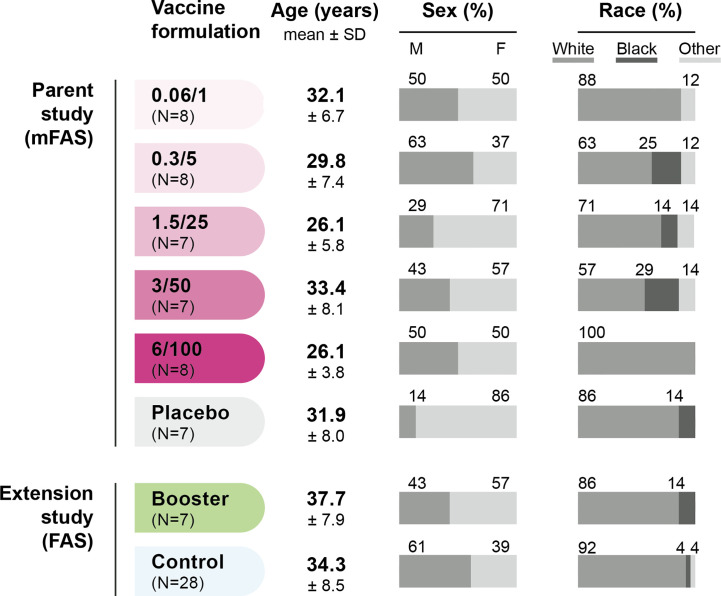
is the second most deadly diarrheal disease among children under five years of age, after rotavirus, with high morbidity and mortality in developing countries. Currently, no vaccine is widely available, and the increasing levels of multidrug resistance make a high priority for vaccine development. The single-component candidate vaccine against (1790GAHB), developed using the GMMA technology, contains the O antigen (OAg) portion of lipopolysaccharide (LPS) as active moiety. The vaccine was well tolerated and immunogenic in early-phase clinical trials. In a phase 1 placebo-controlled dose escalation trial in France (NCT02017899), three doses of five different vaccine formulations (0.06/1, 0.3/5, 1.5/25, 3/50, 6/100 µg of OAg/protein) were administered to healthy adults. In the phase 1 extension trial (NCT03089879), conducted 2-3 years following the parent study, primed individuals who had undetectable antibody levels before the primary series received a 1790GAHB booster dose (1.5/25 µg OAg/protein). Controls were unprimed participants immunized with one 1790GAHB dose. The current analysis assessed the functionality of sera collected from both studies using a high-throughput luminescence-based serum bactericidal activity (SBA) assay optimized for testing human sera. Antibodies with complement-mediated bactericidal activity were detected in vaccinees but not in placebo recipients. SBA titers increased with OAg dose, with a persistent response up to six months after the primary vaccination with at least 1.5/25 µg of OAg/protein. The booster dose induced a strong increase of SBA titers in most primed participants. Correlation between SBA titers and anti- LPS serum immunoglobulin G levels was observed. Results suggest that GMMA is a promising OAg delivery system for the generation of functional antibody responses and persistent immunological memory.
是五岁以下儿童中仅次于轮状病毒的第二大致命腹泻病,在发展中国家发病率和死亡率很高。目前,尚无广泛可用的疫苗,而且多药耐药性水平的不断提高使得疫苗的开发成为当务之急。使用 GMMA 技术开发的针对 (1790GAHB)的单价候选疫苗含有脂多糖(LPS)的 O 抗原(OAg)部分作为活性部分。该疫苗在早期临床试验中具有良好的耐受性和免疫原性。在法国进行的一项 1 期安慰剂对照剂量递增试验(NCT02017899)中,向健康成年人接种了五种不同疫苗制剂(0.06/1、0.3/5、1.5/25、3/50、6/100µg OAg/蛋白)的三剂。在母体研究后 2-3 年进行的 1 期扩展试验(NCT03089879)中,在主要系列之前抗体水平无法检测到的个体接受了 1790GAHB 加强剂量(1.5/25µg OAg/蛋白)。对照组是未接种疫苗但接种了 1790GAHB 一剂的参与者。当前分析使用针对人类血清优化的基于高通量发光的血清杀菌活性(SBA)测定法评估了两项研究中收集的血清的功能。在疫苗接种者中检测到具有补体介导的杀菌活性的抗体,但在安慰剂接受者中未检测到。SBA 滴度随 OAg 剂量增加,在初次接种至少 1.5/25µg OAg/蛋白后六个月内持续增加。加强剂量可在大多数接种者中强烈增加 SBA 滴度。观察到 SBA 滴度与抗 LPS 血清免疫球蛋白 G 水平之间的相关性。结果表明,GMMA 是一种有前途的 OAg 传递系统,可产生功能性抗体反应和持久的免疫记忆。