Whittenbury Kate, Kroll Leopold, Dubicka Bernadka, Bull Eleanor R
Faculty of Health and Education, Manchester Metropolitan University, UK.
Young People's Mental Health Research Unit, Pennine Care NHS Foundation Trust Headquarters, UK.
BJPsych Open. 2022 Feb 4;8(2):e38. doi: 10.1192/bjo.2022.7.
Depression prevalence among young people is increasing, with growing pressures on specialist mental health services. Manualised behavioural activation therapy may be effective for young people, and can be delivered by a range of mental health professionals (MHPs). This study explored clinician perspectives of barriers and facilitators to implementing behavioural activation with young people in routine practice.
We conducted a qualitative study with individual semi-structured interviews with MHPs, as part of a wider feasibility study.
Participants were mental health professionals (therapists and supervisors) from two UK NHS sites delivering manualised behavioural activation for young people. Data were analysed with an inductive followed by deductive approach, applying the Theoretical Domains Framework (TDF) to understand key influences on practice change. Identified domains were mapped onto possible behaviour change techniques (BCTs) to support implementation, using the Theory and Techniques Tool (TTT).
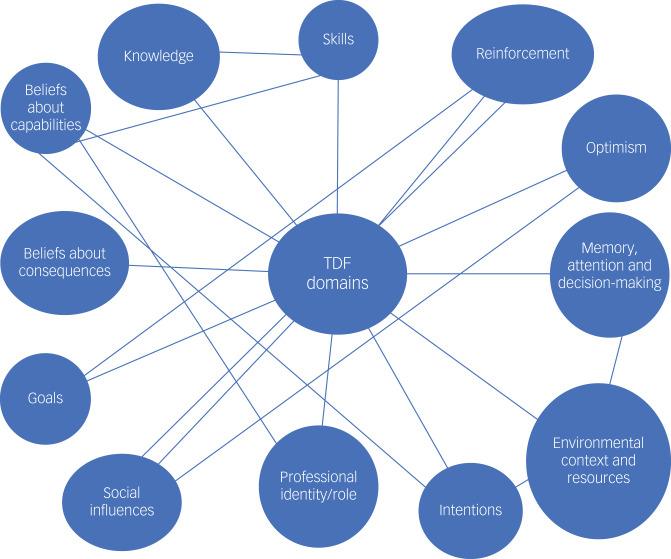
Nine MHPs were interviewed. Thirteen of fourteen TDF domains were relevant, including perceived professional identity, beliefs about own capabilities and perceived positive or negative consequences of using manualised behavioural activation, social influences, memory and attention, and environmental resources. Fourteen theory-linked BCTs were identified as possible strategies to help clinicians overcome barriers (e.g. integrating behavioural practice/rehearsal, prompts and persuasive communications within training, and supervision).
Behavioural science approaches (TDF, TTT) helped conceptualise key barriers and facilitators for MHPs delivering manualised behavioural activation with young people. Interventions using BCTs to address identified barriers could help the implementation of new therapies into routine practice, working to bridge the research-practice gap in clinical psychology.
年轻人中抑郁症的患病率正在上升,专业心理健康服务面临的压力越来越大。手册化行为激活疗法可能对年轻人有效,并且可以由一系列心理健康专业人员(MHP)提供。本研究探讨了临床医生对在常规实践中对年轻人实施行为激活的障碍和促进因素的看法。
作为一项更广泛的可行性研究的一部分,我们对MHP进行了个体半结构化访谈的定性研究。
参与者是来自英国两个国民保健服务机构的心理健康专业人员(治疗师和督导),他们为年轻人提供手册化行为激活治疗。采用归纳法随后演绎法对数据进行分析,应用理论领域框架(TDF)来理解对实践改变的关键影响。使用理论与技术工具(TTT),将确定的领域映射到可能的行为改变技术(BCT)上,以支持实施。
对9名MHP进行了访谈。14个TDF领域中有13个是相关的,包括感知到的职业身份、对自身能力的信念以及使用手册化行为激活的感知到的积极或消极后果、社会影响、记忆和注意力以及环境资源。确定了14种与理论相关的BCT作为帮助临床医生克服障碍的可能策略(例如在培训和督导中整合行为实践/演练、提示和说服性沟通)。
行为科学方法(TDF、TTT)有助于概念化MHP对年轻人实施手册化行为激活的关键障碍和促进因素。使用BCT来解决已确定障碍的干预措施可能有助于将新疗法应用于常规实践,努力弥合临床心理学研究与实践之间的差距。