Navarrabiomed, Hospital Universitario de Navarra (HUN), Navarra Institute for Health Research (IdiSNA), Universidad Pública de Navarra (UPNA), Pamplona, Spain.
CIBER of Frailty and Healthy Aging (CIBERFES), Instituto de Salud Carlos III, Madrid, Spain.
Geroscience. 2022 Jun;44(3):1677-1688. doi: 10.1007/s11357-021-00511-1. Epub 2022 Feb 4.
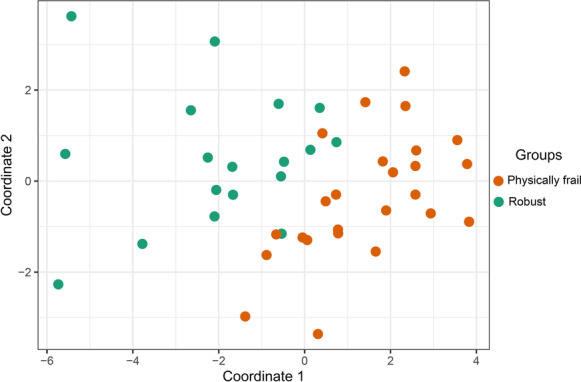
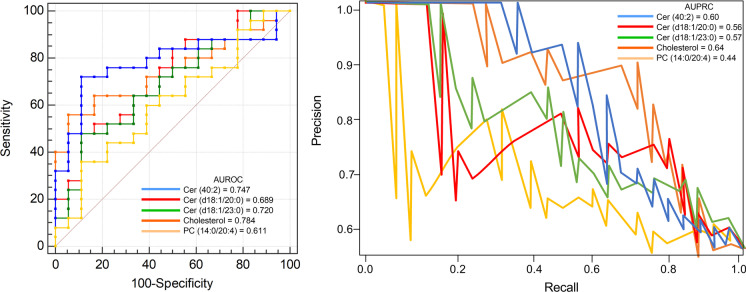
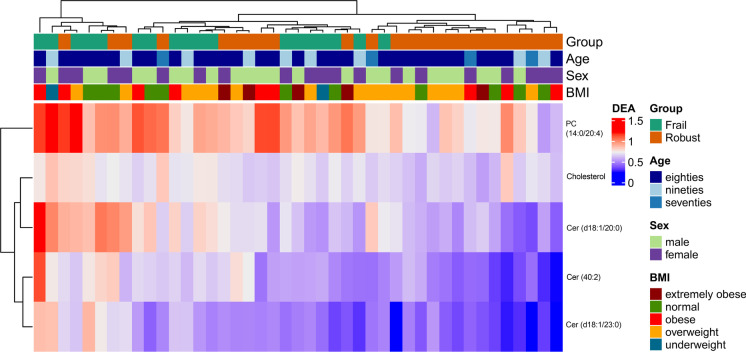
Identifying serum biomarkers that can predict physical frailty in older adults would have tremendous clinical value for primary care, as this condition is inherently related to poor quality of life and premature mortality. We compared the serum lipid profile of physically frail and robust older adults to identify specific lipid biomarkers that could be used to assess physical frailty in older patients at hospital admission. Forty-three older adults (58.1% male), mean (range) age 86.4 (78-100 years) years, were classified as physically frail (n = 18) or robust (n = 25) based on scores from the Short Physical Performance Battery (≤ 6 points). Non-targeted metabolomic study by ultra-high performance liquid chromatography coupled to mass spectrometry (UHPLC-MS) analysis with later bioinformatics data analysis. Once the significantly different metabolites were identified, the KEGG database was used on them to establish which were the metabolic pathways mainly involved. Area under receiver-operating curve (AUROC) analysis was used to test the discriminatory ability of lipid biomarkers for frailty based on the Short Physical Performance Battery. We identified a panel of five metabolites including ceramides Cer (40:2), Cer (d18:1/20:0), Cer (d18:1/23:0), cholesterol, and phosphatidylcholine (PC) (14:0/20:4) that were significantly increased in physically frail older adults compared with robust older adults at hospital admission. The most interesting in the physically frail metabolome study found with the KEGG database were the metabolic pathways, vitamin digestion and absorption, AGE-RAGE signaling pathway in diabetic complications, and insulin resistance. In addition, Cer (40:2) (AUROC 0.747), Cer (d18:1/23:0) (AUROC 0.720), and cholesterol (AUROC 0.784) were identified as higher values of physically frail at hospital admission. The non-targeted metabolomic study can open a wide view of the physically frail features changes at the plasma level, which would be linked to the physical frailty phenotype at hospital admission. Also, we propose that metabolome analysis will have a suitable niche in personalized medicine for physically frail older adults.
鉴定能够预测老年人身体虚弱的血清生物标志物对初级保健具有巨大的临床价值,因为这种情况与生活质量差和过早死亡密切相关。我们比较了身体虚弱和强壮的老年人的血清脂质谱,以确定特定的脂质生物标志物,可用于评估入院时老年患者的身体虚弱程度。43 名老年人(58.1%为男性),平均(范围)年龄 86.4(78-100 岁)岁,根据短体功电池评分(SPPB)(≤6 分)分为身体虚弱(n=18)或强壮(n=25)。采用超高效液相色谱-质谱联用(UHPLC-MS)分析的非靶向代谢组学研究,结合后期生物信息学数据分析。确定了差异显著的代谢物后,使用 KEGG 数据库对其进行分析,以确定主要涉及的代谢途径。使用接收器操作特征曲线(AUROC)分析基于 SPPB 测试脂质生物标志物对虚弱的区分能力。我们鉴定了一组包括神经酰胺 Cer(40:2)、Cer(d18:1/20:0)、Cer(d18:1/23:0)、胆固醇和磷脂酰胆碱(PC)(14:0/20:4)在内的五种代谢物,它们在入院时身体虚弱的老年人中明显高于强壮的老年人。在与 KEGG 数据库的身体虚弱代谢组学研究中发现的最有趣的是维生素消化和吸收、糖尿病并发症的 AGE-RAGE 信号通路和胰岛素抵抗代谢途径。此外,Cer(40:2)(AUROC 0.747)、Cer(d18:1/23:0)(AUROC 0.720)和胆固醇(AUROC 0.784)被鉴定为入院时身体虚弱的更高值。非靶向代谢组学研究可以从血浆水平上广泛了解身体虚弱特征的变化,这与入院时的身体虚弱表型有关。此外,我们提出代谢组分析将在体弱老年人的个性化医学中有合适的应用。