Department of Psychology, Nottingham Trent University, Nottingham, UK.
Br J Soc Psychol. 2022 Jul;61(3):907-923. doi: 10.1111/bjso.12523. Epub 2022 Feb 4.
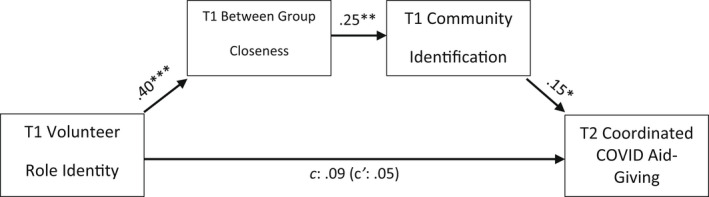
Mutual aid groups have allowed community members to respond collectively to the COVID-19 pandemic, providing essential support to the vulnerable. While research has begun to explore the benefits of participating in these groups, there is a lack of work investigating who is likely to engage in this form of aid-giving, although early accounts suggest that existing volunteers have played a significant part in the mutual aid phenomena. Taking a social identity approach, the present study sought to identify what social psychological processes predict this continued engagement by exploring predictors of coordinated COVID-19 aid-giving for pre-existing volunteers. A two-wave longitudinal online survey study (N = 214) revealed that volunteer role identity among existing volunteers at T1 (pre-pandemic) was positively associated with volunteer-beneficiary between-group closeness at T1, which in turn was positively associated with community identification at T1. This in turn positively predicted coordinated COVID-19 aid-giving at T2 (3 months later). This paper therefore reveals the intra- and intergroup predictors of pandemic-related coordinated aid-giving in pre-existing volunteers. Implications for voluntary organisations and emergency voluntary aid provision are discussed.
互助组织使社区成员能够共同应对 COVID-19 大流行,为弱势群体提供重要支持。虽然已经开始研究参与这些组织的好处,但缺乏对谁可能参与这种形式的援助的工作调查,尽管早期的报道表明,现有的志愿者在互助现象中发挥了重要作用。本研究采用社会认同方法,通过探索预先存在的志愿者协调 COVID-19 援助的预测因素,试图确定哪些社会心理过程可以预测这种持续参与。一项两波纵向在线调查研究(N=214)表明,T1(大流行前)现有志愿者的志愿者角色认同与 T1 时志愿者-受益人群体间的亲近度呈正相关,而后者又与 T1 时的社区认同呈正相关。这反过来又积极预测了 T2(3 个月后)的协调 COVID-19 援助。因此,本文揭示了预先存在的志愿者中与大流行相关的协调援助的群体内和群体间预测因素。讨论了对志愿组织和紧急志愿援助提供的影响。