Research School of Psychology, The Australian National University, Canberra, ACT, 2601, Australia.
BMC Public Health. 2021 May 5;21(1):869. doi: 10.1186/s12889-021-10925-3.
The social identity model of risk taking proposes that people take more risks with ingroup members because they trust them more. While this can be beneficial in some circumstances, in the context of the COVID-19 pandemic it has the potential to undermine an effective public health response if people underestimate the risk of contagion posed by ingroup members, or overestimate the risk of vaccines or treatments developed by outgroup members.
Three studies (two prospective surveys, one experiment) with community-based adults tested the potential for the social identity model of risk taking to explain risk perception and risk taking in the context of COVID-19.
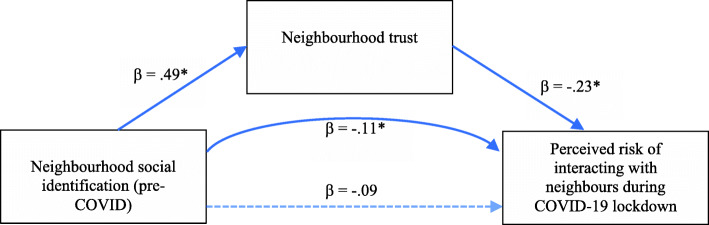
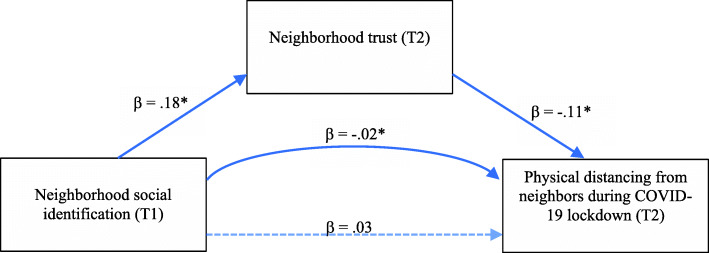
Study 1 was a two-wave study with a pre-COVID baseline, and found that people who identified more strongly as a member of their neighborhood pre-COVID tended to trust their neighbors more, and perceive interacting with them during COVID-19 lockdown to be less risky. Study 2 (N = 2033) replicated these findings in a two-wave nationally representative Australian sample. Study 3 (N = 216) was a pre-registered experiment which found that people indicated greater willingness to take a vaccine, and perceived it to be less risky, when it was developed by an ingroup compared to an outgroup source. We interpret this as evidence that the tendency to trust ingroup members more could be harnessed to enhance the COVID-19 response.
Across all three studies, ingroup members were trusted more and were perceived to pose less health risk. These findings are discussed with a focus on how group processes can be more effectively incorporated into public health policy, both for the current pandemic and for future contagious disease threats.
冒险的社会认同模型提出,人们与群体内成员一起承担更多的风险,因为他们更信任他们。虽然在某些情况下这可能是有益的,但在 COVID-19 大流行的背景下,如果人们低估了群体内成员传染的风险,或者高估了群体外成员开发的疫苗或治疗方法的风险,这可能会破坏有效的公共卫生应对措施。
三项基于社区的成年人的研究(两项前瞻性调查,一项实验)检验了冒险的社会认同模型在 COVID-19 背景下解释风险感知和风险承担的潜在作用。
研究 1 是一项具有 COVID-19 基线的两波研究,发现 COVID-19 大流行前对自己所在社区认同度越高的人,往往越信任他们的邻居,并且认为在 COVID-19 封锁期间与他们互动的风险较低。研究 2(N=2033)在澳大利亚全国代表性的两波样本中复制了这些发现。研究 3(N=216)是一项预先注册的实验,发现与群体外来源相比,当疫苗由群体内来源开发时,人们表示更愿意接种疫苗,并认为它的风险较低。我们将此解释为证据,即更信任群体内成员的倾向可以被利用来增强 COVID-19 应对措施。
在所有三项研究中,群体内成员更受信任,被认为健康风险较低。这些发现与如何将群体过程更有效地纳入公共卫生政策,无论是针对当前大流行还是未来的传染病威胁进行了讨论。