• 文献检索
  • 文档翻译
  • 深度研究
  • 学术资讯
  • Suppr Zotero 插件Zotero 插件
  • 邀请有礼
  • 套餐&价格
  • 历史记录
应用&插件
Suppr Zotero 插件Zotero 插件浏览器插件Mac 客户端Windows 客户端微信小程序
定价
高级版会员购买积分包购买API积分包
服务
文献检索文档翻译深度研究API 文档MCP 服务
关于我们
关于 Suppr公司介绍联系我们用户协议隐私条款
关注我们

Suppr 超能文献

核心技术专利:CN118964589B侵权必究
粤ICP备2023148730 号-1Suppr @ 2026

文献检索

告别复杂PubMed语法,用中文像聊天一样搜索,搜遍4000万医学文献。AI智能推荐,让科研检索更轻松。

立即免费搜索

文件翻译

保留排版,准确专业,支持PDF/Word/PPT等文件格式,支持 12+语言互译。

免费翻译文档

深度研究

AI帮你快速写综述,25分钟生成高质量综述,智能提取关键信息,辅助科研写作。

立即免费体验

阐明指导目标疟疾参与战略的伦理原则。

Articulating ethical principles guiding Target Malaria's engagement strategy.

机构信息

Institute On Ethics and Policy for Innovation, McMaster University, Hamilton, Canada.

Imperial College, London, UK.

出版信息

Malar J. 2022 Feb 5;21(1):35. doi: 10.1186/s12936-022-04062-4.

DOI:10.1186/s12936-022-04062-4
PMID:35123487
原文链接:https://pmc.ncbi.nlm.nih.gov/articles/PMC8818152/
Abstract

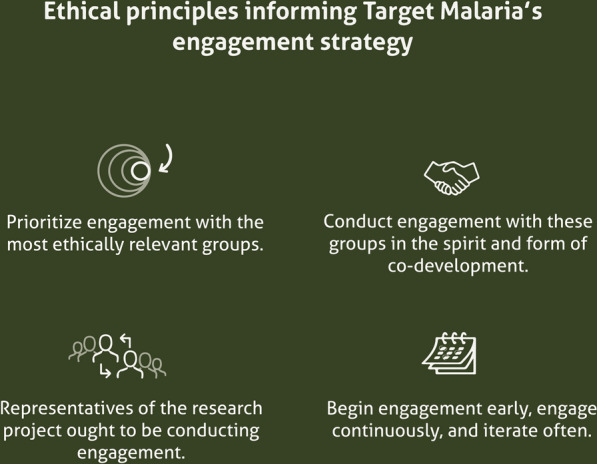
Progress in gene drive research has engendered a lively discussion about community engagement and the ethical standards the work hinges on. While there is broad agreement regarding ethical principles and established best practices for conducting clinical public health research, projects developing area-wide vector control technologies and initiating ambitious engagement strategies raise specific questions: who to engage, when to engage, and how? When responding to these fundamental questions, with few best practices available for guidance, projects need to reflect on and articulate the ethical principles that motivate and justify their approach. Target Malaria is a not-for-profit research consortium that aims to develop and share malaria control and elimination technology. The consortium is currently investigating the potential of a genetic technique called gene drive to control populations of malaria vectoring mosquito species Anopheles gambiae. Due to the potentially broad geographical, environmental impact of gene drive technology, Target Malaria has committed to a robust form of tailored engagement with the local communities in Burkina Faso, Mali, and Uganda, where research activities are currently taking place. This paper presents the principles guiding Target Malaria's engagement strategy. Herein the authors (i) articulate the principles; (ii) explain the rationale for selecting them; (iii) share early lessons about the application of the principles. Since gene drive technology is an emerging technology, with few best practices available for guidance, the authors hope by sharing these lessons, to add to the growing literature regarding engagement strategies and practices for area-wide vector control, and more specifically, for gene drive research.

摘要

基因驱动研究的进展引发了一场关于社区参与和这项工作所依据的伦理标准的热烈讨论。虽然人们对于开展临床公共卫生研究的伦理原则和既定最佳实践有广泛共识,但开发区域范围的矢量控制技术和启动雄心勃勃的参与策略的项目提出了具体问题:与谁接触、何时接触以及如何接触?在回答这些基本问题时,由于几乎没有最佳实践可供指导,项目需要反思并阐明激励和证明其方法合理的伦理原则。靶向疟疾是一个非营利性研究联盟,旨在开发和共享疟疾控制和消除技术。该联盟目前正在研究一种名为基因驱动的遗传技术,以控制疟蚊 Anopheles gambiae 种群。由于基因驱动技术可能具有广泛的地理和环境影响,靶向疟疾已承诺与布基纳法索、马里和乌干达的当地社区进行强有力的定制接触,目前正在这些地方开展研究活动。本文介绍了指导靶向疟疾参与策略的原则。作者在此:(i) 阐明这些原则;(ii) 解释选择它们的理由;(iii) 分享应用这些原则的早期经验。由于基因驱动技术是一种新兴技术,几乎没有最佳实践可供指导,作者希望通过分享这些经验,为有关区域范围矢量控制的参与策略和实践,更具体地说,为基因驱动研究的不断增长的文献做出贡献。
https://cdn.ncbi.nlm.nih.gov/pmc/blobs/5d04/8818152/6c4961415b44/12936_2022_4062_Fig2_HTML.jpg
https://cdn.ncbi.nlm.nih.gov/pmc/blobs/5d04/8818152/cc281052642d/12936_2022_4062_Fig1_HTML.jpg
https://cdn.ncbi.nlm.nih.gov/pmc/blobs/5d04/8818152/6c4961415b44/12936_2022_4062_Fig2_HTML.jpg
https://cdn.ncbi.nlm.nih.gov/pmc/blobs/5d04/8818152/cc281052642d/12936_2022_4062_Fig1_HTML.jpg
https://cdn.ncbi.nlm.nih.gov/pmc/blobs/5d04/8818152/6c4961415b44/12936_2022_4062_Fig2_HTML.jpg

相似文献

1
Articulating ethical principles guiding Target Malaria's engagement strategy.阐明指导目标疟疾参与战略的伦理原则。
Malar J. 2022 Feb 5;21(1):35. doi: 10.1186/s12936-022-04062-4.
2
Procedural legitimacy: co-developing a community agreement model for genetic approaches research to malaria control in Africa.程序合法性:共同制定非洲疟疾控制遗传方法研究的社区协议模型。
Malar J. 2024 Nov 26;23(1):359. doi: 10.1186/s12936-024-05160-1.
3
Operationalizing stakeholder engagement for gene drive research in malaria elimination in Africa-translating guidance into practice.将利益相关者参与付诸实践,以促进非洲消除疟疾中的基因驱动研究——将指导意见转化为实践。
Malar J. 2022 Jul 23;21(1):225. doi: 10.1186/s12936-022-04241-3.
4
Motivations and expectations driving community participation in entomological research projects: Target Malaria as a case study in Bana, Western Burkina Faso.推动社区参与昆虫学研究项目的动机和期望:以布基纳法索西部班纳的目标疟疾为例。
Malar J. 2020 Jun 5;19(1):199. doi: 10.1186/s12936-020-03277-7.
5
Small-scale release of non-gene drive mosquitoes in Burkina Faso: from engagement implementation to assessment, a learning journey.布基纳法索小规模释放非基因驱动蚊子:从参与实施到评估的学习之旅。
Malar J. 2021 Oct 9;20(1):395. doi: 10.1186/s12936-021-03929-2.
6
Stakeholder engagement in the development of genetically modified mosquitoes for malaria control in West Africa: lessons learned from 10 years of Target Malaria's work in Mali.利益相关者参与西非转基因蚊子用于疟疾控制的研发:从目标疟疾在马里十年工作中吸取的经验教训。
Front Bioeng Biotechnol. 2024 Jan 5;11:1286694. doi: 10.3389/fbioe.2023.1286694. eCollection 2023.
7
Co-developing a common glossary with stakeholders for engagement on new genetic approaches for malaria control in a local African setting.与利益相关者共同制定一个通用词汇表,以参与在非洲当地环境下针对疟疾控制的新遗传方法。
Malar J. 2021 Jan 21;20(1):53. doi: 10.1186/s12936-020-03577-y.
8
Systematic identification of plausible pathways to potential harm via problem formulation for investigational releases of a population suppression gene drive to control the human malaria vector Anopheles gambiae in West Africa.通过制定问题方案,对人群抑制基因驱动释放以控制西非人类疟疾传播媒介冈比亚按蚊进行调查性释放,系统性地识别潜在危害的可能途径。
Malar J. 2021 Mar 29;20(1):170. doi: 10.1186/s12936-021-03674-6.
9
Ugandan stakeholder hopes and concerns about gene drive mosquitoes for malaria control: new directions for gene drive risk governance.乌干达利益攸关方对基因驱动蚊子控制疟疾的希望和担忧:基因驱动风险治理的新方向。
Malar J. 2021 Mar 16;20(1):149. doi: 10.1186/s12936-021-03682-6.
10
Considerations for first field trials of low-threshold gene drive for malaria vector control.考虑首次野外试验的低门槛基因驱动疟疾媒介控制。
Malar J. 2024 May 22;23(1):156. doi: 10.1186/s12936-024-04952-9.

引用本文的文献

1
Strengthening Research Ethics Capacity in West Africa, 2015-2024.2015 - 2024年加强西非的研究伦理能力
J Empir Res Hum Res Ethics. 2025 Jun 30:15562646251335076. doi: 10.1177/15562646251335076.
2
Talking About Gene Drive in Uganda: The Need for Science Communication to Underpin Engagement.谈乌干达的基因驱动:科学传播对促进参与的必要性。
Sci Commun. 2024 Aug;46(4):431-457. doi: 10.1177/10755470241234048. Epub 2024 Mar 11.
3
Taking stock: Is gene drive research delivering on its principles?盘点:基因驱动研究是否符合其原理?

本文引用的文献

1
Small-scale release of non-gene drive mosquitoes in Burkina Faso: from engagement implementation to assessment, a learning journey.布基纳法索小规模释放非基因驱动蚊子:从参与实施到评估的学习之旅。
Malar J. 2021 Oct 9;20(1):395. doi: 10.1186/s12936-021-03929-2.
2
Eave and swarm collections prove effective for biased captures of male Anopheles gambiae mosquitoes in Uganda.檐和群集收集器可有效偏倚捕获乌干达雄性冈比亚按蚊。
Parasit Vectors. 2021 May 26;14(1):281. doi: 10.1186/s13071-021-04770-x.
3
Proceedings of an expert workshop on community agreement for gene drive research in Africa - Co-organised by KEMRI, PAMCA and Target Malaria.
Gates Open Res. 2024 Feb 22;8:14. doi: 10.12688/gatesopenres.15323.1. eCollection 2024.
4
Stakeholder engagement in the development of genetically modified mosquitoes for malaria control in West Africa: lessons learned from 10 years of Target Malaria's work in Mali.利益相关者参与西非转基因蚊子用于疟疾控制的研发:从目标疟疾在马里十年工作中吸取的经验教训。
Front Bioeng Biotechnol. 2024 Jan 5;11:1286694. doi: 10.3389/fbioe.2023.1286694. eCollection 2023.
5
Operationalizing stakeholder engagement for gene drive research in malaria elimination in Africa-translating guidance into practice.将利益相关者参与付诸实践,以促进非洲消除疟疾中的基因驱动研究——将指导意见转化为实践。
Malar J. 2022 Jul 23;21(1):225. doi: 10.1186/s12936-022-04241-3.
非洲基因驱动研究社区共识专家研讨会会议记录 - 由肯尼亚医学研究协会、泛非疟疾控制联盟和目标疟疾联合组织
Gates Open Res. 2021 Mar 24;5:19. doi: 10.12688/gatesopenres.13221.2. eCollection 2021.
4
Experts' moral views on gene drive technologies: a qualitative interview study.专家对基因驱动技术的道德观点:一项定性访谈研究
BMC Med Ethics. 2021 Mar 8;22(1):25. doi: 10.1186/s12910-021-00588-5.
5
Co-developing a common glossary with stakeholders for engagement on new genetic approaches for malaria control in a local African setting.与利益相关者共同制定一个通用词汇表,以参与在非洲当地环境下针对疟疾控制的新遗传方法。
Malar J. 2021 Jan 21;20(1):53. doi: 10.1186/s12936-020-03577-y.
6
Application of the Relationship-Based Model to Engagement for Field Trials of Genetically Engineered Malaria Vectors.基于关系模型在基因工程疟疾媒介田间试验中的应用。
Am J Trop Med Hyg. 2020 Dec 21;104(3):805-811. doi: 10.4269/ajtmh.20-0868.
7
Core commitments for field trials of gene drive organisms.基因驱动生物田间试验的核心承诺。
Science. 2020 Dec 18;370(6523):1417-1419. doi: 10.1126/science.abd1908.
8
A male-biased sex-distorter gene drive for the human malaria vector Anopheles gambiae.一种针对人类疟疾传播媒介冈比亚按蚊的雄性偏向性性干扰基因驱动。
Nat Biotechnol. 2020 Sep;38(9):1054-1060. doi: 10.1038/s41587-020-0508-1. Epub 2020 May 11.
9
Articulating 'free, prior and informed consent' (FPIC) for engineered gene drives.明确工程基因驱动的“自由、事先和知情同意”(FPIC)。
Proc Biol Sci. 2019 Dec 18;286(1917):20191484. doi: 10.1098/rspb.2019.1484.
10
Gene drive: progress and prospects.基因驱动:进展与展望。
Proc Biol Sci. 2019 Dec 18;286(1917):20192709. doi: 10.1098/rspb.2019.2709.