Department of Psychology, The Education University of Hong Kong, Hong Kong, SAR, China.
Centre for Psychosocial Health, The Education University of Hong Kong, Hong Kong, SAR, China.
Transl Psychiatry. 2021 Mar 17;11(1):174. doi: 10.1038/s41398-021-01279-w.
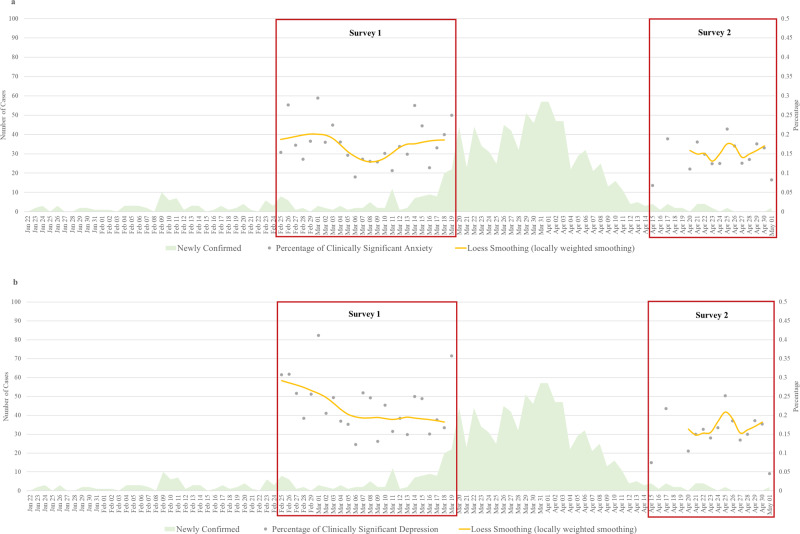
This study examined prevalences of anxiety and depression and their correlations with daily routines among Hong Kong Chinese during the COVID-19 pandemic. Random digit dialing recruited two population-representative samples of 6029 residents during a period of low infection and limited intervention (survey 1: n = 4021) and high incidence and intensive measures (survey 2: n = 2008). Prevalence of anxiety for survey 1 and survey 2 were 14.9% and 14% and depression were 19.6% and 15.3%, respectively. Increased odds of anxiety and depression were associated with disrupted routines and lower socioeconomic status in both surveys, whereas depression was inversely related to the novel preventive routine of avoiding going to crowded places in survey 1. The prevalences of anxiety and depression were higher than preceding public health/social crises. A heavier burden of psychiatric conditions was evidenced amongst people experiencing disrupted daily routines across different phases of the pandemic and without novel preventive routines in the early phase.
本研究考察了 COVID-19 大流行期间香港华人的焦虑和抑郁患病率及其与日常生活的相关性。随机数字拨号在感染率低且干预措施有限(调查 1:n=4021)和发病率高且干预措施密集(调查 2:n=2008)期间招募了两个具有代表性的 6029 名居民的样本。调查 1 和调查 2 的焦虑症患病率分别为 14.9%和 14%,抑郁症患病率分别为 19.6%和 15.3%。在这两项调查中,日常生活被打乱和社会经济地位较低与焦虑和抑郁的几率增加有关,而在调查 1 中,避免去人多的地方这一新的预防常规与抑郁呈负相关。焦虑症和抑郁症的患病率高于之前的公共卫生/社会危机。在疫情的不同阶段,日常生活被打乱且在早期阶段没有新的预防常规的人群中,精神疾病的负担更重。